Q7VPN8
Gene name |
xerD |
Protein name |
Tyrosine recombinase XerD |
Names |
|
Species |
Haemophilus ducreyi (strain 35000HP / ATCC 700724) |
KEGG Pathway |
hdu:HD_0013 |
EC number |
|
Protein Class |
|
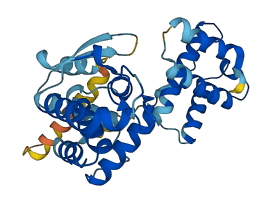
Descriptions
The autoinhibited protein was predicted that may have potential autoinhibitory elements via cis-regPred.
Autoinhibitory domains (AIDs)
Target domain |
|
Relief mechanism |
|
Assay |
cis-regPred |
Accessory elements
No accessory elements
Autoinhibited structure

Activated structure
1 structures for Q7VPN8
| Entry ID | Method | Resolution | Chain | Position | Source |
|---|---|---|---|---|---|
| AF-Q7VPN8-F1 | Predicted | AlphaFoldDB |
No variants for Q7VPN8
| Variant ID(s) | Position | Change | Description | Diseaes Association | Provenance |
|---|---|---|---|---|---|
| No variants for Q7VPN8 | |||||
No associated diseases with Q7VPN8
1 GO annotations of cellular component
| Name | Definition |
|---|---|
| cytoplasm | The contents of a cell excluding the plasma membrane and nucleus, but including other subcellular structures. |
2 GO annotations of molecular function
| Name | Definition |
|---|---|
| DNA binding | Any molecular function by which a gene product interacts selectively and non-covalently with DNA (deoxyribonucleic acid). |
| tyrosine-based site-specific recombinase activity | Catalysis of the formation of new phosphodiester bonds between a pair of short, unique DNA target sequences; occurs through a phosphotyrosyl intermediate in which the target sequence is first cleaved by the nucleophilic attack by a tyrosine in the active site. |
4 GO annotations of biological process
| Name | Definition |
|---|---|
| cell cycle | The progression of biochemical and morphological phases and events that occur in a cell during successive cell replication or nuclear replication events. Canonically, the cell cycle comprises the replication and segregation of genetic material followed by the division of the cell, but in endocycles or syncytial cells nuclear replication or nuclear division may not be followed by cell division. |
| cell division | The process resulting in division and partitioning of components of a cell to form more cells; may or may not be accompanied by the physical separation of a cell into distinct, individually membrane-bounded daughter cells. |
| chromosome segregation | The process in which genetic material, in the form of chromosomes, is organized into specific structures and then physically separated and apportioned to two or more sets. In eukaryotes, chromosome segregation begins with the condensation of chromosomes, includes chromosome separation, and ends when chromosomes have completed movement to the spindle poles. |
| transposition, DNA-mediated | Any process involved in a type of transpositional recombination which occurs via a DNA intermediate. |
No homologous proteins in AiPD
| UniProt AC | Gene Name | Protein Name | Species | Evidence Code |
|---|---|---|---|---|
| No homologous proteins | ||||
| 10 | 20 | 30 | 40 | 50 | 60 |
| MKKLDPIIEQ | FLDTLWLEQS | LSHNTLLSYR | LDLELFSAWL | VEPRAFLTLT | HTDLQLFLGD |
| 70 | 80 | 90 | 100 | 110 | 120 |
| RLDKGYKSSS | SARIISCLRK | FFRFLCLEKY | RLDDPTSMLI | SPRKRVQLPK | SLSEEQVMDL |
| 130 | 140 | 150 | 160 | 170 | 180 |
| LDAPNPLDPI | ELRDKAMLEL | LYATGLRVTE | LISLTIDNLN | LRQGVVRVIG | KGDKERLVPI |
| 190 | 200 | 210 | 220 | 230 | 240 |
| GEEASYWIQE | FFDYGRMILL | SDQQSDVLFP | SRRAKQMTRQ | TFWHRIKYYA | ILAGIDAEKL |
| 250 | 260 | 270 | 280 | 290 | |
| SPHVLRHAFA | THLINHGADL | RVVQMLLGHS | DLSTTQIYTH | VAKTRLKSIH | KQFHPRG |