Q7TSL0
Gene name |
Ifnk |
Protein name |
Interferon kappa |
Names |
IFN-kappa |
Species |
Mus musculus (Mouse) |
KEGG Pathway |
mmu:387510 |
EC number |
|
Protein Class |
|
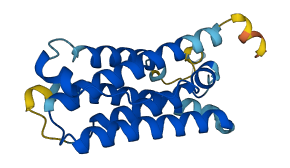
Descriptions
The autoinhibited protein was predicted that may have potential autoinhibitory elements via cis-regPred.
Autoinhibitory domains (AIDs)
Target domain |
|
Relief mechanism |
|
Assay |
cis-regPred |
Accessory elements
No accessory elements
Autoinhibited structure

Activated structure
1 structures for Q7TSL0
| Entry ID | Method | Resolution | Chain | Position | Source |
|---|---|---|---|---|---|
| AF-Q7TSL0-F1 | Predicted | AlphaFoldDB |
11 variants for Q7TSL0
| Variant ID(s) | Position | Change | Description | Diseaes Association | Provenance |
|---|---|---|---|---|---|
| rs27797054 | 5 | F>Y | No | EVA | |
| rs3393967952 | 51 | K>Y | No | EVA | |
| rs3388674119 | 53 | I>N | No | EVA | |
| rs27797052 | 71 | R>K | No | EVA | |
| rs3388678681 | 88 | F>L | No | EVA | |
| rs3388674045 | 104 | R>C | No | EVA | |
| rs3388668654 | 112 | Q>P | No | EVA | |
| rs215630809 | 132 | H>Y | No | EVA | |
| rs3388678025 | 174 | C>* | No | EVA | |
| rs3388677489 | 192 | P>L | No | EVA | |
| rs3388675402 | 197 | E>K | No | EVA |
No associated diseases with Q7TSL0
No regional properties for Q7TSL0
| Type | Name | Position | InterPro Accession |
|---|---|---|---|
| No domain, repeats, and functional sites for Q7TSL0 | |||
1 GO annotations of cellular component
| Name | Definition |
|---|---|
| extracellular space | That part of a multicellular organism outside the cells proper, usually taken to be outside the plasma membranes, and occupied by fluid. |
2 GO annotations of molecular function
| Name | Definition |
|---|---|
| cytokine activity | The activity of a soluble extracellular gene product that interacts with a receptor to effect a change in the activity of the receptor to control the survival, growth, differentiation and effector function of tissues and cells. |
| type I interferon receptor binding | Binding to an interferon-type I receptor, a heterodimeric complex composed of an alpha subunit (IFNAR1) and a beta subunit (IFNAR2). |
11 GO annotations of biological process
| Name | Definition |
|---|---|
| adaptive immune response | An immune response mediated by cells expressing specific receptors for antigen produced through a somatic diversification process, and allowing for an enhanced secondary response to subsequent exposures to the same antigen (immunological memory). |
| B cell differentiation | The process in which a precursor cell type acquires the specialized features of a B cell. A B cell is a lymphocyte of B lineage with the phenotype CD19-positive and capable of B cell mediated immunity. |
| B cell proliferation | The expansion of a B cell population by cell division. Follows B cell activation. |
| cytokine-mediated signaling pathway | The series of molecular signals initiated by the binding of a cytokine to a receptor on the surface of a cell, and ending with the regulation of a downstream cellular process, e.g. transcription. |
| defense response to virus | Reactions triggered in response to the presence of a virus that act to protect the cell or organism. |
| humoral immune response | An immune response mediated through a body fluid. |
| natural killer cell activation involved in immune response | The change in morphology and behavior of a natural killer cell resulting from exposure a cytokine, chemokine, cellular ligand, or soluble factor, leading to the initiation or perpetuation of an immune response. |
| positive regulation of peptidyl-serine phosphorylation of STAT protein | Any process that activates or increases the frequency, rate or extent of the phosphorylation of a serine residue of a STAT (Signal Transducer and Activator of Transcription) protein. |
| regulation of DNA-templated transcription | Any process that modulates the frequency, rate or extent of cellular DNA-templated transcription. |
| response to exogenous dsRNA | Any process that results in a change in state or activity of a cell or an organism (in terms of movement, secretion, enzyme production, gene expression, etc.) as a result of an exogenous double-stranded RNA stimulus. |
| T cell activation involved in immune response | The change in morphology and behavior of a mature or immature T cell resulting from exposure to a mitogen, cytokine, chemokine, cellular ligand, or an antigen for which it is specific, leading to the initiation or perpetuation of an immune response. |
No homologous proteins in AiPD
| UniProt AC | Gene Name | Protein Name | Species | Evidence Code |
|---|---|---|---|---|
| No homologous proteins | ||||
| 10 | 20 | 30 | 40 | 50 | 60 |
| MTPKFLWLVA | LVALYIPPIQ | SLNCVYLDDS | ILENVKLLGS | TMTGFPLRCL | KDITDFKFPK |
| 70 | 80 | 90 | 100 | 110 | 120 |
| EILPYIQHMK | REINAVSYRI | SSLALTIFNL | KGSIPPVTEE | HWERIRSGLF | KQVRQAQECF |
| 130 | 140 | 150 | 160 | 170 | 180 |
| MDEEKENREH | PHSEDFLTVY | LELGKYFFRI | KKFLINKKYS | FCAWKIVTVE | IRRCFIIFSK |
| 190 | |||||
| SRKLLKMISE | SPTFKQELK |