Q7TQA8
Gene name |
Tas2r136 (T2r52, Tas2r36) |
Protein name |
Taste receptor type 2 member 136 |
Names |
T2R136, Taste receptor type 2 member 36, T2R36, mT2r52 |
Species |
Mus musculus (Mouse) |
KEGG Pathway |
mmu:353165 |
EC number |
|
Protein Class |
|
Descriptions
The autoinhibited protein was predicted that may have potential autoinhibitory elements via cis-regPred.
Autoinhibitory domains (AIDs)
Target domain |
|
Relief mechanism |
|
Assay |
cis-regPred |
Accessory elements
No accessory elements
Autoinhibited structure

Activated structure
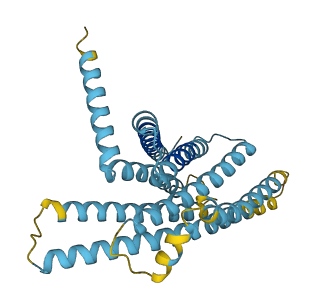
1 structures for Q7TQA8
| Entry ID | Method | Resolution | Chain | Position | Source |
|---|---|---|---|---|---|
| AF-Q7TQA8-F1 | Predicted | AlphaFoldDB |
No variants for Q7TQA8
| Variant ID(s) | Position | Change | Description | Diseaes Association | Provenance |
|---|---|---|---|---|---|
| No variants for Q7TQA8 | |||||
No associated diseases with Q7TQA8
No regional properties for Q7TQA8
| Type | Name | Position | InterPro Accession |
|---|---|---|---|
| No domain, repeats, and functional sites for Q7TQA8 | |||
1 GO annotations of cellular component
| Name | Definition |
|---|---|
| integral component of membrane | The component of a membrane consisting of the gene products and protein complexes having at least some part of their peptide sequence embedded in the hydrophobic region of the membrane. |
3 GO annotations of molecular function
| Name | Definition |
|---|---|
| bitter taste receptor activity | Combining with soluble bitter compounds to initiate a change in cell activity. These receptors are responsible for the sense of bitter taste. |
| G protein-coupled receptor activity | Combining with an extracellular signal and transmitting the signal across the membrane by activating an associated G-protein; promotes the exchange of GDP for GTP on the alpha subunit of a heterotrimeric G-protein complex. |
| taste receptor activity | Combining with soluble compounds to initiate a change in cell activity. These receptors are responsible for the sense of taste. |
1 GO annotations of biological process
| Name | Definition |
|---|---|
| detection of chemical stimulus involved in sensory perception of bitter taste | The series of events required for a bitter taste stimulus to be received and converted to a molecular signal. |
No homologous proteins in AiPD
| UniProt AC | Gene Name | Protein Name | Species | Evidence Code |
|---|---|---|---|---|
| No homologous proteins | ||||
| 10 | 20 | 30 | 40 | 50 | 60 |
| MMSFLVSIAS | IAMLVKIVLG | TFANVFIVLV | NFTDCIKKRK | FLLADRILTV | LAIFRFDLLW |
| 70 | 80 | 90 | 100 | 110 | 120 |
| IILMNWSSSV | FHVGLYFQVR | FCICVVWIVT | NHFNTWLANI | LSILYLLKID | NFSNLIFLGL |
| 130 | 140 | 150 | 160 | 170 | 180 |
| KGKIKCPYIV | LLPCFVLLFP | NLIMVTICET | TQANGHQGNL | TGKTKLTYFT | NLIAMTFTLG |
| 190 | 200 | 210 | 220 | 230 | 240 |
| SLVPFTTFMI | CFLLLICSLC | KHLRTMRLYG | KGSQGPSAST | HIKVLQVLIS | FLLLFSMFIL |
| 250 | 260 | 270 | 280 | 290 | 300 |
| LLIISDYNYT | KSLEEPIHLI | CQVIGTLYPS | RHSYILLWGN | KRIKQAFVLA | MVQVRARFWL |
| KEKKP |