Q7TPY9
Gene name |
Ldoc1 (Gm366) |
Protein name |
Protein LDOC1 |
Names |
|
Species |
Mus musculus (Mouse) |
KEGG Pathway |
mmu:434784 |
EC number |
|
Protein Class |
|
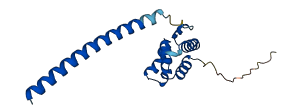
Descriptions
The autoinhibited protein was predicted that may have potential autoinhibitory elements via cis-regPred.
Autoinhibitory domains (AIDs)
Target domain |
|
Relief mechanism |
|
Assay |
cis-regPred |
Accessory elements
No accessory elements
Autoinhibited structure

Activated structure
1 structures for Q7TPY9
| Entry ID | Method | Resolution | Chain | Position | Source |
|---|---|---|---|---|---|
| AF-Q7TPY9-F1 | Predicted | AlphaFoldDB |
5 variants for Q7TPY9
| Variant ID(s) | Position | Change | Description | Diseaes Association | Provenance |
|---|---|---|---|---|---|
| rs3389560448 | 33 | L>S | No | EVA | |
| rs3389577337 | 97 | S>F | No | EVA | |
| rs3389574739 | 98 | G>V | No | EVA | |
| rs3410548217 | 107 | Y>F | No | EVA | |
| rs3389574785 | 127 | Q>E | No | EVA |
No associated diseases with Q7TPY9
1 regional properties for Q7TPY9
| Type | Name | Position | InterPro Accession |
|---|---|---|---|
| domain | Domain of unknown function DUF4939 | 27 - 138 | IPR032549 |
2 GO annotations of cellular component
| Name | Definition |
|---|---|
| nucleolus | A small, dense body one or more of which are present in the nucleus of eukaryotic cells. It is rich in RNA and protein, is not bounded by a limiting membrane, and is not seen during mitosis. Its prime function is the transcription of the nucleolar DNA into 45S ribosomal-precursor RNA, the processing of this RNA into 5.8S, 18S, and 28S components of ribosomal RNA, and the association of these components with 5S RNA and proteins synthesized outside the nucleolus. This association results in the formation of ribonucleoprotein precursors; these pass into the cytoplasm and mature into the 40S and 60S subunits of the ribosome. |
| nucleoplasm | That part of the nuclear content other than the chromosomes or the nucleolus. |
No GO annotations of molecular function
| Name | Definition |
|---|---|
| No GO annotations for molecular function |
5 GO annotations of biological process
| Name | Definition |
|---|---|
| cellular response to lipopolysaccharide | Any process that results in a change in state or activity of a cell (in terms of movement, secretion, enzyme production, gene expression, etc.) as a result of a lipopolysaccharide stimulus; lipopolysaccharide is a major component of the cell wall of gram-negative bacteria. |
| cellular response to muramyl dipeptide | Any process that results in a change in state or activity of a cell (in terms of movement, secretion, enzyme production, gene expression, etc.) as a result of a muramyl dipeptide stimulus. Muramyl dipeptide is derived from peptidoglycan. |
| maternal placenta development | Maternally driven process whose specific outcome is the progression of the placenta over time, from its formation to the mature structure. The placenta is an organ of metabolic interchange between fetus and mother, partly of embryonic origin and partly of maternal origin. |
| maternal process involved in parturition | A reproductive process occurring in the mother that results in birth. |
| regulation of growth hormone activity | Any process that modulates the frequency, rate or extent of growth hormone activity. |
No homologous proteins in AiPD
| UniProt AC | Gene Name | Protein Name | Species | Evidence Code |
|---|---|---|---|---|
| No homologous proteins | ||||
| 10 | 20 | 30 | 40 | 50 | 60 |
| MVEELLSLLH | ALLDRHQALC | MENHQLLKQL | RLLVCERARL | LRQVCPPSCP | VPYPSRFSGE |
| 70 | 80 | 90 | 100 | 110 | 120 |
| SGRLPEFIMQ | TMSYMLANEE | HFCNDAMKVA | FLISLLSGEA | EEWVMPYIES | NSYVLGDYQA |
| 130 | 140 | 150 | |||
| FVDEMKQYFG | WGTDDEDDGD | DDEEEEMEED | H |