Q7TNY7
Gene name |
Myrip (Slac2c) |
Protein name |
Rab effector MyRIP |
Names |
Exophilin-8, Myosin-VIIa- and Rab-interacting protein, Synaptotagmin-like protein lacking C2 domains C, SlaC2-c, Slp homolog lacking C2 domains c |
Species |
Rattus norvegicus (Rat) |
KEGG Pathway |
rno:360034 |
EC number |
|
Protein Class |
|
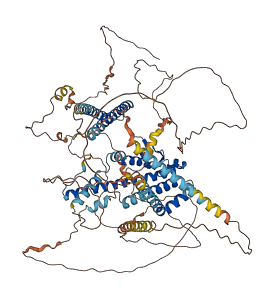
Descriptions
The autoinhibited protein was predicted that may have potential autoinhibitory elements via cis-regPred.
Autoinhibitory domains (AIDs)
Target domain |
|
Relief mechanism |
|
Assay |
cis-regPred |
Accessory elements
No accessory elements
Autoinhibited structure

Activated structure
1 structures for Q7TNY7
| Entry ID | Method | Resolution | Chain | Position | Source |
|---|---|---|---|---|---|
| AF-Q7TNY7-F1 | Predicted | AlphaFoldDB |
No variants for Q7TNY7
| Variant ID(s) | Position | Change | Description | Diseaes Association | Provenance |
|---|---|---|---|---|---|
| No variants for Q7TNY7 | |||||
No associated diseases with Q7TNY7
Functions
11 GO annotations of cellular component
| Name | Definition |
|---|---|
| actin cytoskeleton | The part of the cytoskeleton (the internal framework of a cell) composed of actin and associated proteins. Includes actin cytoskeleton-associated complexes. |
| apical plasma membrane | The region of the plasma membrane located at the apical end of the cell. |
| cortical actin cytoskeleton | The portion of the actin cytoskeleton, comprising filamentous actin and associated proteins, that lies just beneath the plasma membrane. |
| dense core granule | Electron-dense organelle with a granular internal matrix; contains proteins destined to be secreted. |
| exocyst | A protein complex peripherally associated with the plasma membrane that determines where vesicles dock and fuse. At least eight complex components are conserved between yeast and mammals. |
| melanosome | A tissue-specific, membrane-bounded cytoplasmic organelle within which melanin pigments are synthesized and stored. Melanosomes are synthesized in melanocyte cells. |
| perinuclear region of cytoplasm | Cytoplasm situated near, or occurring around, the nucleus. |
| photoreceptor outer segment | The outer segment of a vertebrate photoreceptor that contains a stack of membrane discs embedded with photoreceptor proteins. |
| secretory granule membrane | The lipid bilayer surrounding a secretory granule. |
| synapse | The junction between an axon of one neuron and a dendrite of another neuron, a muscle fiber or a glial cell. As the axon approaches the synapse it enlarges into a specialized structure, the presynaptic terminal bouton, which contains mitochondria and synaptic vesicles. At the tip of the terminal bouton is the presynaptic membrane; facing it, and separated from it by a minute cleft (the synaptic cleft) is a specialized area of membrane on the receiving cell, known as the postsynaptic membrane. In response to the arrival of nerve impulses, the presynaptic terminal bouton secretes molecules of neurotransmitters into the synaptic cleft. These diffuse across the cleft and transmit the signal to the postsynaptic membrane. |
| transport vesicle | Any of the vesicles of the constitutive secretory pathway, which carry cargo from the endoplasmic reticulum to the Golgi, between Golgi cisternae, from the Golgi to the ER (retrograde transport) or to destinations within or outside the cell. |
5 GO annotations of molecular function
| Name | Definition |
|---|---|
| actin binding | Binding to monomeric or multimeric forms of actin, including actin filaments. |
| metal ion binding | Binding to a metal ion. |
| myosin binding | Binding to a myosin; myosins are any of a superfamily of molecular motor proteins that bind to actin and use the energy of ATP hydrolysis to generate force and movement along actin filaments. |
| protein kinase A binding | Binding to a protein kinase A. |
| small GTPase binding | Binding to a small monomeric GTPase. |
2 GO annotations of biological process
| Name | Definition |
|---|---|
| intracellular protein transport | The directed movement of proteins in a cell, including the movement of proteins between specific compartments or structures within a cell, such as organelles of a eukaryotic cell. |
| positive regulation of insulin secretion | Any process that activates or increases the frequency, rate or extent of the regulated release of insulin. |
| 10 | 20 | 30 | 40 | 50 | 60 |
| MGRKLDLSGL | TDDETEHVLQ | VVQRDFNLRK | KEEDRLSEMK | QRLAEENSKC | SILSKHQKFV |
| 70 | 80 | 90 | 100 | 110 | 120 |
| ERCCMRCCSP | FTFLVNARRR | CGECKFSVCK | SCCSYQKHEK | LWVCCVCQQA | RLLRTQSLEW |
| 130 | 140 | 150 | 160 | 170 | 180 |
| FYNNVKTRFK | RFGSAKVLKN | LYKKHRLESG | ACFDILGGGL | YEPNLENEGS | ISGSDSTFYR |
| 190 | 200 | 210 | 220 | 230 | 240 |
| QSEGHSMMDT | LAVALQVAEE | AIEEAISKAE | SQRDSLDKQN | EASYLRDHRQ | ELAEELAGTI |
| 250 | 260 | 270 | 280 | 290 | 300 |
| LQRIIRKQKD | KADLHAEEEE | PECTRPQSSG | VKARGEGTAA | PPGRHKARAA | LWRSQSAFSF |
| 310 | 320 | 330 | 340 | 350 | 360 |
| TTEDTLKTSS | AEAAPRQPKD | RAQRLLEESA | LPSWRSMDGL | DGKNLVPLLQ | SPDGNWMTLK |
| 370 | 380 | 390 | 400 | 410 | 420 |
| DSSRQPPTRL | LAKPKSRTFQ | ALEVASSVAS | AYDELGSDSE | EDFDYSEALS | KLRPPSQGRL |
| 430 | 440 | 450 | 460 | 470 | 480 |
| KQPQPQPAQA | QSSGQGPLAT | SPSNPEAMCS | DSETSSTSSS | REAGCRAKLL | WLQRKAPKNP |
| 490 | 500 | 510 | 520 | 530 | 540 |
| SAEKTHLQGE | LDVNFNPQAA | GGETSDSSDP | EETLHTADRR | ARRWRRARVG | PEESNRGLPS |
| 550 | 560 | 570 | 580 | 590 | 600 |
| PSAYPPALHT | AQVSDNVSET | DISNEAQNSR | SSTDSAEEKL | RNRLYELAMK | MSEKETSSGE |
| 610 | 620 | 630 | 640 | 650 | 660 |
| DQESESKTEP | KNQKGSLSSE | ENNQGVQEEL | KKKCSAVSLC | NISTEVLKVI | NATEELIAES |
| 670 | 680 | 690 | 700 | 710 | 720 |
| AGPWEIPPVS | TDRDNGMFPL | GTDQRSLDKQ | LTSLEENVYL | AAGTVYGLEG | QLSELEDAAR |
| 730 | 740 | 750 | 760 | 770 | 780 |
| CIHSSTGETE | LADLEDQVAA | AAAQVHHAEL | QISDIESRIS | ALTIAGLNIA | PCVRLTRRRD |
| 790 | 800 | 810 | 820 | 830 | 840 |
| QKQRSQVQTI | DTSRQQRRKL | PAPPVKAEKI | EASSVTPIKT | FNRNFLLQGS | STNRPTASTS |
| 850 | |||||
| NTKDLMEPVL | ESAVMY |