Q7TNJ4
Gene name |
Amigo2 |
Protein name |
Amphoterin-induced protein 2 |
Names |
AMIGO-2, Alivin-1 |
Species |
Rattus norvegicus (Rat) |
KEGG Pathway |
rno:300186 |
EC number |
|
Protein Class |
|
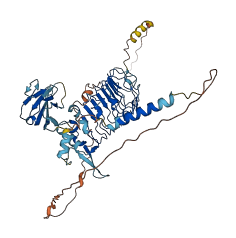
Descriptions
The autoinhibited protein was predicted that may have potential autoinhibitory elements via cis-regPred.
Autoinhibitory domains (AIDs)
Target domain |
|
Relief mechanism |
|
Assay |
cis-regPred |
Accessory elements
No accessory elements
Autoinhibited structure

Activated structure
1 structures for Q7TNJ4
| Entry ID | Method | Resolution | Chain | Position | Source |
|---|---|---|---|---|---|
| AF-Q7TNJ4-F1 | Predicted | AlphaFoldDB |
No variants for Q7TNJ4
| Variant ID(s) | Position | Change | Description | Diseaes Association | Provenance |
|---|---|---|---|---|---|
| No variants for Q7TNJ4 | |||||
No associated diseases with Q7TNJ4
11 regional properties for Q7TNJ4
| Type | Name | Position | InterPro Accession |
|---|---|---|---|
| repeat | Leucine-rich repeat | 93 - 114 | IPR001611-1 |
| repeat | Leucine-rich repeat | 116 - 174 | IPR001611-2 |
| repeat | Leucine-rich repeat, typical subtype | 91 - 114 | IPR003591-1 |
| repeat | Leucine-rich repeat, typical subtype | 115 - 138 | IPR003591-2 |
| repeat | Leucine-rich repeat, typical subtype | 139 - 162 | IPR003591-3 |
| repeat | Leucine-rich repeat, typical subtype | 163 - 186 | IPR003591-4 |
| repeat | Leucine-rich repeat, typical subtype | 190 - 214 | IPR003591-5 |
| domain | Immunoglobulin subtype 2 | 300 - 369 | IPR003598 |
| domain | Immunoglobulin subtype | 294 - 380 | IPR003599 |
| domain | Immunoglobulin-like domain | 302 - 378 | IPR007110 |
| domain | Immunoglobulin | 298 - 367 | IPR013151 |
Functions
4 GO annotations of cellular component
| Name | Definition |
|---|---|
| integral component of membrane | The component of a membrane consisting of the gene products and protein complexes having at least some part of their peptide sequence embedded in the hydrophobic region of the membrane. |
| integral component of plasma membrane | The component of the plasma membrane consisting of the gene products and protein complexes having at least some part of their peptide sequence embedded in the hydrophobic region of the membrane. |
| nucleus | A membrane-bounded organelle of eukaryotic cells in which chromosomes are housed and replicated. In most cells, the nucleus contains all of the cell's chromosomes except the organellar chromosomes, and is the site of RNA synthesis and processing. In some species, or in specialized cell types, RNA metabolism or DNA replication may be absent. |
| plasma membrane | The membrane surrounding a cell that separates the cell from its external environment. It consists of a phospholipid bilayer and associated proteins. |
No GO annotations of molecular function
| Name | Definition |
|---|---|
| No GO annotations for molecular function |
7 GO annotations of biological process
| Name | Definition |
|---|---|
| brain development | The process whose specific outcome is the progression of the brain over time, from its formation to the mature structure. Brain development begins with patterning events in the neural tube and ends with the mature structure that is the center of thought and emotion. The brain is responsible for the coordination and control of bodily activities and the interpretation of information from the senses (sight, hearing, smell, etc.). |
| cerebellum development | The process whose specific outcome is the progression of the cerebellum over time, from its formation to the mature structure. The cerebellum is the portion of the brain in the back of the head between the cerebrum and the pons. In mice, the cerebellum controls balance for walking and standing, modulates the force and range of movement and is involved in the learning of motor skills. |
| heterophilic cell-cell adhesion via plasma membrane cell adhesion molecules | The attachment of an adhesion molecule in one cell to a nonidentical adhesion molecule in an adjacent cell. |
| homophilic cell adhesion via plasma membrane adhesion molecules | The attachment of a plasma membrane adhesion molecule in one cell to an identical molecule in an adjacent cell. |
| negative regulation of neuron apoptotic process | Any process that stops, prevents, or reduces the frequency, rate or extent of cell death by apoptotic process in neurons. |
| negative regulation of programmed cell death | Any process that stops, prevents, or reduces the frequency, rate or extent of programmed cell death, cell death resulting from activation of endogenous cellular processes. |
| positive regulation of synapse assembly | Any process that activates, maintains or increases the frequency, rate or extent of synapse assembly, the aggregation, arrangement and bonding together of a set of components to form a synapse. |
1 homologous proteins in AiPD
| UniProt AC | Gene Name | Protein Name | Species | Evidence Code |
|---|---|---|---|---|
| Q80ZD9 | Amigo2 | Amphoterin-induced protein 2 | Mus musculus (Mouse) | PR |
| 10 | 20 | 30 | 40 | 50 | 60 |
| MSLRFHTLPT | LPRAVKPGCR | ELLCLLVIAV | MVSPSSSGLC | PTACICATDI | VSCTNKNLSK |
| 70 | 80 | 90 | 100 | 110 | 120 |
| VPGNLFRLIK | RLDLSYNRIG | LLDADWIPVS | FVKLSTLIVR | HNNITSISTG | SFSTTPNLKC |
| 130 | 140 | 150 | 160 | 170 | 180 |
| LDLSSNRLKS | VKSAMFQELK | VLEVLLLYNN | HISYLDPAAF | GGLSHLQKLY | LSGNFLTKFP |
| 190 | 200 | 210 | 220 | 230 | 240 |
| MDLYVGRFKL | ADLTFLDVSY | NQIASIPMHH | INLVPGKQLR | GIFLHGNPFV | CDCSLYSLLT |
| 250 | 260 | 270 | 280 | 290 | 300 |
| FWYRRHFNSV | TDFKHDYTCR | LWLDSRHSHQ | LLLLQDSFLN | CSHSVINGSF | HALGFIHEAQ |
| 310 | 320 | 330 | 340 | 350 | 360 |
| VGERAIVHCD | GKTGNGNTDF | IWVGPDNRLL | EPDKDTGNFR | VFYNGSLVIE | NPGFEDAGVY |
| 370 | 380 | 390 | 400 | 410 | 420 |
| SCIAMNRQRL | LNETVDIMIN | VSNFTINRSH | HAHEAFNTAF | TTLAACVVSI | VLVLLYLYLT |
| 430 | 440 | 450 | 460 | 470 | 480 |
| PCPCKCRDKR | QKNALNQSNA | HSSILSPGPT | RDASAEDRKA | GKRVVFLEPL | KDPAVGQNGK |
| 490 | 500 | 510 | |||
| VKLVPSKTVI | AEGILKSSRA | KSDSDSVNSV | FSDTPFVAST |