Q7SXY4
Gene name |
dync2li1 (zgc:63673) |
Protein name |
Cytoplasmic dynein 2 light intermediate chain 1 |
Names |
|
Species |
Danio rerio (Zebrafish) (Brachydanio rerio) |
KEGG Pathway |
dre:393452 |
EC number |
|
Protein Class |
|
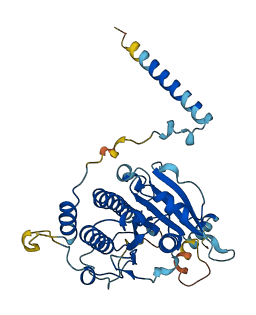
Descriptions
The autoinhibited protein was predicted that may have potential autoinhibitory elements via cis-regPred.
Autoinhibitory domains (AIDs)
Target domain |
|
Relief mechanism |
|
Assay |
cis-regPred |
Accessory elements
No accessory elements
Autoinhibited structure

Activated structure
1 structures for Q7SXY4
| Entry ID | Method | Resolution | Chain | Position | Source |
|---|---|---|---|---|---|
| AF-Q7SXY4-F1 | Predicted | AlphaFoldDB |
No variants for Q7SXY4
| Variant ID(s) | Position | Change | Description | Diseaes Association | Provenance |
|---|---|---|---|---|---|
| No variants for Q7SXY4 | |||||
No associated diseases with Q7SXY4
No regional properties for Q7SXY4
| Type | Name | Position | InterPro Accession |
|---|---|---|---|
| No domain, repeats, and functional sites for Q7SXY4 | |||
Functions
5 GO annotations of cellular component
| Name | Definition |
|---|---|
| axoneme | The bundle of microtubules and associated proteins that forms the core of cilia (also called flagella) in eukaryotic cells and is responsible for their movements. |
| ciliary basal body | A membrane-tethered, short cylindrical array of microtubules and associated proteins found at the base of a eukaryotic cilium (also called flagellum) that is similar in structure to a centriole and derives from it. The cilium basal body is the site of assembly and remodelling of the cilium and serves as a nucleation site for axoneme growth. As well as anchoring the cilium, it is thought to provide a selective gateway regulating the entry of ciliary proteins and vesicles by intraflagellar transport. |
| cytoplasmic dynein complex | Any dynein complex with a homodimeric dynein heavy chain core that catalyzes movement along a microtubule. Cytoplasmic dynein complexes participate in many cytoplasmic transport activities in eukaryotes, such as mRNA localization, intermediate filament transport, nuclear envelope breakdown, apoptosis, transport of centrosomal proteins, mitotic spindle assembly, virus transport, kinetochore functions, and movement of signaling and spindle checkpoint proteins. Some complexes participate in intraflagellar transport. Subunits associated with the dynein heavy chain mediate association between dynein heavy chain and cargoes, and may include light chains and light intermediate chains. |
| microtubule | Any of the long, generally straight, hollow tubes of internal diameter 12-15 nm and external diameter 24 nm found in a wide variety of eukaryotic cells; each consists (usually) of 13 protofilaments of polymeric tubulin, staggered in such a manner that the tubulin monomers are arranged in a helical pattern on the microtubular surface, and with the alpha/beta axes of the tubulin subunits parallel to the long axis of the tubule; exist in equilibrium with pool of tubulin monomers and can be rapidly assembled or disassembled in response to physiological stimuli; concerned with force generation, e.g. in the spindle. |
| non-motile cilium | A cilium which may have a variable array of axonemal microtubules but does not contain molecular motors. |
1 GO annotations of molecular function
| Name | Definition |
|---|---|
| dynein heavy chain binding | Binding to a heavy chain of the dynein complex. |
3 GO annotations of biological process
| Name | Definition |
|---|---|
| intraciliary retrograde transport | The directed movement of large protein complexes along microtubules from the tip of a cilium (also called flagellum) toward the cell body, mediated by motor proteins. |
| intraciliary transport | The bidirectional movement of large protein complexes along microtubules within a cilium, mediated by motor proteins. |
| intraciliary transport involved in cilium assembly | The bidirectional movement of large protein complexes along microtubules within a cilium that contributes to cilium assembly. |
No homologous proteins in AiPD
| UniProt AC | Gene Name | Protein Name | Species | Evidence Code |
|---|---|---|---|---|
| No homologous proteins | ||||
| 10 | 20 | 30 | 40 | 50 | 60 |
| MPKVSSDTLW | DIAAAEVRSR | ESRTDEEEAE | EEDAHFPSQR | TVFFMGSKAG | GKTTILLRFL |
| 70 | 80 | 90 | 100 | 110 | 120 |
| ERDETAKPTL | ALEYTFGRRA | RGHNTPKDIA | HLWELGGGIS | LSDLVQIPIT | ADNVSFLSVV |
| 130 | 140 | 150 | 160 | 170 | 180 |
| LVLDLSKPNA | LWETMESLLG | SARNQVEKVC | AALQKTGESR | SGKQRVPRVL | HKDYPDRELI |
| 190 | 200 | 210 | 220 | 230 | 240 |
| SPFPVPLLIV | GSKFDIFQDF | DSEKRKVICK | TLRFLAHFYG | ASLIFTSSKS | ETTMSKSRSF |
| 250 | 260 | 270 | 280 | 290 | 300 |
| INQLAFGTER | PKSISTDPSK | PLAIPAGSDS | LSQIGPPVAT | EVDIGTLHAK | NPFDLWKKVF |
| 310 | 320 | 330 | 340 | 350 | |
| EKVFPHESTR | ERKELKDPVK | DPQFSEPLID | SIRAQKDQEL | DQYKREQAKS | WKSLALDP |