Q7SI68
Gene name |
cry (B22I21.260, NCU00582) |
Protein name |
Putative cryptochrome DASH, mitochondrial |
Names |
|
Species |
Neurospora crassa (strain ATCC 24698 / 74-OR23-1A / CBS 708.71 / DSM 1257 / FGSC 987) |
KEGG Pathway |
ncr:NCU00582 |
EC number |
|
Protein Class |
|
Descriptions
The autoinhibited protein was predicted that may have potential autoinhibitory elements via cis-regPred.
Autoinhibitory domains (AIDs)
Target domain |
|
Relief mechanism |
|
Assay |
cis-regPred |
Accessory elements
No accessory elements
Autoinhibited structure

Activated structure
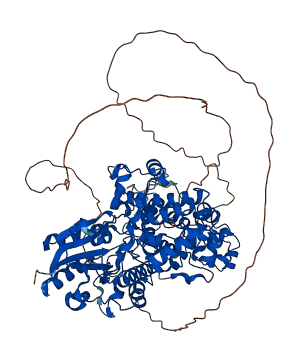
1 structures for Q7SI68
| Entry ID | Method | Resolution | Chain | Position | Source |
|---|---|---|---|---|---|
| AF-Q7SI68-F1 | Predicted | AlphaFoldDB |
No variants for Q7SI68
| Variant ID(s) | Position | Change | Description | Diseaes Association | Provenance |
|---|---|---|---|---|---|
| No variants for Q7SI68 | |||||
No associated diseases with Q7SI68
1 GO annotations of cellular component
| Name | Definition |
|---|---|
| mitochondrion | A semiautonomous, self replicating organelle that occurs in varying numbers, shapes, and sizes in the cytoplasm of virtually all eukaryotic cells. It is notably the site of tissue respiration. |
4 GO annotations of molecular function
| Name | Definition |
|---|---|
| damaged DNA binding | Binding to damaged DNA. |
| deoxyribodipyrimidine photo-lyase activity | Catalysis of the reaction: cyclobutadipyrimidine (in DNA) = 2 pyrimidine residues (in DNA). This reaction represents the reactivation of irradiated DNA by light. |
| DNA binding | Any molecular function by which a gene product interacts selectively and non-covalently with DNA (deoxyribonucleic acid). |
| FAD binding | Binding to the oxidized form, FAD, of flavin-adenine dinucleotide, the coenzyme or the prosthetic group of various flavoprotein oxidoreductase enzymes. |
1 GO annotations of biological process
| Name | Definition |
|---|---|
| photoreactive repair | The repair of UV-induced T-T, C-T and C-C dimers by directly reversing the damage to restore the original pyrimidines. |
No homologous proteins in AiPD
| UniProt AC | Gene Name | Protein Name | Species | Evidence Code |
|---|---|---|---|---|
| No homologous proteins | ||||
| 10 | 20 | 30 | 40 | 50 | 60 |
| MAPSKVVIYA | MRRELRLSDN | PIFHHLSNPE | SKHGFSHLLP | VYVFPAQQID | LSGFVPKGSE |
| 70 | 80 | 90 | 100 | 110 | 120 |
| NPHPAPKSAV | GGYARCGPYR | AKFLAESVWD | LKTSLQSIGS | DLLVRAGPYK | DVIQSLVEGL |
| 130 | 140 | 150 | 160 | 170 | 180 |
| KAKECQVGAV | WMTSHEGSEE | KSEEKTVASF | CAKSGIDFKL | WDDEKYLIHD | RDTGITHLND |
| 190 | 200 | 210 | 220 | 230 | 240 |
| LPDVFTTYRK | QIEPLREKAR | KTLPVPEKGA | LPAYPDIDMI | PSQQPPFNIP | GTCEELVDAV |
| 250 | 260 | 270 | 280 | 290 | 300 |
| VRPVKNFLKD | LPDFPEKAES | SHPFRGGETS | AHKRIDHLVL | SGGMKSYKDS | RNGLLGPDFS |
| 310 | 320 | 330 | 340 | 350 | 360 |
| TKLSAYLAQG | CVTARQIHHA | LVAYEDGTGT | KYKGADGFGE | GDNQGTETVR | MELLWRDYMR |
| 370 | 380 | 390 | 400 | 410 | 420 |
| LCHQKYGDKL | FRVEGFNGKH | TDYEGEDKKY | GWRTANTSIA | LPGQEPTPEK | VSEILARFNA |
| 430 | 440 | 450 | 460 | 470 | 480 |
| GTTGMGLIDA | SQRELIHTGY | TSNRTRQNVA | SFLAKHLEID | WRYGAEWYEM | LLVDYDVSSN |
| 490 | 500 | 510 | 520 | 530 | 540 |
| WANWQYVAGV | GNDPRGAARI | FNPVKQAFDY | DKDGTYVRTW | VPEVAKFENL | ENVFQAWTAS |
| 550 | 560 | 570 | 580 | 590 | 600 |
| KEDLKTAGLE | GNIMVTDPVK | PIKFNLDHKP | SKVKKRPFFR | KRGTKTRDAQ | GSAESPGSSD |
| 610 | 620 | 630 | 640 | 650 | 660 |
| SHSGSGGSPD | GSGGGNIPSE | SNCAAAGSGQ | AQQTHQGSGR | SQSSSNHGGR | SHSHQHNQQN |
| 670 | 680 | 690 | 700 | 710 | 720 |
| YHHSHRGNDY | TRGGGGGRGG | RGGRGGGGGG | YSASQGYYGI | GGGYRGGGRG | RGGGGGFRGR |
| 730 | 740 | ||||
| YAPTGGLGGH | HHSEQQVASQ | FQTDA |