Q7SI01
Gene name |
un-7 (png-1, NCU00651) |
Protein name |
Protein png-1 |
Names |
|
Species |
Neurospora crassa (strain ATCC 24698 / 74-OR23-1A / CBS 708.71 / DSM 1257 / FGSC 987) |
KEGG Pathway |
ncr:NCU00651 |
EC number |
|
Protein Class |
|
Descriptions
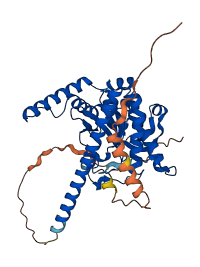
The autoinhibited protein was predicted that may have potential autoinhibitory elements via cis-regPred.
Autoinhibitory domains (AIDs)
Target domain |
|
Relief mechanism |
|
Assay |
cis-regPred |
Accessory elements
No accessory elements
Autoinhibited structure

Activated structure
1 structures for Q7SI01
| Entry ID | Method | Resolution | Chain | Position | Source |
|---|---|---|---|---|---|
| AF-Q7SI01-F1 | Predicted | AlphaFoldDB |
No variants for Q7SI01
| Variant ID(s) | Position | Change | Description | Diseaes Association | Provenance |
|---|---|---|---|---|---|
| No variants for Q7SI01 | |||||
No associated diseases with Q7SI01
2 regional properties for Q7SI01
| Type | Name | Position | InterPro Accession |
|---|---|---|---|
| conserved_site | UbiE/COQ5 methyltransferase, conserved site | 33 - 48 | IPR023576-1 |
| conserved_site | UbiE/COQ5 methyltransferase, conserved site | 159 - 173 | IPR023576-2 |
2 GO annotations of cellular component
| Name | Definition |
|---|---|
| cytosol | The part of the cytoplasm that does not contain organelles but which does contain other particulate matter, such as protein complexes. |
| nucleus | A membrane-bounded organelle of eukaryotic cells in which chromosomes are housed and replicated. In most cells, the nucleus contains all of the cell's chromosomes except the organellar chromosomes, and is the site of RNA synthesis and processing. In some species, or in specialized cell types, RNA metabolism or DNA replication may be absent. |
2 GO annotations of molecular function
| Name | Definition |
|---|---|
| metal ion binding | Binding to a metal ion. |
| peptide-N4-(N-acetyl-beta-glucosaminyl)asparagine amidase activity | Catalysis of the reaction: 4-N-(N-acetyl-D-glucosaminyl)-protein + H2O = N-acetyl-beta-D-glucosaminylamine + peptide L-aspartate. This reaction is the hydrolysis of an N4-(acetyl-beta-D-glucosaminyl)asparagine residue in which the N-acetyl-D-glucosamine residue may be further glycosylated, to yield a (substituted) N-acetyl-beta-D-glucosaminylamine and the peptide containing an aspartic residue. |
4 GO annotations of biological process
| Name | Definition |
|---|---|
| glycoprotein catabolic process | The chemical reactions and pathways resulting in the breakdown of a glycoprotein, a protein that contains covalently bound glycose (i.e. monosaccharide) residues; the glycose occurs most commonly as oligosaccharide or fairly small polysaccharide but occasionally as monosaccharide. |
| protein deglycosylation | The removal of sugar residues from a glycosylated protein. |
| protein quality control for misfolded or incompletely synthesized proteins | The chemical reactions and pathways resulting in the breakdown of misfolded or attenuated proteins. |
| response to stress | Any process that results in a change in state or activity of a cell or an organism (in terms of movement, secretion, enzyme production, gene expression, etc.) as a result of a disturbance in organismal or cellular homeostasis, usually, but not necessarily, exogenous (e.g. temperature, humidity, ionizing radiation). |
No homologous proteins in AiPD
| UniProt AC | Gene Name | Protein Name | Species | Evidence Code |
|---|---|---|---|---|
| No homologous proteins | ||||
| 10 | 20 | 30 | 40 | 50 | 60 |
| MAGNNSGGGS | YPLDDHVKSV | ARDLQHRFAQ | MSNRDQKFDL | HVIPDLLSQP | VVPEPPAQDD |
| 70 | 80 | 90 | 100 | 110 | 120 |
| KEAQNFEKYL | IAMSHIPLNY | ENPGLLDEAL | QQIPLDRLSQ | EAEEEVELFQ | AKAASLGRSK |
| 130 | 140 | 150 | 160 | 170 | 180 |
| PEWSHQECMV | RALLRWFRRS | FFTFVNNPPC | SECLSPTNKI | RNVAPTPEER | AHSATWVELY |
| 190 | 200 | 210 | 220 | 230 | 240 |
| ACVTCGAYER | FPRYTEAWQL | LRVKRGRAGD | FANVFTMLCR | ALDIRARWVW | CQEDYLWTEI |
| 250 | 260 | 270 | 280 | 290 | 300 |
| YSEHQQRWVH | VDSCEEAWDM | PHMYYKNWGK | KMSYVIAFSR | EGAVDVTRRY | VGSPDALLPR |
| 310 | 320 | 330 | 340 | 350 | 360 |
| TRCPEGVLKF | IMEEITNLHR | PKYAPDGETR | LRLYREDVAE | DVQLRSLWSA | TLEQSRRLKA |
| 370 | 380 | 390 | 400 | 410 | |
| AAAAAARGGR | SSPDNKSGAN | MMGSPATGDI | KRPIPEDAPV | PDVPSLWPTY | GP |