Q7SF84
Gene name |
NCU00565 |
Protein name |
Lipoyl synthase, mitochondrial |
Names |
Lipoate synthase, LS, Lip-syn, Lipoic acid synthase |
Species |
Neurospora crassa (strain ATCC 24698 / 74-OR23-1A / CBS 708.71 / DSM 1257 / FGSC 987) |
KEGG Pathway |
ncr:NCU00565 |
EC number |
2.8.1.8: Sulfurtransferases |
Protein Class |
|
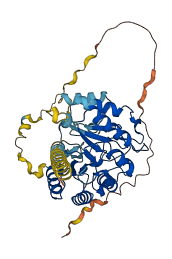
Descriptions
The autoinhibited protein was predicted that may have potential autoinhibitory elements via cis-regPred.
Autoinhibitory domains (AIDs)
Target domain |
|
Relief mechanism |
|
Assay |
cis-regPred |
Accessory elements
No accessory elements
Autoinhibited structure

Activated structure
1 structures for Q7SF84
| Entry ID | Method | Resolution | Chain | Position | Source |
|---|---|---|---|---|---|
| AF-Q7SF84-F1 | Predicted | AlphaFoldDB |
No variants for Q7SF84
| Variant ID(s) | Position | Change | Description | Diseaes Association | Provenance |
|---|---|---|---|---|---|
| No variants for Q7SF84 | |||||
No associated diseases with Q7SF84
Functions
| Description | ||
|---|---|---|
| EC Number | 2.8.1.8 | Sulfurtransferases |
| Subcellular Localization |
|
|
| PANTHER Family | ||
| PANTHER Subfamily | ||
| PANTHER Protein Class | ||
| PANTHER Pathway Category | No pathway information available | |
1 GO annotations of cellular component
| Name | Definition |
|---|---|
| mitochondrion | A semiautonomous, self replicating organelle that occurs in varying numbers, shapes, and sizes in the cytoplasm of virtually all eukaryotic cells. It is notably the site of tissue respiration. |
3 GO annotations of molecular function
| Name | Definition |
|---|---|
| 4 iron, 4 sulfur cluster binding | Binding to a 4 iron, 4 sulfur (4Fe-4S) cluster; this cluster consists of four iron atoms, with the inorganic sulfur atoms found between the irons and acting as bridging ligands. |
| lipoate synthase activity | Catalysis of the reaction: protein N6-(octanoyl)lysine + 2 sulfur + 2 S-adenosyl-L-methionine = protein N6-(lipoyl)lysine + 2 L-methionine + 2 5'-deoxyadenosyl. |
| metal ion binding | Binding to a metal ion. |
2 GO annotations of biological process
| Name | Definition |
|---|---|
| lipoate biosynthetic process | The chemical reactions and pathways resulting in the formation of lipoate, 1,2-dithiolane-3-pentanoate, the anion derived from lipoic acid. |
| protein lipoylation | The lipoylation of peptidyl-lysine to form peptidyl-N6-lipoyl-L-lysine. |
No homologous proteins in AiPD
| UniProt AC | Gene Name | Protein Name | Species | Evidence Code |
|---|---|---|---|---|
| No homologous proteins | ||||
| 10 | 20 | 30 | 40 | 50 | 60 |
| MASPVPIQRL | QAPLRRSLAR | AAALSTRSYA | TIPSGPSSQP | TSQESSSAAS | ASAPATKPRP |
| 70 | 80 | 90 | 100 | 110 | 120 |
| TYFKDTTLAS | LDDFIANQSS | AAPLAPSEAY | TLRTAEVGPA | GKKRTITRLP | EWLKTPIPSA |
| 130 | 140 | 150 | 160 | 170 | 180 |
| GANPEFAKIK | ADLRGLNLHT | VCEEARCPNI | GECWGGSNKA | AATATIMLMG | DTCTRGCRFC |
| 190 | 200 | 210 | 220 | 230 | 240 |
| SVKTSRKPPP | LDPHEPENTA | EALARWGLGY | VVLTSVDRDD | LADGGARHFA | ETIRRIKQKK |
| 250 | 260 | 270 | 280 | 290 | 300 |
| PTLLVEALTG | DFAGDLDMVK | IVAESGLDVY | AHNVETVENL | TPYVRDRRAT | FRQSLKVLEH |
| 310 | 320 | 330 | 340 | 350 | 360 |
| VKKVRGKEGI | ITKTSIMLGL | GETEEELWEA | LRELRKVDVD | VVTFGQYMRP | TKRHLAVEKY |
| 370 | 380 | 390 | 400 | 410 | 420 |
| ITPDEFELWR | QRALDMGFLY | CASGPLVRSS | YKAGEAFIEN | VLRKRSGEKV | VSEALGQAVA |
| AEEATSVQSS |