Q7RV88
Gene name |
tif-1 (tif-41, NCU07420) |
Protein name |
ATP-dependent RNA helicase eIF4A |
Names |
Eukaryotic initiation factor 4A, eIF-4A, Translation initiation factor 1 |
Species |
Neurospora crassa (strain ATCC 24698 / 74-OR23-1A / CBS 708.71 / DSM 1257 / FGSC 987) |
KEGG Pathway |
ncr:NCU07420 |
EC number |
3.6.4.13: Acting on ATP; involved in cellular and subcellular movement |
Protein Class |
|
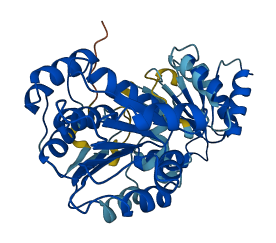
Descriptions
The autoinhibited protein was predicted that may have potential autoinhibitory elements via cis-regPred.
Autoinhibitory domains (AIDs)
Target domain |
|
Relief mechanism |
|
Assay |
cis-regPred |
Accessory elements
No accessory elements
Autoinhibited structure

Activated structure
1 structures for Q7RV88
| Entry ID | Method | Resolution | Chain | Position | Source |
|---|---|---|---|---|---|
| AF-Q7RV88-F1 | Predicted | AlphaFoldDB |
No variants for Q7RV88
| Variant ID(s) | Position | Change | Description | Diseaes Association | Provenance |
|---|---|---|---|---|---|
| No variants for Q7RV88 | |||||
No associated diseases with Q7RV88
6 regional properties for Q7RV88
| Type | Name | Position | InterPro Accession |
|---|---|---|---|
| conserved_site | ATP-dependent RNA helicase DEAD-box, conserved site | 171 - 179 | IPR000629 |
| domain | Helicase, C-terminal | 236 - 397 | IPR001650 |
| domain | DEAD/DEAH box helicase domain | 49 - 213 | IPR011545 |
| domain | Helicase superfamily 1/2, ATP-binding domain | 43 - 240 | IPR014001 |
| domain | RNA helicase, DEAD-box type, Q motif | 24 - 52 | IPR014014 |
| domain | ATP-dependent RNA helicase eIF4A, DEAD-box helicase domain | 26 - 226 | IPR044728 |
Functions
| Description | ||
|---|---|---|
| EC Number | 3.6.4.13 | Acting on ATP; involved in cellular and subcellular movement |
| Subcellular Localization |
|
|
| PANTHER Family | ||
| PANTHER Subfamily | ||
| PANTHER Protein Class | ||
| PANTHER Pathway Category | No pathway information available | |
1 GO annotations of cellular component
| Name | Definition |
|---|---|
| cytoplasm | The contents of a cell excluding the plasma membrane and nucleus, but including other subcellular structures. |
5 GO annotations of molecular function
| Name | Definition |
|---|---|
| ATP binding | Binding to ATP, adenosine 5'-triphosphate, a universally important coenzyme and enzyme regulator. |
| ATP hydrolysis activity | Catalysis of the reaction: ATP + H2O = ADP + H+ phosphate. ATP hydrolysis is used in some reactions as an energy source, for example to catalyze a reaction or drive transport against a concentration gradient. |
| RNA binding | Binding to an RNA molecule or a portion thereof. |
| RNA helicase activity | Unwinding of an RNA helix, driven by ATP hydrolysis. |
| translation initiation factor activity | Functions in the initiation of ribosome-mediated translation of mRNA into a polypeptide. |
1 GO annotations of biological process
| Name | Definition |
|---|---|
| cytoplasmic translational initiation | The process preceding formation of the peptide bond between the first two amino acids of a protein in the cytoplasm. This includes the formation of a complex of the ribosome, mRNA or circRNA, and an initiation complex that contains the first aminoacyl-tRNA. |
No homologous proteins in AiPD
| UniProt AC | Gene Name | Protein Name | Species | Evidence Code |
|---|---|---|---|---|
| No homologous proteins | ||||
| 10 | 20 | 30 | 40 | 50 | 60 |
| MATDKGLEDI | PEGQIESNYD | ETVDSFDEMN | LKPELLRGIY | AYGFERPSAI | QQRAIMPVIK |
| 70 | 80 | 90 | 100 | 110 | 120 |
| GHDVIAQAQS | GTGKTATFSI | SVLQKIDPSL | KACQALILAP | TRELAQQIQK | VVVAIGDFMN |
| 130 | 140 | 150 | 160 | 170 | 180 |
| IECHACIGGT | SVRDDMKALQ | DGPQVVVGTP | GRVHDMIQRR | FLKTDSMKMF | VLDEADEMLS |
| 190 | 200 | 210 | 220 | 230 | 240 |
| RGFTEQIYDI | FQLLPQSTQV | VLLSATMPQD | VLEVTTKFMR | EPVRILVKKD | ELTLEGIKQF |
| 250 | 260 | 270 | 280 | 290 | 300 |
| YIAVEKEEWK | LDTLSDLYET | VTITQAVIFC | NTRRKVDWLT | DKLTARDFTV | SAMHGDMDQA |
| 310 | 320 | 330 | 340 | 350 | 360 |
| QRDLIMKEFR | SGSSRVLIAT | DLLARGIDVQ | QVSLVINYDL | PANRENYIHR | IGRGGRFGRK |
| 370 | 380 | 390 | |||
| GVAINFVTAD | DVRMMREIEQ | FYSTQIEEMP | MNVADLI |