Descriptions
The autoinhibited protein was predicted that may have potential autoinhibitory elements via cis-regPred.
Autoinhibitory domains (AIDs)
Target domain |
|
Relief mechanism |
|
Assay |
cis-regPred |
Accessory elements
No accessory elements
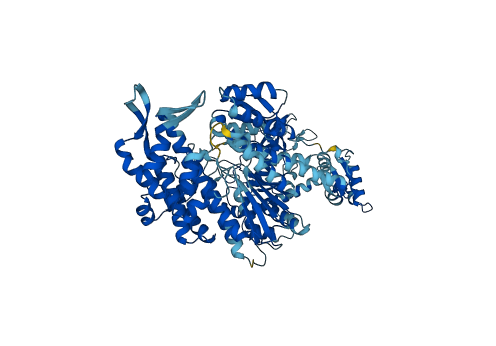
Autoinhibited structure

Activated structure
4 structures for Q7RQ71
| Entry ID | Method | Resolution | Chain | Position | Source |
|---|---|---|---|---|---|
| 2AUC | X-ray | 260 A | D | 803-817 | PDB |
| 2QAC | X-ray | 170 A | T | 803-817 | PDB |
| 4GGN | X-ray | 229 A | D/E/F | 803-817 | PDB |
| AF-Q7RQ71-F1 | Predicted | AlphaFoldDB |
No variants for Q7RQ71
| Variant ID(s) | Position | Change | Description | Diseaes Association | Provenance |
|---|---|---|---|---|---|
| No variants for Q7RQ71 | |||||
No associated diseases with Q7RQ71
2 GO annotations of cellular component
| Name | Definition |
|---|---|
| myosin complex | A protein complex, formed of one or more myosin heavy chains plus associated light chains and other proteins, that functions as a molecular motor; uses the energy of ATP hydrolysis to move actin filaments or to move vesicles or other cargo on fixed actin filaments; has magnesium-ATPase activity and binds actin. Myosin classes are distinguished based on sequence features of the motor, or head, domain, but also have distinct tail regions that are believed to bind specific cargoes. |
| plasma membrane | The membrane surrounding a cell that separates the cell from its external environment. It consists of a phospholipid bilayer and associated proteins. |
3 GO annotations of molecular function
| Name | Definition |
|---|---|
| actin binding | Binding to monomeric or multimeric forms of actin, including actin filaments. |
| ATP binding | Binding to ATP, adenosine 5'-triphosphate, a universally important coenzyme and enzyme regulator. |
| cytoskeletal motor activity | Generation of force resulting in movement, for example along a microfilament or microtubule, or in torque resulting in membrane scission or rotation of a flagellum. The energy required is obtained either from the hydrolysis of a nucleoside triphosphate or by an electrochemical proton gradient (proton-motive force). |
No GO annotations of biological process
| Name | Definition |
|---|---|
| No GO annotations for biological process |
No homologous proteins in AiPD
| UniProt AC | Gene Name | Protein Name | Species | Evidence Code |
|---|---|---|---|---|
| No homologous proteins | ||||
| 10 | 20 | 30 | 40 | 50 | 60 |
| MAVTNEELKT | AHKIVRRVSN | IEAFDKSGVV | FKGYQIWTNI | SPTIEEDPNV | MFVKCVVQHG |
| 70 | 80 | 90 | 100 | 110 | 120 |
| SNQDKLNVVQ | IDPPGSGTPY | EIDVKSAWNC | NSQVDPMSFG | DIGLLNHTNT | PCVLDFLKHR |
| 130 | 140 | 150 | 160 | 170 | 180 |
| YLKNQIYTTA | CPLIVAINPY | KDLGNTTDEW | IRKYRDASDH | TRLPPHIFSC | AREALSNLHG |
| 190 | 200 | 210 | 220 | 230 | 240 |
| VNKSQTIIVS | GESGAGKTEA | TKQIMKYFAS | SKNGNMDLYI | QTAIMAANPV | LEAFGNAKTI |
| 250 | 260 | 270 | 280 | 290 | 300 |
| RNNNSSRFGR | FMQLAISHEG | GIRNGSVVAF | LLEKSRIITQ | DDNERSYHIF | YQFLKGADSN |
| 310 | 320 | 330 | 340 | 350 | 360 |
| MKSKFGLKGI | KDYKLLNPNS | PDVDGIDDVK | DFQEVITSLK | NMQLNDEQIE | VIFSIIAGIL |
| 370 | 380 | 390 | 400 | 410 | 420 |
| TLGNVRIVEK | TEAGLSDAAG | IHNDDMETFK | KACELMFLDP | ELVKRELLIK | VTIAGGNRIE |
| 430 | 440 | 450 | 460 | 470 | 480 |
| GRWNKNDAEV | LKLSLCKAMY | EKLFLWIIKN | LNSRIEPEGG | FKAFMGMLDI | FGFEVFKNNS |
| 490 | 500 | 510 | 520 | 530 | 540 |
| LEQLFINITN | EMLQKNFVDI | VFERESKLYR | DEGISTAELN | YTSNKEVISV | LCERGKSVLS |
| 550 | 560 | 570 | 580 | 590 | 600 |
| YLEDQCLAPG | GSDEKFVNAC | VVNLKSNEKF | IPAKVASNKN | FIIQHTIGPI | QYCSDNFLLK |
| 610 | 620 | 630 | 640 | 650 | 660 |
| NKDVLRGELV | EIILGSGNKV | VSGLFEGQVI | EKGKMAKGSL | IGSQFLNQLT | SLMTLINSTE |
| 670 | 680 | 690 | 700 | 710 | 720 |
| PHFIRCIKPN | ENKKPLEWCE | PKILIQLHAL | SILEALVLRQ | LGYSYRRTFD | EFLYQFKFVD |
| 730 | 740 | 750 | 760 | 770 | 780 |
| INTSENSSLD | SREKCNKILK | LSGLSDDMLK | IGKTMVFLKQ | DGAKMLSKIQ | REKLVEWENC |
| 790 | 800 | 810 | |||
| VSVIEAAIMK | YKHKQNVENN | VSSLMRVQAH | IRKRMVA |