Q7PMG3
Gene name |
GPRgr22 |
Protein name |
Gustatory and odorant receptor 22 |
Names |
|
Species |
Anopheles gambiae (African malaria mosquito) |
KEGG Pathway |
aga:AgaP_AGAP009999 |
EC number |
|
Protein Class |
|
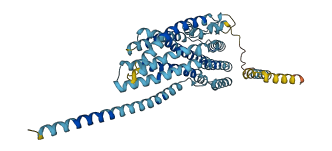
Descriptions
The autoinhibited protein was predicted that may have potential autoinhibitory elements via cis-regPred.
Autoinhibitory domains (AIDs)
Target domain |
|
Relief mechanism |
|
Assay |
cis-regPred |
Accessory elements
No accessory elements
Autoinhibited structure

Activated structure
1 structures for Q7PMG3
| Entry ID | Method | Resolution | Chain | Position | Source |
|---|---|---|---|---|---|
| AF-Q7PMG3-F1 | Predicted | AlphaFoldDB |
No variants for Q7PMG3
| Variant ID(s) | Position | Change | Description | Diseaes Association | Provenance |
|---|---|---|---|---|---|
| No variants for Q7PMG3 | |||||
No associated diseases with Q7PMG3
No regional properties for Q7PMG3
| Type | Name | Position | InterPro Accession |
|---|---|---|---|
| No domain, repeats, and functional sites for Q7PMG3 | |||
5 GO annotations of cellular component
| Name | Definition |
|---|---|
| axon | The long process of a neuron that conducts nerve impulses, usually away from the cell body to the terminals and varicosities, which are sites of storage and release of neurotransmitter. |
| dendrite | A neuron projection that has a short, tapering, morphology. Dendrites receive and integrate signals from other neurons or from sensory stimuli, and conduct nerve impulses towards the axon or the cell body. In most neurons, the impulse is conveyed from dendrites to axon via the cell body, but in some types of unipolar neuron, the impulse does not travel via the cell body. |
| integral component of membrane | The component of a membrane consisting of the gene products and protein complexes having at least some part of their peptide sequence embedded in the hydrophobic region of the membrane. |
| neuronal cell body | The portion of a neuron that includes the nucleus, but excludes cell projections such as axons and dendrites. |
| plasma membrane | The membrane surrounding a cell that separates the cell from its external environment. It consists of a phospholipid bilayer and associated proteins. |
2 GO annotations of molecular function
| Name | Definition |
|---|---|
| olfactory receptor activity | Combining with an odorant and transmitting the signal from one side of the membrane to the other to initiate a change in cell activity in response to detection of smell. |
| taste receptor activity | Combining with soluble compounds to initiate a change in cell activity. These receptors are responsible for the sense of taste. |
5 GO annotations of biological process
| Name | Definition |
|---|---|
| behavior | The internally coordinated responses (actions or inactions) of animals (individuals or groups) to internal or external stimuli, via a mechanism that involves nervous system activity. |
| response to carbon dioxide | Any process that results in a change in state or activity of a cell or an organism (in terms of movement, secretion, enzyme production, gene expression, etc.) as a result of a carbon dioxide (CO2) stimulus. |
| sensory perception of smell | The series of events required for an organism to receive an olfactory stimulus, convert it to a molecular signal, and recognize and characterize the signal. Olfaction involves the detection of chemical composition of an organism's ambient medium by chemoreceptors. This is a neurological process. |
| sensory perception of taste | The series of events required for an organism to receive a gustatory stimulus, convert it to a molecular signal, and recognize and characterize the signal. Gustation involves the direct detection of chemical composition, usually through contact with chemoreceptor cells. This is a neurological process. |
| signal transduction | The cellular process in which a signal is conveyed to trigger a change in the activity or state of a cell. Signal transduction begins with reception of a signal (e.g. a ligand binding to a receptor or receptor activation by a stimulus such as light), or for signal transduction in the absence of ligand, signal-withdrawal or the activity of a constitutively active receptor. Signal transduction ends with regulation of a downstream cellular process, e.g. regulation of transcription or regulation of a metabolic process. Signal transduction covers signaling from receptors located on the surface of the cell and signaling via molecules located within the cell. For signaling between cells, signal transduction is restricted to events at and within the receiving cell. |
No homologous proteins in AiPD
| UniProt AC | Gene Name | Protein Name | Species | Evidence Code |
|---|---|---|---|---|
| No homologous proteins | ||||
| 10 | 20 | 30 | 40 | 50 | 60 |
| MIHTQMEDAQ | YEIRHQVLNP | NQRQQLEDRR | RIKEQLHQLE | QDNESPTHMY | RRKLKIASDV |
| 70 | 80 | 90 | 100 | 110 | 120 |
| NLLDQHDSFY | HTTKSLLVLF | QIMGVMPIMR | SPKGVDMPRT | TFTWCSKAFL | WAYFIYACET |
| 130 | 140 | 150 | 160 | 170 | 180 |
| VIVLVVARER | INKFISTSDK | RFDEVIYNII | FMSIMVPHFL | LPVASWRNGS | EVAKFKNMWT |
| 190 | 200 | 210 | 220 | 230 | 240 |
| DFQYKYLIVT | GKPIVFPKLY | PITWTLCIVS | WSLSLVIILS | QYYLQPDFQF | CHTFAYYHII |
| 250 | 260 | 270 | 280 | 290 | 300 |
| AMLNGFCSLW | FVNCTAFGTA | SKAFAKELTD | VLATERPAAK | LTEYRHLWVD | LSHMMQQLGK |
| 310 | 320 | 330 | 340 | 350 | 360 |
| AYSNMYGIYC | LVIFFTTIIA | TYGSLSEIIE | HGATYKEVGL | FVIVFYCMSL | LFIICNEAHH |
| 370 | 380 | 390 | 400 | 410 | 420 |
| ASKRVGLNFQ | ERLLNVNLTA | VDKATQKEVE | MFLVAIDKNP | PTMNLDGYAN | INRGLITSNI |
| 430 | 440 | 450 | 460 | ||
| SFMATYLVVL | MQFKLTLLRQ | SAKNAFISAL | KANLSRIRSL | DADKVNT |