Q7JVI3
Gene name |
eIF3m |
Protein name |
Eukaryotic translation initiation factor 3 subunit M |
Names |
eIF3m, Transport and Golgi organization protein 7, Tango-7 |
Species |
Drosophila melanogaster (Fruit fly) |
KEGG Pathway |
dme:Dmel_CG8309 |
EC number |
|
Protein Class |
|
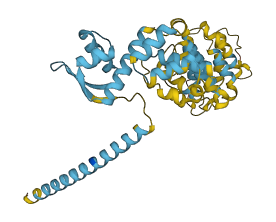
Descriptions
The autoinhibited protein was predicted that may have potential autoinhibitory elements via cis-regPred.
Autoinhibitory domains (AIDs)
Target domain |
|
Relief mechanism |
|
Assay |
cis-regPred |
Accessory elements
No accessory elements
Autoinhibited structure

Activated structure
1 structures for Q7JVI3
| Entry ID | Method | Resolution | Chain | Position | Source |
|---|---|---|---|---|---|
| AF-Q7JVI3-F1 | Predicted | AlphaFoldDB |
No variants for Q7JVI3
| Variant ID(s) | Position | Change | Description | Diseaes Association | Provenance |
|---|---|---|---|---|---|
| No variants for Q7JVI3 | |||||
No associated diseases with Q7JVI3
7 GO annotations of cellular component
| Name | Definition |
|---|---|
| cytosol | The part of the cytoplasm that does not contain organelles but which does contain other particulate matter, such as protein complexes. |
| eukaryotic 43S preinitiation complex | A protein complex composed of the 40S ribosomal subunit plus eIF1A, eIF3, and eIF2-GTP-bound methionyl-initiator methionine tRNA. |
| eukaryotic 48S preinitiation complex | A protein complex composed of the small ribosomal subunit, eIF3, eIF1A, methionyl-initiatior methionine and a capped mRNA. The complex is initially positioned at the 5'-end of the capped mRNA. |
| eukaryotic translation initiation factor 3 complex | A complex of several polypeptides that plays at least two important roles in protein synthesis: First, eIF3 binds to the 40S ribosome and facilitates loading of the Met-tRNA/eIF2.GTP ternary complex to form the 43S preinitiation complex. Subsequently, eIF3 apparently assists eIF4 in recruiting mRNAs to the 43S complex. The eIF3 complex contains five conserved core subunits, and may contain several additional proteins; the non-core subunits are thought to mediate association of the complex with specific sets of mRNAs. |
| eukaryotic translation initiation factor 3 complex, eIF3m | An eukaryotic translation initiation factor 3 complex that contains the PCI-domain protein eIF3m. |
| Golgi apparatus | A membrane-bound cytoplasmic organelle of the endomembrane system that further processes the core oligosaccharides (e.g. N-glycans) added to proteins in the endoplasmic reticulum and packages them into membrane-bound vesicles. The Golgi apparatus operates at the intersection of the secretory, lysosomal, and endocytic pathways. |
| investment cone | A cytoskeletal part that consists of a microfilament-rich cone that forms round each nucleus in a spermatogenic cyst and translocates the length of the cyst during sperm individualization. |
3 GO annotations of molecular function
| Name | Definition |
|---|---|
| caspase binding | Binding to a caspase family protein. |
| translation initiation factor activity | Functions in the initiation of ribosome-mediated translation of mRNA into a polypeptide. |
| translation initiation factor binding | Binding to a translation initiation factor, any polypeptide factor involved in the initiation of ribosome-mediated translation. |
8 GO annotations of biological process
| Name | Definition |
|---|---|
| activation of cysteine-type endopeptidase activity | Any process that initiates the activity of the inactive enzyme cysteine-type endopeptidase. |
| cytoplasmic translational initiation | The process preceding formation of the peptide bond between the first two amino acids of a protein in the cytoplasm. This includes the formation of a complex of the ribosome, mRNA or circRNA, and an initiation complex that contains the first aminoacyl-tRNA. |
| formation of cytoplasmic translation initiation complex | Joining of the large subunit, with release of IF2/eIF2 and IF3/eIF3. This leaves the functional ribosome at the AUG, with the methionyl/formyl-methionyl-tRNA positioned at the P site. |
| Golgi organization | A process that is carried out at the cellular level which results in the assembly, arrangement of constituent parts, or disassembly of the Golgi apparatus. |
| positive regulation of cysteine-type endopeptidase activity involved in execution phase of apoptosis | Any process that activates or increases the frequency, rate or extent of cysteine-type endopeptidase activity involved in execution phase of apoptosis. |
| protein secretion | The controlled release of proteins from a cell. |
| sperm individualization | The resolution of the male germline syncytium or cyst into individual gametes by packaging each spermatid into its own plasma membrane. |
| translation | The cellular metabolic process in which a protein is formed, using the sequence of a mature mRNA or circRNA molecule to specify the sequence of amino acids in a polypeptide chain. Translation is mediated by the ribosome, and begins with the formation of a ternary complex between aminoacylated initiator methionine tRNA, GTP, and initiation factor 2, which subsequently associates with the small subunit of the ribosome and an mRNA or circRNA. Translation ends with the release of a polypeptide chain from the ribosome. |
No homologous proteins in AiPD
| UniProt AC | Gene Name | Protein Name | Species | Evidence Code |
|---|---|---|---|---|
| No homologous proteins | ||||
| 10 | 20 | 30 | 40 | 50 | 60 |
| MTSHPVFIDL | SLDEQVQELR | KYFKKLGAEI | SSEKSNKGVE | DDLHKIIGVC | DVCFKDGEPS |
| 70 | 80 | 90 | 100 | 110 | 120 |
| QIDGILNSIV | SIMITIPLDR | GENIVLAYCE | KMTKAPNLPL | GKVCLQSLWR | LFNNLDTASP |
| 130 | 140 | 150 | 160 | 170 | 180 |
| LRYHVYYHLV | QVAKQCEQVL | EVFSGVDQLK | SQFANCPPSS | EQMQKLYRLL | HDVTKDTNLE |
| 190 | 200 | 210 | 220 | 230 | 240 |
| LSSKVMIELL | GTYTADNACV | AREDAMKCIV | TALADPNTFL | LDPLLSLKPV | RFLEGDLIHD |
| 250 | 260 | 270 | 280 | 290 | 300 |
| LLSIFVSEKL | PAYVQFYEDH | REFVNSQGLN | HEQNMKKMRL | LTFMQLAESS | PEMTFETLTK |
| 310 | 320 | 330 | 340 | 350 | 360 |
| ELQINEDEVE | PFVIEVLKTK | LVRARLDQAN | QKVHISSTMH | RTFGAPQWEQ | LRDLLQAWKE |
| 370 | 380 | ||||
| NLSTVREGLT | SVSSAQLDLA | RSQKLIH |