Q7CKM4
Gene name |
queG |
Protein name |
Epoxyqueuosine reductase |
Names |
Queuosine biosynthesis protein QueG |
Species |
Yersinia pestis |
KEGG Pathway |
ypm:YP_0523 |
EC number |
1.17.99.6: With other acceptors |
Protein Class |
|
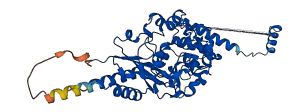
Descriptions
The autoinhibited protein was predicted that may have potential autoinhibitory elements via cis-regPred.
Autoinhibitory domains (AIDs)
Target domain |
|
Relief mechanism |
|
Assay |
cis-regPred |
Accessory elements
No accessory elements
Autoinhibited structure

Activated structure
1 structures for Q7CKM4
| Entry ID | Method | Resolution | Chain | Position | Source |
|---|---|---|---|---|---|
| AF-Q7CKM4-F1 | Predicted | AlphaFoldDB |
No variants for Q7CKM4
| Variant ID(s) | Position | Change | Description | Diseaes Association | Provenance |
|---|---|---|---|---|---|
| No variants for Q7CKM4 | |||||
No associated diseases with Q7CKM4
3 regional properties for Q7CKM4
Functions
| Description | ||
|---|---|---|
| EC Number | 1.17.99.6 | With other acceptors |
| Subcellular Localization |
|
|
| PANTHER Family | ||
| PANTHER Subfamily | ||
| PANTHER Protein Class | ||
| PANTHER Pathway Category | No pathway information available | |
1 GO annotations of cellular component
| Name | Definition |
|---|---|
| cytoplasm | The contents of a cell excluding the plasma membrane and nucleus, but including other subcellular structures. |
3 GO annotations of molecular function
| Name | Definition |
|---|---|
| 4 iron, 4 sulfur cluster binding | Binding to a 4 iron, 4 sulfur (4Fe-4S) cluster; this cluster consists of four iron atoms, with the inorganic sulfur atoms found between the irons and acting as bridging ligands. |
| epoxyqueuosine reductase activity | Catalysis of the reaction: epoxyqueuosine in tRNA + reductant = queuosine in tRNA + oxidised reductant. |
| metal ion binding | Binding to a metal ion. |
2 GO annotations of biological process
| Name | Definition |
|---|---|
| queuosine biosynthetic process | The chemical reactions and pathways resulting in the formation of queuosines, a series of nucleosides found in tRNA and having an additional pentenyl ring added via an NH group to the methyl group of 7-methylguanosine. The pentenyl ring may carry other substituents. |
| tRNA processing | The process in which a pre-tRNA molecule is converted to a mature tRNA, ready for addition of an aminoacyl group. |
No homologous proteins in AiPD
| UniProt AC | Gene Name | Protein Name | Species | Evidence Code |
|---|---|---|---|---|
| No homologous proteins | ||||
| 10 | 20 | 30 | 40 | 50 | 60 |
| MAHPLDLNQL | AQHIKQWGQS | LGFQQVGICD | TDLTAEEPRL | QAWLDKQYHG | EMAWMARHGM |
| 70 | 80 | 90 | 100 | 110 | 120 |
| LRARPHELLP | GTLRVISVRM | NYLPAKAAFA | STLNNPELGY | VSRYALGRDY | HKLLRQRLKK |
| 130 | 140 | 150 | 160 | 170 | 180 |
| LGDQIQHYCL | EQNNLDRHDL | ELHDLEQHDS | ERQGQPEQHT | ASEINFRPFV | DSAPIMERSL |
| 190 | 200 | 210 | 220 | 230 | 240 |
| AAKAGIGWVG | KHSLILNRDA | GSWFFLGELL | IDLPLPVDKP | QEEQCGRCVA | CMTTCPTGAI |
| 250 | 260 | 270 | 280 | 290 | 300 |
| VAPYTVDARR | CISYLTIELE | GAIPEEFRPL | MGNRIYGCDD | CQLICPWNRF | SQLTDEDDFS |
| 310 | 320 | 330 | 340 | 350 | 360 |
| PRAVLHTPQL | LDLFAWNEEK | FLRVTEGSAI | RRIGHLRWLR | NISVALGNAP | YLDSIVLALE |
| 370 | 380 | 390 | 400 | 410 | |
| TRRGLHPMLD | EHIEWAISQQ | LARRATQAVE | VQLPQKKRLI | RAIEKGLPRD | A |