Descriptions
The autoinhibited protein was predicted that may have potential autoinhibitory elements via cis-regPred.
Autoinhibitory domains (AIDs)
Target domain |
|
Relief mechanism |
|
Assay |
cis-regPred |
Accessory elements
No accessory elements
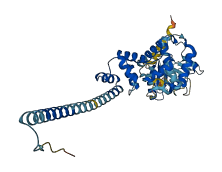
Autoinhibited structure

Activated structure
1 structures for Q76MZ1
| Entry ID | Method | Resolution | Chain | Position | Source |
|---|---|---|---|---|---|
| AF-Q76MZ1-F1 | Predicted | AlphaFoldDB |
No variants for Q76MZ1
| Variant ID(s) | Position | Change | Description | Diseaes Association | Provenance |
|---|---|---|---|---|---|
| No variants for Q76MZ1 | |||||
No associated diseases with Q76MZ1
Functions
4 GO annotations of cellular component
| Name | Definition |
|---|---|
| adherens junction | A cell-cell junction composed of the epithelial cadherin-catenin complex. The epithelial cadherins, or E-cadherins, of each interacting cell extend through the plasma membrane into the extracellular space and bind to each other. The E-cadherins bind to catenins on the cytoplasmic side of the membrane, where the E-cadherin-catenin complex binds to cytoskeletal components and regulatory and signaling molecules. |
| bicellular tight junction | An occluding cell-cell junction that is composed of a branching network of sealing strands that completely encircles the apical end of each cell in an epithelial sheet; the outer leaflets of the two interacting plasma membranes are seen to be tightly apposed where sealing strands are present. Each sealing strand is composed of a long row of transmembrane adhesion proteins embedded in each of the two interacting plasma membranes. |
| cytosol | The part of the cytoplasm that does not contain organelles but which does contain other particulate matter, such as protein complexes. |
| extrinsic component of cytoplasmic side of plasma membrane | The component of a plasma membrane consisting of gene products and protein complexes that are loosely bound to its cytoplasmic surface, but not integrated into the hydrophobic region. |
2 GO annotations of molecular function
| Name | Definition |
|---|---|
| guanyl-nucleotide exchange factor activity | Stimulates the exchange of GDP to GTP on a signaling GTPase, changing its conformation to its active form. Guanine nucleotide exchange factors (GEFs) act by stimulating the release of guanosine diphosphate (GDP) to allow binding of guanosine triphosphate (GTP), which is more abundant in the cell under normal cellular physiological conditions. |
| lipid binding | Binding to a lipid. |
1 GO annotations of biological process
| Name | Definition |
|---|---|
| regulation of ARF protein signal transduction | Any process that modulates the frequency, rate or extent of ARF protein signal transduction. |
No homologous proteins in AiPD
| UniProt AC | Gene Name | Protein Name | Species | Evidence Code |
|---|---|---|---|---|
| No homologous proteins | ||||
| 10 | 20 | 30 | 40 | 50 | 60 |
| MEEDDSYVPS | DLTAEERQEL | ENIRRRKQEL | LADIQRLKDE | IAEVANEIEN | LGSTEERKNM |
| 70 | 80 | 90 | 100 | 110 | 120 |
| QRNKQVAMGR | KKFNMDPKKG | IQFLIENDLL | KNTCEDIAQF | LYKGEGLNKT | AIGDYLGERD |
| 130 | 140 | 150 | 160 | 170 | 180 |
| EFNIQVLHAF | VELHEFTDLN | LVQALRQFLW | SFRLPGEAQK | IDRMMEAFAQ | RYCQCNNGVF |
| 190 | 200 | 210 | 220 | 230 | 240 |
| QSTDTCYVLS | FAIIMLNTSL | HNPNVKDKPT | VERFIAMNRG | INDGGDLPEE | LLRNLYESIK |
| 250 | 260 | 270 | 280 | 290 | 300 |
| NEPFKIPEDD | GNDLTHTFFN | PDREGWLLKL | GGGRVKTWKR | RWFILTDNCL | YYFEYTTDKE |
| 310 | 320 | 330 | 340 | 350 | 360 |
| PRGIIPLENL | SIREVEDSKK | PNCFELYIPD | NKDQVIKACK | TEADGRVVEG | NHTVYRISAP |
| 370 | 380 | 390 | |||
| TPEEKEEWIK | CIKAAISRDP | FYEMLAARKK | KVSSTKRH |