Q75DC6
Gene name |
CSM3 (ABR100W) |
Protein name |
Chromosome segregation in meiosis protein 3 |
Names |
|
Species |
Ashbya gossypii (strain ATCC 10895 / CBS 109.51 / FGSC 9923 / NRRL Y-1056) (Yeast) (Eremothecium gossypii) |
KEGG Pathway |
ago:AGOS_ABR100W |
EC number |
|
Protein Class |
|
Descriptions
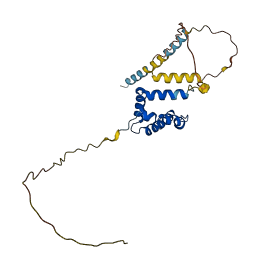
The autoinhibited protein was predicted that may have potential autoinhibitory elements via cis-regPred.
Autoinhibitory domains (AIDs)
Target domain |
|
Relief mechanism |
|
Assay |
cis-regPred |
Accessory elements
No accessory elements
Autoinhibited structure

Activated structure
1 structures for Q75DC6
| Entry ID | Method | Resolution | Chain | Position | Source |
|---|---|---|---|---|---|
| AF-Q75DC6-F1 | Predicted | AlphaFoldDB |
No variants for Q75DC6
| Variant ID(s) | Position | Change | Description | Diseaes Association | Provenance |
|---|---|---|---|---|---|
| No variants for Q75DC6 | |||||
No associated diseases with Q75DC6
1 regional properties for Q75DC6
| Type | Name | Position | InterPro Accession |
|---|---|---|---|
| domain | Chromosome segregation in meiosis protein 3 | 44 - 127 | IPR012923 |
1 GO annotations of cellular component
| Name | Definition |
|---|---|
| replication fork protection complex | A protein complex conserved in eukaryotes and associated with the replication fork; the complex stabilizes stalled replication forks and is thought to be involved in coordinating leading- and lagging-strand synthesis and in replication checkpoint signaling. |
1 GO annotations of molecular function
| Name | Definition |
|---|---|
| DNA binding | Any molecular function by which a gene product interacts selectively and non-covalently with DNA (deoxyribonucleic acid). |
7 GO annotations of biological process
| Name | Definition |
|---|---|
| DNA repair | The process of restoring DNA after damage. Genomes are subject to damage by chemical and physical agents in the environment (e.g. UV and ionizing radiations, chemical mutagens, fungal and bacterial toxins, etc.) and by free radicals or alkylating agents endogenously generated in metabolism. DNA is also damaged because of errors during its replication. A variety of different DNA repair pathways have been reported that include direct reversal, base excision repair, nucleotide excision repair, photoreactivation, bypass, double-strand break repair pathway, and mismatch repair pathway. |
| DNA replication checkpoint signaling | A signal transduction process that contributes to a DNA replication checkpoint, that prevents the initiation of nuclear division until DNA replication is complete, thereby ensuring that progeny inherit a full complement of the genome. |
| establishment of mitotic sister chromatid cohesion | The process in which the sister chromatids of a replicated chromosome become joined along the entire length of the chromosome during S phase during a mitotic cell cycle. |
| maintenance of DNA repeat elements | Any process involved in sustaining the fidelity and copy number of DNA repeat elements. |
| meiotic chromosome segregation | The process in which genetic material, in the form of chromosomes, is organized into specific structures and then physically separated and apportioned to two or more sets during M phase of the meiotic cell cycle. |
| replication fork arrest | Any process that stops, prevents, or reduces the frequency, rate or extent of DNA replication by impeding the progress of the DNA replication fork. Replication fork arrest is one of the 'quality control' processes ensuring that DNA-dependent DNA replication occurs correctly. DNA replication fork arrest during DNA-dependent DNA replication is not known to occur outside of cases where a replication error needs to be prevented or corrected. |
| replication fork protection | Any process that prevents the collapse of stalled replication forks. |
No homologous proteins in AiPD
| UniProt AC | Gene Name | Protein Name | Species | Evidence Code |
|---|---|---|---|---|
| No homologous proteins | ||||
| 10 | 20 | 30 | 40 | 50 | 60 |
| MSSVGPLEDE | AAGTELGGSP | ADPATLTEID | PSAIQVRKTR | TVVKLDCERL | VSKKGLPYLL |
| 70 | 80 | 90 | 100 | 110 | 120 |
| KNAPKHARIS | KRRDTYGNLC | HVLQFYQLWA | HELYPKAKFK | DFVALCDRLG | KTDRQLRAYR |
| 130 | 140 | 150 | 160 | 170 | 180 |
| MQLIREELGL | AAEGLDPPPQ | PLREHTGAGG | SQPAGSVAQD | TNTNADLSDD | DLLYTTSRAA |
| 190 | 200 | 210 | 220 | 230 | |
| AASSTANPVP | RSETPAALAG | VDEAELLAQL | AEMQRAAEED | VHESEDDEQL | ALMREMDEFM |