Q75BS7
Gene name |
ACR194C |
Protein name |
DNA damage-binding protein CMR1 |
Names |
|
Species |
Ashbya gossypii (strain ATCC 10895 / CBS 109.51 / FGSC 9923 / NRRL Y-1056) (Yeast) (Eremothecium gossypii) |
KEGG Pathway |
ago:AGOS_ACR194C |
EC number |
|
Protein Class |
|
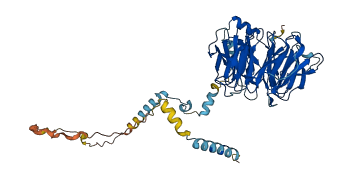
Descriptions
The autoinhibited protein was predicted that may have potential autoinhibitory elements via cis-regPred.
Autoinhibitory domains (AIDs)
Target domain |
|
Relief mechanism |
|
Assay |
cis-regPred |
Accessory elements
No accessory elements
Autoinhibited structure

Activated structure
1 structures for Q75BS7
| Entry ID | Method | Resolution | Chain | Position | Source |
|---|---|---|---|---|---|
| AF-Q75BS7-F1 | Predicted | AlphaFoldDB |
No variants for Q75BS7
| Variant ID(s) | Position | Change | Description | Diseaes Association | Provenance |
|---|---|---|---|---|---|
| No variants for Q75BS7 | |||||
No associated diseases with Q75BS7
6 regional properties for Q75BS7
| Type | Name | Position | InterPro Accession |
|---|---|---|---|
| repeat | WD40 repeat | 177 - 215 | IPR001680-1 |
| repeat | WD40 repeat | 228 - 268 | IPR001680-2 |
| repeat | WD40 repeat | 320 - 362 | IPR001680-3 |
| repeat | WD40 repeat | 378 - 416 | IPR001680-4 |
| repeat | WD40 repeat | 470 - 508 | IPR001680-5 |
| conserved_site | WD40 repeat, conserved site | 347 - 361 | IPR019775 |
4 GO annotations of cellular component
| Name | Definition |
|---|---|
| chromatin | The ordered and organized complex of DNA, protein, and sometimes RNA, that forms the chromosome. |
| cytoplasm | The contents of a cell excluding the plasma membrane and nucleus, but including other subcellular structures. |
| nuclear periphery | The portion of the nuclear lumen proximal to the inner nuclear membrane. |
| nucleus | A membrane-bounded organelle of eukaryotic cells in which chromosomes are housed and replicated. In most cells, the nucleus contains all of the cell's chromosomes except the organellar chromosomes, and is the site of RNA synthesis and processing. In some species, or in specialized cell types, RNA metabolism or DNA replication may be absent. |
1 GO annotations of molecular function
| Name | Definition |
|---|---|
| DNA binding | Any molecular function by which a gene product interacts selectively and non-covalently with DNA (deoxyribonucleic acid). |
2 GO annotations of biological process
| Name | Definition |
|---|---|
| cellular response to DNA damage stimulus | Any process that results in a change in state or activity of a cell (in terms of movement, secretion, enzyme production, gene expression, etc.) as a result of a stimulus indicating damage to its DNA from environmental insults or errors during metabolism. |
| regulation of DNA damage checkpoint | Any process that modulates the frequency, rate or extent of a DNA damage checkpoint. |
No homologous proteins in AiPD
| UniProt AC | Gene Name | Protein Name | Species | Evidence Code |
|---|---|---|---|---|
| No homologous proteins | ||||
| 10 | 20 | 30 | 40 | 50 | 60 |
| MTANSEFNKR | RLENIKRNNE | LLKKLNLAGI | PARIRSEAGI | EDHRKASGGA | VKKKQGKAPV |
| 70 | 80 | 90 | 100 | 110 | 120 |
| KREAKPAPIP | TRRSRRLRGE | AADVEGEAGA | GSDTAQNVKQ | EEEWKELKEA | RVVGDIKLSD |
| 130 | 140 | 150 | 160 | 170 | 180 |
| LIKSEDDGEL | LEKFRRYADK | SFSGGDFFEE | LQRHQKPNPE | VQRLREEMRL | QQYDVFDPKE |
| 190 | 200 | 210 | 220 | 230 | 240 |
| LAIVHERVTA | LCFHPSQEKK | LIVGGDTAGT | VGLWNVADEN | PDPEHPDSVP | DITRFKLFSR |
| 250 | 260 | 270 | 280 | 290 | 300 |
| NVSKIEVFPT | DSSKILAASY | DGALRSIDMQ | SLKSDELLHF | QNEHGDTLGI | SDCQFSYDSP |
| 310 | 320 | 330 | 340 | 350 | 360 |
| NVVMLTTLGG | EFAQRDLRTK | PDTMNIMRLS | DKKIGCMAID | PSRPYSVATA | SLDRTLRIWD |
| 370 | 380 | 390 | 400 | 410 | 420 |
| LRKTVAKPDW | SQYEDYASHE | VVSTYNSRLS | VSAVSYAPID | HTLVCNGYDN | TVRLFNARAD |
| 430 | 440 | 450 | 460 | 470 | 480 |
| LPSELQPDFT | IQHNCKSGRW | VSVLKARFKL | NMDVFAIANM | KRAIDIYTSR | GEQLSHLETS |
| 490 | 500 | 510 | |||
| TVPAVVSWHP | MQNWIVGGNN | SGKVFLFTDA | PQE |