Q75BS4
Gene name |
DHH1 (ACR197W) |
Protein name |
ATP-dependent RNA helicase DHH1 |
Names |
|
Species |
Ashbya gossypii (strain ATCC 10895 / CBS 109.51 / FGSC 9923 / NRRL Y-1056) (Yeast) (Eremothecium gossypii) |
KEGG Pathway |
ago:AGOS_ACR197W |
EC number |
3.6.4.13: Acting on ATP; involved in cellular and subcellular movement |
Protein Class |
|
Descriptions
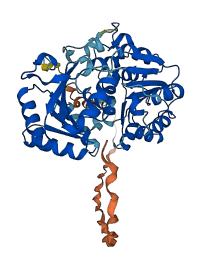
The autoinhibited protein was predicted that may have potential autoinhibitory elements via cis-regPred.
Autoinhibitory domains (AIDs)
Target domain |
|
Relief mechanism |
|
Assay |
cis-regPred |
Accessory elements
No accessory elements
Autoinhibited structure

Activated structure
1 structures for Q75BS4
| Entry ID | Method | Resolution | Chain | Position | Source |
|---|---|---|---|---|---|
| AF-Q75BS4-F1 | Predicted | AlphaFoldDB |
No variants for Q75BS4
| Variant ID(s) | Position | Change | Description | Diseaes Association | Provenance |
|---|---|---|---|---|---|
| No variants for Q75BS4 | |||||
No associated diseases with Q75BS4
5 regional properties for Q75BS4
| Type | Name | Position | InterPro Accession |
|---|---|---|---|
| conserved_site | ATP-dependent RNA helicase DEAD-box, conserved site | 176 - 184 | IPR000629 |
| domain | Helicase, C-terminal | 240 - 400 | IPR001650 |
| domain | DEAD/DEAH box helicase domain | 54 - 218 | IPR011545 |
| domain | Helicase superfamily 1/2, ATP-binding domain | 48 - 244 | IPR014001 |
| domain | RNA helicase, DEAD-box type, Q motif | 29 - 57 | IPR014014 |
Functions
| Description | ||
|---|---|---|
| EC Number | 3.6.4.13 | Acting on ATP; involved in cellular and subcellular movement |
| Subcellular Localization |
|
|
| PANTHER Family | ||
| PANTHER Subfamily | ||
| PANTHER Protein Class | ||
| PANTHER Pathway Category | No pathway information available | |
3 GO annotations of cellular component
| Name | Definition |
|---|---|
| cytoplasmic side of membrane | The side of a membrane that faces the cytoplasm. |
| cytoplasmic stress granule | A dense aggregation in the cytosol composed of proteins and RNAs that appear when the cell is under stress. |
| P-body | A focus in the cytoplasm where mRNAs may become inactivated by decapping or some other mechanism. Protein and RNA localized to these foci are involved in mRNA degradation, nonsense-mediated mRNA decay (NMD), translational repression, and RNA-mediated gene silencing. |
5 GO annotations of molecular function
| Name | Definition |
|---|---|
| ATP binding | Binding to ATP, adenosine 5'-triphosphate, a universally important coenzyme and enzyme regulator. |
| ATP hydrolysis activity | Catalysis of the reaction: ATP + H2O = ADP + H+ phosphate. ATP hydrolysis is used in some reactions as an energy source, for example to catalyze a reaction or drive transport against a concentration gradient. |
| chromatin binding | Binding to chromatin, the network of fibers of DNA, protein, and sometimes RNA, that make up the chromosomes of the eukaryotic nucleus during interphase. |
| mRNA binding | Binding to messenger RNA (mRNA), an intermediate molecule between DNA and protein. mRNA includes UTR and coding sequences, but does not contain introns. |
| RNA helicase activity | Unwinding of an RNA helix, driven by ATP hydrolysis. |
9 GO annotations of biological process
| Name | Definition |
|---|---|
| deadenylation-dependent decapping of nuclear-transcribed mRNA | Cleavage of the 5'-cap of a nuclear mRNA triggered by shortening of the poly(A) tail to below a minimum functional length. |
| mRNA processing | Any process involved in the conversion of a primary mRNA transcript into one or more mature mRNA(s) prior to translation into polypeptide. |
| mRNA transport | The directed movement of mRNA, messenger ribonucleic acid, into, out of or within a cell, or between cells, by means of some agent such as a transporter or pore. |
| negative regulation of translation | Any process that stops, prevents, or reduces the frequency, rate or extent of the chemical reactions and pathways resulting in the formation of proteins by the translation of mRNA or circRNA. |
| negative regulation of translational elongation | Any process that stops, prevents, or reduces the frequency, rate or extent of translational elongation. |
| P-body assembly | The aggregation, arrangement and bonding together of proteins and RNA molecules to form a cytoplasmic mRNA processing body. |
| positive regulation of translation | Any process that activates or increases the frequency, rate or extent of the chemical reactions and pathways resulting in the formation of proteins by the translation of mRNA or circRNA. |
| regulation of cytoplasmic mRNA processing body assembly | Any process that modulates the rate, frequency, or extent of the aggregation, arrangement and bonding together of proteins and RNA molecules to form a cytoplasmic mRNA processing body. |
| stress granule assembly | The aggregation, arrangement and bonding together of proteins and RNA molecules to form a stress granule. |
No homologous proteins in AiPD
| UniProt AC | Gene Name | Protein Name | Species | Evidence Code |
|---|---|---|---|---|
| No homologous proteins | ||||
| 10 | 20 | 30 | 40 | 50 | 60 |
| MSEDWKKKLN | IPKKDTRPQT | DDVLNTKGNT | FEDFYLRREL | LMGIFEAGFE | RPSPIQEEAI |
| 70 | 80 | 90 | 100 | 110 | 120 |
| PIALARRDIL | ARAKNGTGKT | AAFVIPTLEI | VKPKVNKIQA | LIMVPTRELA | LQTSQVVRTL |
| 130 | 140 | 150 | 160 | 170 | 180 |
| GKHCGISCMV | TTGGTNLRDD | IMRLNEPVHV | LVGTPGRVLD | LASRKVADLS | ECSLFVMDEA |
| 190 | 200 | 210 | 220 | 230 | 240 |
| DKMLSRDFKS | LVEQILSFLP | QNHQSLLFSA | TFPLTVKEFM | VKHLNKPYEI | NLMDELTLKG |
| 250 | 260 | 270 | 280 | 290 | 300 |
| ITQYYAFVEE | RQKLHCLNTL | FSKLQINQAI | IFCNSTNRVE | LLAKKITDLG | YSCYYSHARM |
| 310 | 320 | 330 | 340 | 350 | 360 |
| KQQERNKVFH | EFRQGKVRTL | VCSDLLTRGI | DIQAVNVVIN | FDFPKTAETY | LHRIGRSGRF |
| 370 | 380 | 390 | 400 | 410 | 420 |
| GHLGLAINLI | NWNDRFNLYK | IEQELGTEIA | AIPAQIDKSL | YVAEDTSAVP | VPFPLDTMQG |
| 430 | 440 | 450 | 460 | 470 | 480 |
| NARAAQQMPH | PQQQAQLGGM | PQPIPQQIQP | PLAHQQAQPP | PQVYPPQMYH | QGIPPQQFAN |
| PPQF |