Q759H4
Gene name |
PEX3 (ADR296C) |
Protein name |
Peroxisomal biogenesis factor 3 |
Names |
Peroxin-3 |
Species |
Ashbya gossypii (strain ATCC 10895 / CBS 109.51 / FGSC 9923 / NRRL Y-1056) (Yeast) (Eremothecium gossypii) |
KEGG Pathway |
ago:AGOS_ADR296C |
EC number |
|
Protein Class |
|
Descriptions
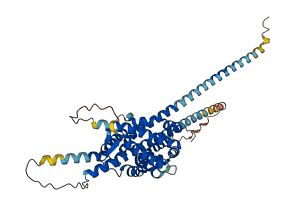
The autoinhibited protein was predicted that may have potential autoinhibitory elements via cis-regPred.
Autoinhibitory domains (AIDs)
Target domain |
|
Relief mechanism |
|
Assay |
cis-regPred |
Accessory elements
No accessory elements
Autoinhibited structure

Activated structure
1 structures for Q759H4
| Entry ID | Method | Resolution | Chain | Position | Source |
|---|---|---|---|---|---|
| AF-Q759H4-F1 | Predicted | AlphaFoldDB |
No variants for Q759H4
| Variant ID(s) | Position | Change | Description | Diseaes Association | Provenance |
|---|---|---|---|---|---|
| No variants for Q759H4 | |||||
No associated diseases with Q759H4
No regional properties for Q759H4
| Type | Name | Position | InterPro Accession |
|---|---|---|---|
| No domain, repeats, and functional sites for Q759H4 | |||
2 GO annotations of cellular component
| Name | Definition |
|---|---|
| endoplasmic reticulum | The irregular network of unit membranes, visible only by electron microscopy, that occurs in the cytoplasm of many eukaryotic cells. The membranes form a complex meshwork of tubular channels, which are often expanded into slitlike cavities called cisternae. The ER takes two forms, rough (or granular), with ribosomes adhering to the outer surface, and smooth (with no ribosomes attached). |
| integral component of peroxisomal membrane | The component of the peroxisomal membrane consisting of the gene products and protein complexes having at least some part of their peptide sequence embedded in the hydrophobic region of the membrane. |
1 GO annotations of molecular function
| Name | Definition |
|---|---|
| protein-macromolecule adaptor activity | The binding activity of a protein that brings together two or more macromolecules in contact, permitting those molecules to function in a coordinated way. The adaptor can bring together two proteins, or a protein and another macromolecule such as a lipid or a nucleic acid. |
3 GO annotations of biological process
| Name | Definition |
|---|---|
| ER-dependent peroxisome organization | A process of peroxisome organization in which assembly or arrangement of constituent parts takes place in the endoplasmic reticulum. |
| peroxisome inheritance | The acquisition of peroxisomes by daughter cells from the mother cell after replication. In Saccharomyces cerevisiae, the number of peroxisomes cells is fairly constant; a subset of the organelles are targeted and segregated to the bud in a highly ordered, vectorial process. Efficient segregation of peroxisomes from mother to bud is dependent on the actin cytoskeleton, and active movement of peroxisomes along actin filaments is driven by the class V myosin motor protein, Myo2p. |
| protein import into peroxisome membrane | The targeting of proteins into the peroxisomal membrane. The process is not well understood, but both signals and mechanism differ from those involved in peroxisomal matrix protein import. |
No homologous proteins in AiPD
| UniProt AC | Gene Name | Protein Name | Species | Evidence Code |
|---|---|---|---|---|
| No homologous proteins | ||||
| 10 | 20 | 30 | 40 | 50 | 60 |
| MARTGLQRHR | GKLLGTGAVL | GGLVVAGVVA | AVAAKRWVRR | QQQRLSEQHY | VREQIKRRFT |
| 70 | 80 | 90 | 100 | 110 | 120 |
| QTQQDALYTM | YELVPVLALV | LGKELDVEEL | VETLKGKKLK | RAGEDDEQGS | GGHASAGEGS |
| 130 | 140 | 150 | 160 | 170 | 180 |
| VSSTVARSKA | ELWQELKMRS | AVKLLAVVYT | TCMLLLLTRL | QLNILARREY | LETAIRVAKG |
| 190 | 200 | 210 | 220 | 230 | 240 |
| EEATRRDAAG | WLGAVWEYGA | AALGALGPRP | AVTAVEPVDQ | HEETRYVNEQ | AFLSLSWWLL |
| 250 | 260 | 270 | 280 | 290 | 300 |
| NRGWLQFKPL | IERQVEQQFG | TLSPRDTLSM | EQFSARLSNT | IHAVNRELFD | SDSRALLLRA |
| 310 | 320 | 330 | 340 | 350 | 360 |
| LLPDATEELH | VLQQTLDEGS | LRVIERDDSM | LRELLQETCR | CAESTASLIV | LESLVNESFQ |
| 370 | 380 | 390 | 400 | 410 | 420 |
| FVMQQLETKV | TKKLRKPATD | APEADGAADA | PSQKFQVALY | SVALKDCCQE | MLKNGLVSMN |
| 430 | 440 | ||||
| NEYLQDLDAV | PELDDLSASV | YSNFGV |