Q757L1
Gene name |
NTH2 (AER001C) |
Protein name |
Probable trehalase |
Names |
Alpha,alpha-trehalase, Alpha,alpha-trehalose glucohydrolase |
Species |
Ashbya gossypii (strain ATCC 10895 / CBS 109.51 / FGSC 9923 / NRRL Y-1056) (Yeast) (Eremothecium gossypii) |
KEGG Pathway |
ago:AGOS_AER001C |
EC number |
3.2.1.28: Glycosidases, ie enzymes hydrolyzing O- and S-glycosyl compounds |
Protein Class |
|
Descriptions
The autoinhibited protein was predicted that may have potential autoinhibitory elements via cis-regPred.
Autoinhibitory domains (AIDs)
Target domain |
|
Relief mechanism |
|
Assay |
cis-regPred |
Accessory elements
No accessory elements
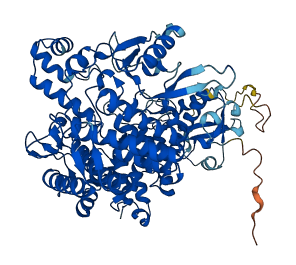
Autoinhibited structure

Activated structure
1 structures for Q757L1
| Entry ID | Method | Resolution | Chain | Position | Source |
|---|---|---|---|---|---|
| AF-Q757L1-F1 | Predicted | AlphaFoldDB |
No variants for Q757L1
| Variant ID(s) | Position | Change | Description | Diseaes Association | Provenance |
|---|---|---|---|---|---|
| No variants for Q757L1 | |||||
No associated diseases with Q757L1
3 regional properties for Q757L1
| Type | Name | Position | InterPro Accession |
|---|---|---|---|
| domain | Neutral trehalase Ca2+ binding | 93 - 122 | IPR011120 |
| conserved_site | Glycoside hydrolase, family 37, conserved site | 286 - 299 | IPR018232-1 |
| conserved_site | Glycoside hydrolase, family 37, conserved site | 609 - 618 | IPR018232-2 |
Functions
| Description | ||
|---|---|---|
| EC Number | 3.2.1.28 | Glycosidases, ie enzymes hydrolyzing O- and S-glycosyl compounds |
| Subcellular Localization |
|
|
| PANTHER Family | ||
| PANTHER Subfamily | ||
| PANTHER Protein Class | ||
| PANTHER Pathway Category | No pathway information available | |
1 GO annotations of cellular component
| Name | Definition |
|---|---|
| alpha,alpha-trehalose-phosphate synthase complex (UDP-forming) | A protein complex that possesses alpha,alpha-trehalose-phosphate synthase (UDP-forming) and trehalose-phosphatase activities, and thus catalyzes two reactions in trehalose biosynthesis. In the complex identified in Saccharomyces, Tps1p has alpha,alpha-trehalose-phosphate synthase (UDP-forming) activity, Tps2p has trehalose 6-phosphate phosphatase activity; Tps3p is a regulatory subunit, and an additional subunit, Tsl1p, may be present. |
2 GO annotations of molecular function
| Name | Definition |
|---|---|
| alpha,alpha-trehalase activity | Catalysis of the reaction: alpha,alpha-trehalose + H2O = 2 D-glucose. |
| calcium ion binding | Binding to a calcium ion (Ca2+). |
2 GO annotations of biological process
| Name | Definition |
|---|---|
| ascospore formation | The process in which cells that are products of meiosis acquire the specialized features of ascospores. Ascospores are generally found in clusters of four or eight spores within a single mother cell, the ascus, and are characteristic of the ascomycete fungi (phylum Ascomycota). |
| trehalose catabolic process | The chemical reactions and pathways resulting in the breakdown of trehalose, a disaccharide isomeric with sucrose and obtained from certain lichens and fungi. |
No homologous proteins in AiPD
| UniProt AC | Gene Name | Protein Name | Species | Evidence Code |
|---|---|---|---|---|
| No homologous proteins | ||||
| 10 | 20 | 30 | 40 | 50 | 60 |
| MLQGMPKRSG | SISELHDPFS | SPDVYYGPAT | DPRRQKQPNK | YSRTRTMSII | ENVSTFKSAG |
| 70 | 80 | 90 | 100 | 110 | 120 |
| KQYNIRRRGS | EDDSMLASSG | HRKFYIKDVD | KTLEELLESE | DTDGNYQITI | EDRGPKTLRV |
| 130 | 140 | 150 | 160 | 170 | 180 |
| GTANSNGFRH | VQIRGTYMLS | NLLQELTIAK | NFGRKQVILD | EARLNEDPVN | RLTRLITHQF |
| 190 | 200 | 210 | 220 | 230 | 240 |
| WDSLTRRIDY | NSIAAIAADT | KVDTPGAKVP | RIYVPHGCPE | QYEYFIECSQ | LNPSLNLEVK |
| 250 | 260 | 270 | 280 | 290 | 300 |
| YLPDVITPEH | VQSLNESPGL | LALAMESHRD | PITGESTLVG | FPYVVPGGRF | NELYGWDSYL |
| 310 | 320 | 330 | 340 | 350 | 360 |
| MALGLLDCNK | VDIARGMVEH | FIFEIEHYGK | ILNANRSYYL | CRSQPPFLTD | MALKVFEKFG |
| 370 | 380 | 390 | 400 | 410 | 420 |
| GDQNPTAVDF | LKRAFIAAIK | EYKSVWMAEP | RYDKTTGLSC | YHPDGIGFPP | ETEPDHFDAI |
| 430 | 440 | 450 | 460 | 470 | 480 |
| CRKFAEKHNV | TIPEFRCMYD | AGEVHEPELD | EFFLHDRAVR | ESGHDTSYRL | ENVCAYLATI |
| 490 | 500 | 510 | 520 | 530 | 540 |
| DLNSLLYKYE | KDIAYVVSKY | FDDSITDYAG | ETTTSSHWEA | LADIRKQRIT | KYLWDEETGF |
| 550 | 560 | 570 | 580 | 590 | 600 |
| FYDYNVHIGK | RTSYDSATTF | WAMWAGLATQ | EQANAMVEKA | LPRLEMLGGL | VACTEESRGE |
| 610 | 620 | 630 | 640 | 650 | 660 |
| ITMNRPSRQW | DYPYGWAPHQ | MLAWTGLDNY | GFTGVARRLA | YRWLFLMTKA | FVDYNGIVVE |
| 670 | 680 | 690 | 700 | 710 | 720 |
| KYDVTRGTDP | HRVDAEYGNQ | GADFKGVATE | GFGWVNSSYI | LGLKFMNTYA | KRALANCTVP |
| 730 | |||||
| DIFFKHMKPE | EKARYALI |