Q756X9
Gene name |
SMA2 (AER135W) |
Protein name |
Spore membrane assembly protein 2 |
Names |
|
Species |
Ashbya gossypii (strain ATCC 10895 / CBS 109.51 / FGSC 9923 / NRRL Y-1056) (Yeast) (Eremothecium gossypii) |
KEGG Pathway |
ago:AGOS_AER135W |
EC number |
|
Protein Class |
|
Descriptions
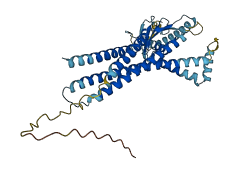
The autoinhibited protein was predicted that may have potential autoinhibitory elements via cis-regPred.
Autoinhibitory domains (AIDs)
Target domain |
|
Relief mechanism |
|
Assay |
cis-regPred |
Accessory elements
No accessory elements
Autoinhibited structure

Activated structure
1 structures for Q756X9
| Entry ID | Method | Resolution | Chain | Position | Source |
|---|---|---|---|---|---|
| AF-Q756X9-F1 | Predicted | AlphaFoldDB |
No variants for Q756X9
| Variant ID(s) | Position | Change | Description | Diseaes Association | Provenance |
|---|---|---|---|---|---|
| No variants for Q756X9 | |||||
No associated diseases with Q756X9
No regional properties for Q756X9
| Type | Name | Position | InterPro Accession |
|---|---|---|---|
| No domain, repeats, and functional sites for Q756X9 | |||
2 GO annotations of cellular component
| Name | Definition |
|---|---|
| integral component of membrane | The component of a membrane consisting of the gene products and protein complexes having at least some part of their peptide sequence embedded in the hydrophobic region of the membrane. |
| prospore membrane | The prospore membrane is a double-membraned structure that extends from the cytoplasmic face of the spindle pole bodies to encompass the spindle pole bodies and the four nuclear lobes that are formed during meiosis. It helps isolate the meiotic nuclei from the cytoplasm during spore formation and serves as a foundation for the formation of the spore walls. An example of this component is found in Schizosaccharomyces pombe. |
No GO annotations of molecular function
| Name | Definition |
|---|---|
| No GO annotations for molecular function |
1 GO annotations of biological process
| Name | Definition |
|---|---|
| sporulation resulting in formation of a cellular spore | The process in which a relatively unspecialized cell acquires the specialized features of a cellular spore, a cell form that can be used for dissemination, for survival of adverse conditions because of its heat and dessication resistance, and/or for reproduction. |
No homologous proteins in AiPD
| UniProt AC | Gene Name | Protein Name | Species | Evidence Code |
|---|---|---|---|---|
| No homologous proteins | ||||
| 10 | 20 | 30 | 40 | 50 | 60 |
| MGSRLLQFQS | YGKWFMLLSL | ATAICLLHLP | SYSCTYSRDL | PICTPQVSFQ | LTNTTPTATL |
| 70 | 80 | 90 | 100 | 110 | 120 |
| FLSTVKEVSM | LLSYVAIDLG | WNVNFPKPND | YDTSNLVNTF | DPSNKYHVNL | FGYCKWQPLS |
| 130 | 140 | 150 | 160 | 170 | 180 |
| NKATWYCMDN | PNGLDIISMI | VRDLGAQLGV | LSHTNTKILS | DSLWILYRSI | FDSFYKFVHD |
| 190 | 200 | 210 | 220 | 230 | 240 |
| DDYRADKVAS | FLQSLQQGGP | LPSVDQFKTV | TLLLKCFEKL | TNAIQVTELC | SFALIIIAIA |
| 250 | 260 | 270 | 280 | 290 | 300 |
| LATVACVMDI | LAAREEKHSA | TSDKLPKALF | FKQITLKLSY | AVVTCSLFYQ | IGMAVYFLAL |
| 310 | 320 | 330 | 340 | 350 | 360 |
| FSIRYPYDYK | VKVMTFNPDT | GYWLSVLRFV | MEFWFAVACY | IGLSLSRRRP | SKEVDDLDWK |
| 370 | 380 | ||||
| DEEQTPDSGE | TAICVSTRGS | TRIQV |