Q755Y8
Gene name |
MIC27 (AER379C) |
Protein name |
MICOS complex subunit MIC27 |
Names |
|
Species |
Ashbya gossypii (strain ATCC 10895 / CBS 109.51 / FGSC 9923 / NRRL Y-1056) (Yeast) (Eremothecium gossypii) |
KEGG Pathway |
ago:AGOS_AER379C |
EC number |
|
Protein Class |
|
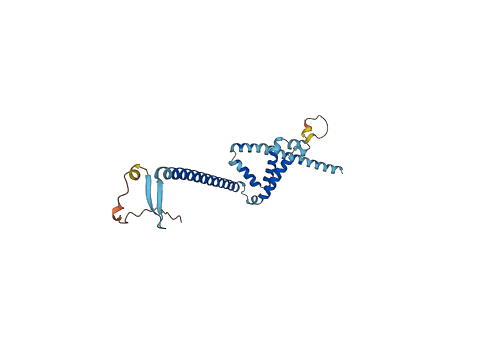
Descriptions
The autoinhibited protein was predicted that may have potential autoinhibitory elements via cis-regPred.
Autoinhibitory domains (AIDs)
Target domain |
|
Relief mechanism |
|
Assay |
cis-regPred |
Accessory elements
No accessory elements
Autoinhibited structure

Activated structure
1 structures for Q755Y8
| Entry ID | Method | Resolution | Chain | Position | Source |
|---|---|---|---|---|---|
| AF-Q755Y8-F1 | Predicted | AlphaFoldDB |
No variants for Q755Y8
| Variant ID(s) | Position | Change | Description | Diseaes Association | Provenance |
|---|---|---|---|---|---|
| No variants for Q755Y8 | |||||
No associated diseases with Q755Y8
No regional properties for Q755Y8
| Type | Name | Position | InterPro Accession |
|---|---|---|---|
| No domain, repeats, and functional sites for Q755Y8 | |||
3 GO annotations of cellular component
| Name | Definition |
|---|---|
| fungal-type vacuole membrane | The lipid bilayer surrounding a vacuole, the shape of which correlates with cell cycle phase. The membrane separates its contents from the cytoplasm of the cell. An example of this structure is found in Saccharomyces cerevisiae. |
| MICOS complex | Mitochondrial inner membrane complex involved in maintenance of crista junctions, inner membrane architecture, and formation of contact sites to the outer membrane. In Saccharomyces cerevisiae the complex has six subunits: MIC10, MIC12, MIC19, MIC26, MIC27, and MIC60. |
| mitochondrial crista junction | A tubular structure of relatively uniform size that connects a mitochondrial crista to the mitochondrial inner boundary membrane. |
No GO annotations of molecular function
| Name | Definition |
|---|---|
| No GO annotations for molecular function |
2 GO annotations of biological process
| Name | Definition |
|---|---|
| cristae formation | The assembly of cristae, the inwards folds of the inner mitochondrial membrane. |
| protein-containing complex organization | Any process in which macromolecules aggregate, disaggregate, or are modified, resulting in the formation, disassembly, or alteration of a protein complex. |
No homologous proteins in AiPD
| UniProt AC | Gene Name | Protein Name | Species | Evidence Code |
|---|---|---|---|---|
| No homologous proteins | ||||
| 10 | 20 | 30 | 40 | 50 | 60 |
| MSRNFYNYDP | TVDILQPPLI | PDVILKSNLK | ELTLPTGNQV | LESLPLTAWF | HRTRSNIISH |
| 70 | 80 | 90 | 100 | 110 | 120 |
| LTRYEAEWET | QKSAARNELH | SVKSYLKGNI | FNDARELYAL | PETNILTICA | YFAGRIITNR |
| 130 | 140 | 150 | 160 | 170 | 180 |
| KNWGVSAATL | QSVKSSVHRP | SLMARVCTSI | PSKMVLPWAM | AGAVFKELAP | TAFDNTITSL |
| 190 | 200 | 210 | 220 | 230 | |
| ESDILDPGFV | AQYKTLWRDY | YTNGAKKASI | EAAELLEGKL | QGYIGFARNF | IIYSTR |