Q754W7
Gene name |
CBC2 (AFL050W) |
Protein name |
Nuclear cap-binding protein subunit 2 |
Names |
20 kDa nuclear cap-binding protein, NCBP 20 kDa subunit, CBP20 |
Species |
Ashbya gossypii (strain ATCC 10895 / CBS 109.51 / FGSC 9923 / NRRL Y-1056) (Yeast) (Eremothecium gossypii) |
KEGG Pathway |
ago:AGOS_AFL050W |
EC number |
|
Protein Class |
|
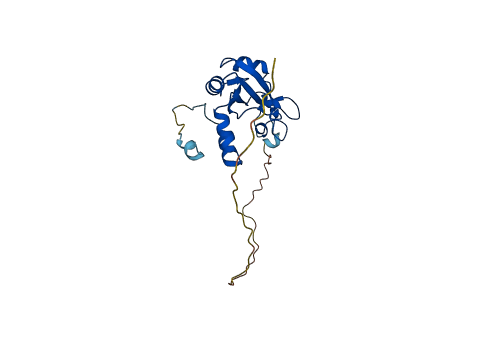
Descriptions
The autoinhibited protein was predicted that may have potential autoinhibitory elements via cis-regPred.
Autoinhibitory domains (AIDs)
Target domain |
|
Relief mechanism |
|
Assay |
cis-regPred |
Accessory elements
No accessory elements
Autoinhibited structure

Activated structure
1 structures for Q754W7
| Entry ID | Method | Resolution | Chain | Position | Source |
|---|---|---|---|---|---|
| AF-Q754W7-F1 | Predicted | AlphaFoldDB |
No variants for Q754W7
| Variant ID(s) | Position | Change | Description | Diseaes Association | Provenance |
|---|---|---|---|---|---|
| No variants for Q754W7 | |||||
No associated diseases with Q754W7
2 regional properties for Q754W7
| Type | Name | Position | InterPro Accession |
|---|---|---|---|
| conserved_site | Calreticulin/calnexin, conserved site | 107 - 122 | IPR018124-1 |
| conserved_site | Calreticulin/calnexin, conserved site | 139 - 147 | IPR018124-2 |
3 GO annotations of cellular component
| Name | Definition |
|---|---|
| commitment complex | A spliceosomal complex that is formed by association of the U1 snRNP with the 5' splice site of an unspliced intron in an RNA transcript. |
| mRNA cap binding complex | Any protein complex that binds to an mRNA cap at any time in the lifetime of the mRNA. |
| nuclear cap binding complex | A conserved heterodimeric protein complex that binds to the 5' terminal cap structure m7G(5')ppp(5')N of nascent eukaryotic RNA polymerase II transcripts such as pre-mRNA and U snRNA. The consists of proteins known as CBP20 and CBP80, binds to cap structures in the nucleus, and is involved in pre-mRNA splicing, 3'-end formation, and RNA nuclear export. |
1 GO annotations of molecular function
| Name | Definition |
|---|---|
| RNA cap binding | Binding to a 7-methylguanosine (m7G) group or derivative located at the 5' end of an RNA molecule. |
8 GO annotations of biological process
| Name | Definition |
|---|---|
| mRNA 3'-end processing | Any process involved in forming the mature 3' end of an mRNA molecule. |
| mRNA cis splicing, via spliceosome | The joining together, after removal of an intervening sequence composed of one or more introns, of two segments of the same RNA molecule via spliceosomal catalysis to produce an mRNA composed only of exon sequences that all came from the same primary transcript. |
| mRNA export from nucleus | The directed movement of mRNA from the nucleus to the cytoplasm. |
| mRNA splicing, via spliceosome | The joining together of exons from one or more primary transcripts of messenger RNA (mRNA) and the excision of intron sequences, via a spliceosomal mechanism, so that mRNA consisting only of the joined exons is produced. |
| mRNA transcription by RNA polymerase II | The cellular synthesis of messenger RNA (mRNA) from a DNA template by RNA polymerase II, originating at an RNA polymerase II promoter. |
| nuclear-transcribed mRNA catabolic process | The chemical reactions and pathways resulting in the breakdown of nuclear-transcribed mRNAs in eukaryotic cells. |
| response to osmotic stress | Any process that results in a change in state or activity of a cell or an organism (in terms of movement, secretion, enzyme production, gene expression, etc.) as a result of a stimulus indicating an increase or decrease in the concentration of solutes outside the organism or cell. |
| rRNA processing | Any process involved in the conversion of a primary ribosomal RNA (rRNA) transcript into one or more mature rRNA molecules. |
No homologous proteins in AiPD
| UniProt AC | Gene Name | Protein Name | Species | Evidence Code |
|---|---|---|---|---|
| No homologous proteins | ||||
| 10 | 20 | 30 | 40 | 50 | 60 |
| MSLAEFDELR | WDHSCDRLDV | PSNYLKRKAR | KTPGGLEELR | KSMTSATIYV | GNLSFYTSEE |
| 70 | 80 | 90 | 100 | 110 | 120 |
| QLYELFSKCG | SIEKIIMGLD | RFKFTPCGFC | FIIYQTPQEA | LAALKYLSKT | KLDDREITID |
| 130 | 140 | 150 | 160 | 170 | 180 |
| LDPGFEEGRQ | FGRGKNGGQV | SDELRFEFDA | SRGGFYVPLE | NRIGAVNHFG | ARRIRDPHKN |
| 190 | 200 | 210 | |||
| HHHHHHGHHH | HHGQPHAAAA | KVNPMEVEEE | LDSYIPGQ |