Q754G5
Gene name |
ARP4 (AFR105C) |
Protein name |
Actin-related protein 4 |
Names |
Actin-like protein ARP4, Actin-like protein 4 |
Species |
Ashbya gossypii (strain ATCC 10895 / CBS 109.51 / FGSC 9923 / NRRL Y-1056) (Yeast) (Eremothecium gossypii) |
KEGG Pathway |
ago:AGOS_AFR105C |
EC number |
|
Protein Class |
|
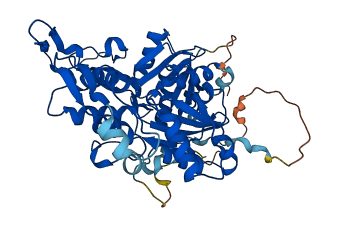
Descriptions
The autoinhibited protein was predicted that may have potential autoinhibitory elements via cis-regPred.
Autoinhibitory domains (AIDs)
Target domain |
|
Relief mechanism |
|
Assay |
cis-regPred |
Accessory elements
No accessory elements
Autoinhibited structure

Activated structure
1 structures for Q754G5
| Entry ID | Method | Resolution | Chain | Position | Source |
|---|---|---|---|---|---|
| AF-Q754G5-F1 | Predicted | AlphaFoldDB |
No variants for Q754G5
| Variant ID(s) | Position | Change | Description | Diseaes Association | Provenance |
|---|---|---|---|---|---|
| No variants for Q754G5 | |||||
1 associated diseases with Q754G5
[MIM: 601552]: Facial dysmorphism, lens dislocation, anterior segment abnormalities, and spontaneous filtering blebs (FDLAB)
A syndrome characterized by dislocated crystalline lenses and anterior segment abnormalities in association with a distinctive facies involving flat cheeks and a beaked nose. Some affected individuals develop highly unusual non-traumatic conjunctival cysts (filtering blebs). {ECO:0000269|PubMed:24768550}. Note=The disease is caused by variants affecting the gene represented in this entry.
Without disease ID
- A syndrome characterized by dislocated crystalline lenses and anterior segment abnormalities in association with a distinctive facies involving flat cheeks and a beaked nose. Some affected individuals develop highly unusual non-traumatic conjunctival cysts (filtering blebs). {ECO:0000269|PubMed:24768550}. Note=The disease is caused by variants affecting the gene represented in this entry.
4 regional properties for Q754G5
| Type | Name | Position | InterPro Accession |
|---|---|---|---|
| domain | Aspartyl/asparaginy/proline hydroxylase | 591 - 745 | IPR007803 |
| domain | Aspartyl beta-hydroxylase/Triadin domain | 43 - 108 | IPR007943 |
| repeat | Tetratricopeptide repeat | 341 - 374 | IPR019734-1 |
| repeat | Tetratricopeptide repeat | 454 - 487 | IPR019734-2 |
4 GO annotations of cellular component
| Name | Definition |
|---|---|
| Ino80 complex | A multisubunit protein complex that contains the Ino80p ATPase; exhibits chromatin remodeling activity. |
| NuA4 histone acetyltransferase complex | A complex having histone acetylase activity on chromatin, as well as ATPase, DNA helicase and structural DNA binding activities. The complex is thought to be involved in double-strand DNA break repair. Subunits of the human complex include HTATIP/TIP60, TRRAP, RUVBL1, BUVBL2, beta-actin and BAF53/ACTL6A. In yeast, the complex has 13 subunits, including the catalytic subunit Esa1 (homologous to human Tip60). |
| SWI/SNF complex | A SWI/SNF-type complex that contains 8 to 14 proteins, including both conserved (core) and nonconserved components; contains the ATPase product of the yeast SNF2 or mammalian SMARCA4/BAF190A/BRG1 gene, or an ortholog thereof. |
| Swr1 complex | A multisubunit protein complex that is involved in chromatin remodeling. It is required for the incorporation of the histone variant H2AZ into chromatin. In S. cerevisiae, the complex contains Swr1p, a Swi2/Snf2-related ATPase, and 12 additional subunits. |
3 GO annotations of molecular function
| Name | Definition |
|---|---|
| chromatin binding | Binding to chromatin, the network of fibers of DNA, protein, and sometimes RNA, that make up the chromosomes of the eukaryotic nucleus during interphase. |
| histone acetyltransferase activity | Catalysis of the reaction: acetyl-CoA + histone = CoA + acetyl-histone. |
| histone binding | Binding to a histone, any of a group of water-soluble proteins found in association with the DNA of eukaryotic or archaeal chromosomes. They are involved in the condensation and coiling of chromosomes during cell division and have also been implicated in gene regulation and DNA replication. They may be chemically modified (methylated, acetlyated and others) to regulate gene transcription. |
5 GO annotations of biological process
| Name | Definition |
|---|---|
| chromatin remodeling | A dynamic process of chromatin reorganization resulting in changes to chromatin structure. These changes allow DNA metabolic processes such as transcriptional regulation, DNA recombination, DNA repair, and DNA replication. |
| DNA repair | The process of restoring DNA after damage. Genomes are subject to damage by chemical and physical agents in the environment (e.g. UV and ionizing radiations, chemical mutagens, fungal and bacterial toxins, etc.) and by free radicals or alkylating agents endogenously generated in metabolism. DNA is also damaged because of errors during its replication. A variety of different DNA repair pathways have been reported that include direct reversal, base excision repair, nucleotide excision repair, photoreactivation, bypass, double-strand break repair pathway, and mismatch repair pathway. |
| histone H4 acetylation | The modification of histone H4 by the addition of an acetyl group. |
| kinetochore assembly | The aggregation, arrangement and bonding together of a set of components to form the kinetochore, a multisubunit complex that is located at the centromeric region of DNA and provides an attachment point for the spindle microtubules. |
| regulation of transcription by RNA polymerase II | Any process that modulates the frequency, rate or extent of transcription mediated by RNA polymerase II. |
No homologous proteins in AiPD
| UniProt AC | Gene Name | Protein Name | Species | Evidence Code |
|---|---|---|---|---|
| No homologous proteins | ||||
| 10 | 20 | 30 | 40 | 50 | 60 |
| MSNSALQVYG | GDEITAVVID | PGSFTTNIGY | SGTDCPQAIL | PSCYGKYTEG | EKDELFSEQS |
| 70 | 80 | 90 | 100 | 110 | 120 |
| IGLPRKDYEI | HNIVQNGEVV | DWEKAEKQWD | WAIRSELRFE | TNSGMPALLT | EPIWNSEENR |
| 130 | 140 | 150 | 160 | 170 | 180 |
| KKSLEVLLES | MDFSACYLVP | TATAVSFAMG | RPTCLVVDIG | HDVTSVCPVV | DGMTLSKSSM |
| 190 | 200 | 210 | 220 | 230 | 240 |
| RSYIAGSLLN | ELIRSQLAPR | KVIPLFQVAQ | RRPVFMERKF | DYEIHPSLQK | FVNERQFFQE |
| 250 | 260 | 270 | 280 | 290 | 300 |
| FKETMLQVAP | TSISKFKSEI | ETTSKRSIEA | PWGEELVYDS | LQRLEFAEQL | FTPDLSQFPE |
| 310 | 320 | 330 | 340 | 350 | 360 |
| DWPISKDGVV | ETWHNDYVPL | KRNKPGTNVK | DKEGTLDATP | VPDENSVTSA | DQPNDNGKRN |
| 370 | 380 | 390 | 400 | 410 | 420 |
| LEETTPDQKN | EVSGLADLIY | SSIMSTDVDL | RTTLSHNVVI | TGGTSSLPGL | MDRISAELNR |
| 430 | 440 | 450 | 460 | 470 | |
| SLPALKFRML | TSGQLRERQY | QGWLGGSILA | SLGTFHQLWV | GKQEYAEVGA | DRLLKDRFR |