Q752B6
Gene name |
CWC23 (AFR659W) |
Protein name |
Pre-mRNA-splicing factor CWC23 |
Names |
|
Species |
Ashbya gossypii (strain ATCC 10895 / CBS 109.51 / FGSC 9923 / NRRL Y-1056) (Yeast) (Eremothecium gossypii) |
KEGG Pathway |
ago:AGOS_AFR659W |
EC number |
|
Protein Class |
|
Descriptions
The autoinhibited protein was predicted that may have potential autoinhibitory elements via cis-regPred.
Autoinhibitory domains (AIDs)
Target domain |
|
Relief mechanism |
|
Assay |
cis-regPred |
Accessory elements
No accessory elements
Autoinhibited structure

Activated structure
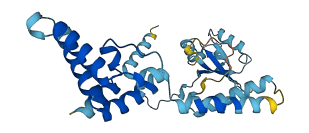
1 structures for Q752B6
| Entry ID | Method | Resolution | Chain | Position | Source |
|---|---|---|---|---|---|
| AF-Q752B6-F1 | Predicted | AlphaFoldDB |
No variants for Q752B6
| Variant ID(s) | Position | Change | Description | Diseaes Association | Provenance |
|---|---|---|---|---|---|
| No variants for Q752B6 | |||||
No associated diseases with Q752B6
2 GO annotations of cellular component
| Name | Definition |
|---|---|
| endoplasmic reticulum | The irregular network of unit membranes, visible only by electron microscopy, that occurs in the cytoplasm of many eukaryotic cells. The membranes form a complex meshwork of tubular channels, which are often expanded into slitlike cavities called cisternae. The ER takes two forms, rough (or granular), with ribosomes adhering to the outer surface, and smooth (with no ribosomes attached). |
| spliceosomal complex | Any of a series of ribonucleoprotein complexes that contain snRNA(s) and small nuclear ribonucleoproteins (snRNPs), and are formed sequentially during the spliceosomal splicing of one or more substrate RNAs, and which also contain the RNA substrate(s) from the initial target RNAs of splicing, the splicing intermediate RNA(s), to the final RNA products. During cis-splicing, the initial target RNA is a single, contiguous RNA transcript, whether mRNA, snoRNA, etc., and the released products are a spliced RNA and an excised intron, generally as a lariat structure. During trans-splicing, there are two initial substrate RNAs, the spliced leader RNA and a pre-mRNA. |
2 GO annotations of molecular function
| Name | Definition |
|---|---|
| chaperone binding | Binding to a chaperone protein, a class of proteins that bind to nascent or unfolded polypeptides and ensure correct folding or transport. |
| misfolded protein binding | Binding to a misfolded protein. |
3 GO annotations of biological process
| Name | Definition |
|---|---|
| mRNA processing | Any process involved in the conversion of a primary mRNA transcript into one or more mature mRNA(s) prior to translation into polypeptide. |
| RNA splicing | The process of removing sections of the primary RNA transcript to remove sequences not present in the mature form of the RNA and joining the remaining sections to form the mature form of the RNA. |
| ubiquitin-dependent ERAD pathway | The series of steps necessary to target endoplasmic reticulum (ER)-resident proteins for degradation by the cytoplasmic proteasome. Begins with recognition of the ER-resident protein, includes retrotranslocation (dislocation) of the protein from the ER to the cytosol, protein ubiquitination necessary for correct substrate transfer, transport of the protein to the proteasome, and ends with degradation of the protein by the cytoplasmic proteasome. |
No homologous proteins in AiPD
| UniProt AC | Gene Name | Protein Name | Species | Evidence Code |
|---|---|---|---|---|
| No homologous proteins | ||||
| 10 | 20 | 30 | 40 | 50 | 60 |
| MSADALKDVI | GGGKDLYALL | EVSISSPEEL | EAVDAAQLRA | QFRRLALRYH | PDKRRDDTQQ |
| 70 | 80 | 90 | 100 | 110 | 120 |
| NDKFVSVQKA | YDILSNSSLR | ATYNRWLSCR | LFGDPERRRL | VRELHQREQL | QVRQKEPMDK |
| 130 | 140 | 150 | 160 | 170 | 180 |
| DIQNIQSYGQ | LLRKMRHLRI | PYGDWRPNTS | ISRDSTLVET | CTLRLLLRQN | STTNSKSSML |
| 190 | 200 | 210 | 220 | 230 | 240 |
| QLFQRAKLHI | VDLYFSSRNV | DTENDLVLYA | VMPDVDTMLD | LLNNWAVKPP | LSEHILQVQP |
| 250 | 260 | 270 | |||
| RVHTDYFHFK | TDISLDKTIT | EAIDADNQYM | SSF |