Q74ZL1
Gene name |
ADK1 |
Protein name |
Adenylate kinase |
Names |
ATP-AMP transphosphorylase, ATP:AMP phosphotransferase, Adenylate kinase cytosolic and mitochondrial, Adenylate monophosphate kinase |
Species |
Ashbya gossypii (strain ATCC 10895 / CBS 109.51 / FGSC 9923 / NRRL Y-1056) (Yeast) (Eremothecium gossypii) |
KEGG Pathway |
ago:AGOS_AGR187W |
EC number |
2.7.4.3: Phosphotransferases with a phosphate group as acceptor |
Protein Class |
|
Descriptions
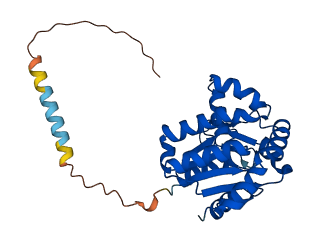
The autoinhibited protein was predicted that may have potential autoinhibitory elements via cis-regPred.
Autoinhibitory domains (AIDs)
Target domain |
|
Relief mechanism |
|
Assay |
cis-regPred |
Accessory elements
No accessory elements
Autoinhibited structure

Activated structure
1 structures for Q74ZL1
| Entry ID | Method | Resolution | Chain | Position | Source |
|---|---|---|---|---|---|
| AF-Q74ZL1-F1 | Predicted | AlphaFoldDB |
No variants for Q74ZL1
| Variant ID(s) | Position | Change | Description | Diseaes Association | Provenance |
|---|---|---|---|---|---|
| No variants for Q74ZL1 | |||||
1 associated diseases with Q74ZL1
[MIM: 616503]: Lethal congenital contracture syndrome 9 (LCCS9)
A form of lethal congenital contracture syndrome, an autosomal recessive disorder characterized by degeneration of anterior horn neurons, extreme skeletal muscle atrophy and congenital non-progressive joint contractures. The contractures can involve the upper or lower limbs and/or the vertebral column, leading to various degrees of flexion or extension limitations evident at birth. {ECO:0000269|PubMed:26004201}. Note=The disease is caused by variants affecting the gene represented in this entry.
Without disease ID
- A form of lethal congenital contracture syndrome, an autosomal recessive disorder characterized by degeneration of anterior horn neurons, extreme skeletal muscle atrophy and congenital non-progressive joint contractures. The contractures can involve the upper or lower limbs and/or the vertebral column, leading to various degrees of flexion or extension limitations evident at birth. {ECO:0000269|PubMed:26004201}. Note=The disease is caused by variants affecting the gene represented in this entry.
1 regional properties for Q74ZL1
| Type | Name | Position | InterPro Accession |
|---|---|---|---|
| conserved_site | Aminoacyl-tRNA synthetase, class I, conserved site | 46 - 56 | IPR001412 |
Functions
| Description | ||
|---|---|---|
| EC Number | 2.7.4.3 | Phosphotransferases with a phosphate group as acceptor |
| Subcellular Localization |
|
|
| PANTHER Family | ||
| PANTHER Subfamily | ||
| PANTHER Protein Class | ||
| PANTHER Pathway Category | No pathway information available | |
4 GO annotations of cellular component
| Name | Definition |
|---|---|
| cytoplasm | The contents of a cell excluding the plasma membrane and nucleus, but including other subcellular structures. |
| cytosol | The part of the cytoplasm that does not contain organelles but which does contain other particulate matter, such as protein complexes. |
| mitochondrial intermembrane space | The region between the inner and outer lipid bilayers of the mitochondrial envelope. |
| mitochondrion | A semiautonomous, self replicating organelle that occurs in varying numbers, shapes, and sizes in the cytoplasm of virtually all eukaryotic cells. It is notably the site of tissue respiration. |
2 GO annotations of molecular function
| Name | Definition |
|---|---|
| adenylate kinase activity | Catalysis of the reaction: ATP + AMP = 2 ADP. |
| ATP binding | Binding to ATP, adenosine 5'-triphosphate, a universally important coenzyme and enzyme regulator. |
5 GO annotations of biological process
| Name | Definition |
|---|---|
| ADP biosynthetic process | The chemical reactions and pathways resulting in the formation of ADP, adenosine 5'-diphosphate. |
| AMP metabolic process | The chemical reactions and pathways involving AMP, adenosine monophosphate. |
| ATP metabolic process | The chemical reactions and pathways involving ATP, adenosine triphosphate, a universally important coenzyme and enzyme regulator. |
| DNA replication initiation | The process in which DNA-dependent DNA replication is started; this begins with the ATP dependent loading of an initiator complex onto the DNA, this is followed by DNA melting and helicase activity. In bacteria, the gene products that enable the helicase activity are loaded after the initial melting and in archaea and eukaryotes, the gene products that enable the helicase activity are inactive when they are loaded and subsequently activate. |
| phosphorylation | The process of introducing a phosphate group into a molecule, usually with the formation of a phosphoric ester, a phosphoric anhydride or a phosphoric amide. |
No homologous proteins in AiPD
| UniProt AC | Gene Name | Protein Name | Species | Evidence Code |
|---|---|---|---|---|
| No homologous proteins | ||||
| 10 | 20 | 30 | 40 | 50 | 60 |
| MSCWTYLGRA | RGPRASAPTA | RRFFANFFND | LIVAVSSTVG | ALKTSQQTPL | KMSQDMSHVP |
| 70 | 80 | 90 | 100 | 110 | 120 |
| EAIRMVLIGP | PGAGKGTQAP | KLKEKFCVCH | LATGDMLRSQ | VAKQTALGVQ | AKKIMDQGGL |
| 130 | 140 | 150 | 160 | 170 | 180 |
| VSDEIMVNMI | KDELRSNPEC | ANGFILDGFP | RTIPQAQKLD | EMLVAQGKPL | DRAVELKIDD |
| 190 | 200 | 210 | 220 | 230 | 240 |
| ELLVARITGR | LVHPASGRSY | HKLFNPPKVA | MTDDVTGDPL | VQRSDDNADA | LKKRLDAYHA |
| 250 | 260 | 270 | |||
| QTEPIVDFYK | KTGIWAGVDA | SQPPKTVWSD | ILKALGK |