Q74GV6
Gene name |
prfC |
Protein name |
Peptide chain release factor 3 |
Names |
RF-3 |
Species |
Geobacter sulfurreducens (strain ATCC 51573 / DSM 12127 / PCA) |
KEGG Pathway |
gsu:GSU0138 |
EC number |
|
Protein Class |
|
Descriptions
The autoinhibited protein was predicted that may have potential autoinhibitory elements via cis-regPred.
Autoinhibitory domains (AIDs)
Target domain |
|
Relief mechanism |
|
Assay |
cis-regPred |
Accessory elements
No accessory elements
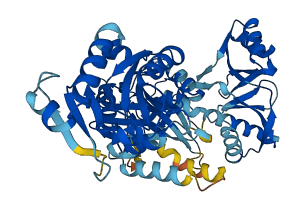
Autoinhibited structure

Activated structure
1 structures for Q74GV6
| Entry ID | Method | Resolution | Chain | Position | Source |
|---|---|---|---|---|---|
| AF-Q74GV6-F1 | Predicted | AlphaFoldDB |
No variants for Q74GV6
| Variant ID(s) | Position | Change | Description | Diseaes Association | Provenance |
|---|---|---|---|---|---|
| No variants for Q74GV6 | |||||
No associated diseases with Q74GV6
6 regional properties for Q74GV6
| Type | Name | Position | InterPro Accession |
|---|---|---|---|
| domain | Translational (tr)-type GTP-binding domain | 8 - 277 | IPR000795 |
| domain | Translation elongation factor EFTu-like, domain 2 | 311 - 377 | IPR004161 |
| domain | Small GTP-binding protein domain | 12 - 159 | IPR005225 |
| conserved_site | Tr-type G domain, conserved site | 55 - 70 | IPR031157 |
| domain | Peptide chain release factor 3, C-terminal | 384 - 511 | IPR032090 |
| domain | Peptide chain release factor 3, GTP-binding domain | 9 - 276 | IPR041732 |
1 GO annotations of cellular component
| Name | Definition |
|---|---|
| cytosol | The part of the cytoplasm that does not contain organelles but which does contain other particulate matter, such as protein complexes. |
4 GO annotations of molecular function
| Name | Definition |
|---|---|
| GTP binding | Binding to GTP, guanosine triphosphate. |
| GTPase activity | Catalysis of the reaction: GTP + H2O = GDP + H+ + phosphate. |
| translation release factor activity, codon nonspecific | A translation release factor that is not specific to particular codons; binds to guanine nucleotides. |
| translation release factor activity, codon specific | A translation release factor that is specific for one or more particular termination codons; acts at the ribosomal A-site and require polypeptidyl-tRNA at the P-site. |
2 GO annotations of biological process
| Name | Definition |
|---|---|
| regulation of translational termination | Any process that modulates the frequency, rate or extent of translational termination. |
| translational termination | The process resulting in the release of a polypeptide chain from the ribosome, usually in response to a termination codon (UAA, UAG, or UGA in the universal genetic code). |
No homologous proteins in AiPD
| UniProt AC | Gene Name | Protein Name | Species | Evidence Code |
|---|---|---|---|---|
| No homologous proteins | ||||
| 10 | 20 | 30 | 40 | 50 | 60 |
| MKYNEQEVDR | RRTFAIVSHP | DAGKTTITEK | LLLFGGAIQQ | AGEVRARKAA | RHATSDWMEM |
| 70 | 80 | 90 | 100 | 110 | 120 |
| EKQRGISVTS | SVMKFTYRDY | EVNLLDTPGH | NDFSEDTYRV | LTAVDSALMV | IDSVKGVESQ |
| 130 | 140 | 150 | 160 | 170 | 180 |
| TIKLLDVCRL | RHTPIMTFIN | KLDREGRDPF | ELIDEIEKVL | RIQCAPMTWP | IGMGKRFRGT |
| 190 | 200 | 210 | 220 | 230 | 240 |
| YHLYTKELVI | FDAEAERGTG | GVISMTGLDD | PQLDELLGSQ | ADELRADVEL | LEGAAHPFEE |
| 250 | 260 | 270 | 280 | 290 | 300 |
| EAYHAGLQTP | VFFGSAINTF | GVQQLLDTFV | DHAPAPLPRE | AVSRTVSPYE | EPFTAFAFKI |
| 310 | 320 | 330 | 340 | 350 | 360 |
| QANMDPAHRD | RIAFFRICSG | KFTRGMKVRH | VRLGREVAIN | NATIFMAQDR | THVDEAFPGD |
| 370 | 380 | 390 | 400 | 410 | 420 |
| IIGIHNHGTI | KIGDTFTLGE | DIKFTGIPNF | APEHFRRVRL | LDPLKSKALE | KGLTQLAEEG |
| 430 | 440 | 450 | 460 | 470 | 480 |
| TTQVFRPLMG | ADWVVGAVGL | LQFDVVMHRL | EHEYNVKATY | EPVSYVTARW | VTGEKKKVEE |
| 490 | 500 | 510 | 520 | ||
| FQKKEVMNCY | IDGEGDLAYL | AGSQWRLDNT | MDNWKDLTFH | ATREHS |