Q74CF3
Gene name |
queE |
Protein name |
7-carboxy-7-deazaguanine synthase |
Names |
CDG synthase, Queuosine biosynthesis protein QueE |
Species |
Geobacter sulfurreducens (strain ATCC 51573 / DSM 12127 / PCA) |
KEGG Pathway |
gsu:GSU1721 |
EC number |
4.3.99.3: Other carbon-nitrogen lyases |
Protein Class |
|
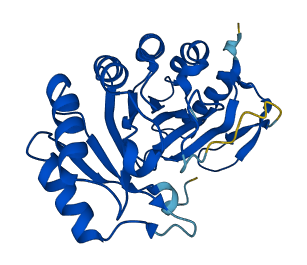
Descriptions
The autoinhibited protein was predicted that may have potential autoinhibitory elements via cis-regPred.
Autoinhibitory domains (AIDs)
Target domain |
|
Relief mechanism |
|
Assay |
cis-regPred |
Accessory elements
No accessory elements
Autoinhibited structure

Activated structure
1 structures for Q74CF3
| Entry ID | Method | Resolution | Chain | Position | Source |
|---|---|---|---|---|---|
| AF-Q74CF3-F1 | Predicted | AlphaFoldDB |
No variants for Q74CF3
| Variant ID(s) | Position | Change | Description | Diseaes Association | Provenance |
|---|---|---|---|---|---|
| No variants for Q74CF3 | |||||
No associated diseases with Q74CF3
1 regional properties for Q74CF3
| Type | Name | Position | InterPro Accession |
|---|---|---|---|
| domain | Radical SAM | 21 - 250 | IPR007197 |
Functions
| Description | ||
|---|---|---|
| EC Number | 4.3.99.3 | Other carbon-nitrogen lyases |
| Subcellular Localization |
|
|
| PANTHER Family | ||
| PANTHER Subfamily | ||
| PANTHER Protein Class | ||
| PANTHER Pathway Category | No pathway information available | |
No GO annotations of cellular component
| Name | Definition |
|---|---|
| No GO annotations for cellular component |
4 GO annotations of molecular function
| Name | Definition |
|---|---|
| 4 iron, 4 sulfur cluster binding | Binding to a 4 iron, 4 sulfur (4Fe-4S) cluster; this cluster consists of four iron atoms, with the inorganic sulfur atoms found between the irons and acting as bridging ligands. |
| carbon-nitrogen lyase activity | Catalysis of the release of ammonia or one of its derivatives, with the formation of a double bond or ring. Enzymes with this activity may catalyze the actual elimination of the ammonia, amine or amide, e.g. CH-CH(-NH-R) = C=CH- + NH2-R. Others, however, catalyze elimination of another component, e.g. water, which is followed by spontaneous reactions that lead to breakage of the C-N bond, e.g. L-serine ammonia-lyase (EC:4.3.1.17), so that the overall reaction is C(-OH)-CH(-NH2) = CH2-CO- + NH3, i.e. an elimination with rearrangement. The sub-subclasses of EC:4.3 are the ammonia-lyases (EC:4.3.1), lyases acting on amides, amidines, etc. (EC:4.3.2), the amine-lyases (EC:4.3.3), and other carbon-nitrogen lyases (EC:4.3.99). |
| magnesium ion binding | Binding to a magnesium (Mg) ion. |
| S-adenosyl-L-methionine binding | Binding to S-adenosyl-L-methionine. |
1 GO annotations of biological process
| Name | Definition |
|---|---|
| queuosine biosynthetic process | The chemical reactions and pathways resulting in the formation of queuosines, a series of nucleosides found in tRNA and having an additional pentenyl ring added via an NH group to the methyl group of 7-methylguanosine. The pentenyl ring may carry other substituents. |
No homologous proteins in AiPD
| UniProt AC | Gene Name | Protein Name | Species | Evidence Code |
|---|---|---|---|---|
| No homologous proteins | ||||
| 10 | 20 | 30 | 40 | 50 | 60 |
| MSKPGAELEE | VFSSVQGEGM | LIGLRQVFIR | FRGCNLTCDY | CDTPAGTPAE | PCRIEQTPGR |
| 70 | 80 | 90 | 100 | 110 | 120 |
| RDFVPADNPV | SLDRVAALVE | GWQRGWPGVH | DSISITGGEP | LLRHDILMQW | LPVLREHLPV |
| 130 | 140 | 150 | 160 | 170 | 180 |
| YLETNGVMHA | ALGLVINHVD | IIGMDIKIPS | TSGCTDLWDD | HRQFLEIANT | RRAFIKIVVG |
| 190 | 200 | 210 | 220 | 230 | 240 |
| EETEDWEITR | ASEIIAGVNR | DIPLILQPVT | RAGDTLGIKP | VKALELQELA | CRYLAEVRII |
| PQTHRFMGQL |