Q73JN2
Gene name |
ddl |
Protein name |
D-alanine--D-alanine ligase |
Names |
D-Ala-D-Ala ligase, D-alanylalanine synthetase |
Species |
Treponema denticola (strain ATCC 35405 / DSM 14222 / CIP 103919 / JCM 8153 / KCTC 15104) |
KEGG Pathway |
tde:TDE_2385 |
EC number |
6.3.2.4: Acid--amino-acid ligases (peptide synthases) |
Protein Class |
|
Descriptions
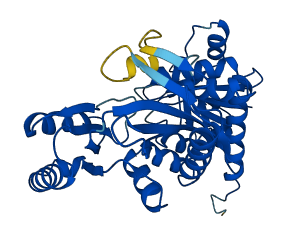
The autoinhibited protein was predicted that may have potential autoinhibitory elements via cis-regPred.
Autoinhibitory domains (AIDs)
Target domain |
|
Relief mechanism |
|
Assay |
cis-regPred |
Accessory elements
No accessory elements
Autoinhibited structure

Activated structure
1 structures for Q73JN2
| Entry ID | Method | Resolution | Chain | Position | Source |
|---|---|---|---|---|---|
| AF-Q73JN2-F1 | Predicted | AlphaFoldDB |
No variants for Q73JN2
| Variant ID(s) | Position | Change | Description | Diseaes Association | Provenance |
|---|---|---|---|---|---|
| No variants for Q73JN2 | |||||
No associated diseases with Q73JN2
5 regional properties for Q73JN2
| Type | Name | Position | InterPro Accession |
|---|---|---|---|
| conserved_site | D-alanine--D-alanine ligase/VANA/B/C, conserved site | 103 - 114 | IPR000291-1 |
| conserved_site | D-alanine--D-alanine ligase/VANA/B/C, conserved site | 294 - 323 | IPR000291-2 |
| domain | D-alanine--D-alanine ligase, C-terminal | 144 - 350 | IPR011095 |
| domain | D-alanine--D-alanine ligase, N-terminal domain | 2 - 125 | IPR011127 |
| domain | ATP-grasp fold | 141 - 350 | IPR011761 |
Functions
| Description | ||
|---|---|---|
| EC Number | 6.3.2.4 | Acid--amino-acid ligases (peptide synthases) |
| Subcellular Localization |
|
|
| PANTHER Family | ||
| PANTHER Subfamily | ||
| PANTHER Protein Class | ||
| PANTHER Pathway Category | No pathway information available | |
1 GO annotations of cellular component
| Name | Definition |
|---|---|
| cytoplasm | The contents of a cell excluding the plasma membrane and nucleus, but including other subcellular structures. |
3 GO annotations of molecular function
| Name | Definition |
|---|---|
| ATP binding | Binding to ATP, adenosine 5'-triphosphate, a universally important coenzyme and enzyme regulator. |
| D-alanine-D-alanine ligase activity | Catalysis of the reaction: 2 D-alanine + ATP = D-alanyl-D-alanine + ADP + 2 H(+) + phosphate. |
| metal ion binding | Binding to a metal ion. |
3 GO annotations of biological process
| Name | Definition |
|---|---|
| cell wall organization | A process that results in the assembly, arrangement of constituent parts, or disassembly of the cell wall, the rigid or semi-rigid envelope lying outside the cell membrane of plant, fungal and most prokaryotic cells, maintaining their shape and protecting them from osmotic lysis. |
| peptidoglycan biosynthetic process | The chemical reactions and pathways resulting in the formation of peptidoglycans, any of a class of glycoconjugates found in bacterial cell walls. |
| regulation of cell shape | Any process that modulates the surface configuration of a cell. |
No homologous proteins in AiPD
| UniProt AC | Gene Name | Protein Name | Species | Evidence Code |
|---|---|---|---|---|
| No homologous proteins | ||||
| 10 | 20 | 30 | 40 | 50 | 60 |
| MNIAIIYGGK | SSEHEVSLQS | ASSIIRTIDK | KHKLHLIGIS | KNGAWYLHGD | EERERIIKNE |
| 70 | 80 | 90 | 100 | 110 | 120 |
| KAVLKIKKDE | AKRVTVIPGG | GAKKGLKAGD | EFLPTDAVFA | VLHGRFGEDG | TIQGLFEMAD |
| 130 | 140 | 150 | 160 | 170 | 180 |
| LPYVGGDVMS | TSISMDKEKT | KMIWDYSGLP | IVPYIAIKRQ | DWDDPEKKKA | ILARAEKDLE |
| 190 | 200 | 210 | 220 | 230 | 240 |
| YPLFIKPCRA | GSSVGAGMVK | NRNELLEQAE | ESFLWDNKIL | VEACIEAREV | ECSVTGNTKT |
| 250 | 260 | 270 | 280 | 290 | 300 |
| VAYIPGEIIP | THKFYDYEAK | YTDPNGAELK | IPADLNETQR | KTIRETAIKA | YEALDLSGLS |
| 310 | 320 | 330 | 340 | 350 | 360 |
| RVDFFIDKRT | GKIYLNEVNT | IPGFTAISMF | PKMCGASGLP | YNELIMHLIE | LAIDRFKTDR |
| KLKTCRQS |