Q6ZQM0
Gene name |
Rffl |
Protein name |
E3 ubiquitin-protein ligase rififylin |
Names |
RING finger and FYVE-like domain-containing protein 1, Fring, RING-type E3 ubiquitin transferase rififylin |
Species |
Mus musculus (Mouse) |
KEGG Pathway |
mmu:67338 |
EC number |
2.3.2.27: Aminoacyltransferases |
Protein Class |
|
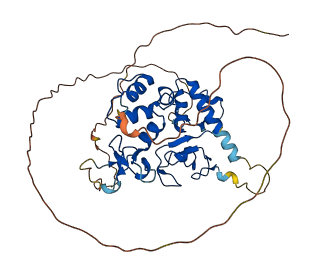
Descriptions
The autoinhibited protein was predicted that may have potential autoinhibitory elements via cis-regPred.
Autoinhibitory domains (AIDs)
Target domain |
|
Relief mechanism |
|
Assay |
cis-regPred |
Accessory elements
No accessory elements
Autoinhibited structure

Activated structure
1 structures for Q6ZQM0
| Entry ID | Method | Resolution | Chain | Position | Source |
|---|---|---|---|---|---|
| AF-Q6ZQM0-F1 | Predicted | AlphaFoldDB |
29 variants for Q6ZQM0
| Variant ID(s) | Position | Change | Description | Diseaes Association | Provenance |
|---|---|---|---|---|---|
| rs243568523 | 4 | P>S | No | EVA | |
| rs229575191 | 6 | L>R | No | EVA | |
| rs246851006 | 9 | D>E | No | EVA | |
| rs232506400 | 10 | S>N | No | EVA | |
| rs3389187381 | 28 | Q>H | No | EVA | |
| rs3413039575 | 30 | E>D | No | EVA | |
| rs3389160283 | 34 | P>L | No | EVA | |
| rs28225470 | 69 | A>T | No | EVA | |
| rs3389181470 | 87 | T>S | No | EVA | |
| rs3389182001 | 91 | Q>L | No | EVA | |
| rs3389160251 | 104 | R>Q | No | EVA | |
| rs3389123235 | 114 | E>V | No | EVA | |
| rs3389189591 | 115 | L>I | No | EVA | |
| rs3389200116 | 142 | E>G | No | EVA | |
| rs245772194 | 162 | V>A | No | EVA | |
| rs231367750 | 167 | Q>H | No | EVA | |
| rs253941789 | 225 | F>S | No | EVA | |
| rs3389184824 | 241 | V>I | No | EVA | |
| rs3389189570 | 258 | L>M | No | EVA | |
| rs3389156401 | 283 | Y>C | No | EVA | |
| rs3389186961 | 324 | G>D | No | EVA | |
| rs3389187326 | 343 | L>P | No | EVA | |
| rs3389196364 | 347 | H>R | No | EVA | |
| rs3389189006 | 348 | M>I | No | EVA | |
| rs3389195687 | 348 | M>L | No | EVA | |
| rs3389200159 | 351 | C>G | No | EVA | |
| rs3389173724 | 353 | K>M | No | EVA | |
| rs3389173714 | 360 | E>A | No | EVA | |
| rs3389195706 | 376 | R>Q | No | EVA |
No associated diseases with Q6ZQM0
18 regional properties for Q6ZQM0
| Type | Name | Position | InterPro Accession |
|---|---|---|---|
| domain | B-box-type zinc finger | 134 - 184 | IPR000315-1 |
| domain | B-box-type zinc finger | 190 - 232 | IPR000315-2 |
| domain | Zinc finger, RING-type | 30 - 80 | IPR001841 |
| domain | B30.2/SPRY domain | 516 - 709 | IPR001870 |
| domain | B-box, C-terminal | 239 - 365 | IPR003649 |
| domain | SPRY domain | 588 - 706 | IPR003877 |
| domain | Butyrophylin-like, SPRY domain | 532 - 549 | IPR003879-1 |
| domain | Butyrophylin-like, SPRY domain | 573 - 597 | IPR003879-2 |
| domain | Butyrophylin-like, SPRY domain | 645 - 669 | IPR003879-3 |
| domain | Fibronectin type III | 401 - 531 | IPR003961 |
| domain | COS domain | 340 - 399 | IPR017903 |
| conserved_site | Zinc finger, RING-type, conserved site | 45 - 54 | IPR017907 |
| domain | Zinc finger, RING-type, eukaryotic | 30 - 77 | IPR027370 |
| domain | Probable E3 ubiquitin-protein ligase MID2, RING finger, HC subclass | 21 - 90 | IPR033491 |
| domain | TRIM1, PRY/SPRY domain | 536 - 705 | IPR035752 |
| domain | Midline-1, COS domain | 343 - 394 | IPR040859 |
| domain | Probable E3 ubiquitin-protein ligase MID2, B-box-type 2 zinc finger | 193 - 232 | IPR047063 |
| domain | Probable E3 ubiquitin-protein ligase MID2, B-box-type 1 zinc finger | 135 - 187 | IPR047064 |
Functions
| Description | ||
|---|---|---|
| EC Number | 2.3.2.27 | Aminoacyltransferases |
| Subcellular Localization |
|
|
| PANTHER Family | ||
| PANTHER Subfamily | ||
| PANTHER Protein Class | ||
| PANTHER Pathway Category | No pathway information available | |
6 GO annotations of cellular component
| Name | Definition |
|---|---|
| cytoplasm | The contents of a cell excluding the plasma membrane and nucleus, but including other subcellular structures. |
| cytoplasmic vesicle | A vesicle found in the cytoplasm of a cell. |
| cytosol | The part of the cytoplasm that does not contain organelles but which does contain other particulate matter, such as protein complexes. |
| endosome membrane | The lipid bilayer surrounding an endosome. |
| plasma membrane | The membrane surrounding a cell that separates the cell from its external environment. It consists of a phospholipid bilayer and associated proteins. |
| recycling endosome membrane | The lipid bilayer surrounding a recycling endosome. |
6 GO annotations of molecular function
| Name | Definition |
|---|---|
| metal ion binding | Binding to a metal ion. |
| p53 binding | Binding to one of the p53 family of proteins. |
| protease binding | Binding to a protease or a peptidase. |
| protein kinase binding | Binding to a protein kinase, any enzyme that catalyzes the transfer of a phosphate group, usually from ATP, to a protein substrate. |
| ubiquitin protein ligase activity | Catalysis of the transfer of ubiquitin to a substrate protein via the reaction X-ubiquitin + S -> X + S-ubiquitin, where X is either an E2 or E3 enzyme, the X-ubiquitin linkage is a thioester bond, and the S-ubiquitin linkage is an amide bond: an isopeptide bond between the C-terminal glycine of ubiquitin and the epsilon-amino group of lysine residues in the substrate or, in the linear extension of ubiquitin chains, a peptide bond the between the C-terminal glycine and N-terminal methionine of ubiquitin residues. |
| ubiquitin protein ligase binding | Binding to a ubiquitin protein ligase enzyme, any of the E3 proteins. |
10 GO annotations of biological process
| Name | Definition |
|---|---|
| apoptotic process | A programmed cell death process which begins when a cell receives an internal (e.g. DNA damage) or external signal (e.g. an extracellular death ligand), and proceeds through a series of biochemical events (signaling pathway phase) which trigger an execution phase. The execution phase is the last step of an apoptotic process, and is typically characterized by rounding-up of the cell, retraction of pseudopodes, reduction of cellular volume (pyknosis), chromatin condensation, nuclear fragmentation (karyorrhexis), plasma membrane blebbing and fragmentation of the cell into apoptotic bodies. When the execution phase is completed, the cell has died. |
| intracellular protein transport | The directed movement of proteins in a cell, including the movement of proteins between specific compartments or structures within a cell, such as organelles of a eukaryotic cell. |
| negative regulation of cysteine-type endopeptidase activity involved in execution phase of apoptosis | Any process that stops, prevents or reduces the frequency, rate or extent of cysteine-type endopeptidase activity involved in execution phase of apoptosis. |
| negative regulation of extrinsic apoptotic signaling pathway via death domain receptors | Any process that stops, prevents or reduces the frequency, rate or extent of extrinsic apoptotic signaling pathway via death domain receptors. |
| negative regulation of signal transduction by p53 class mediator | Any process that stops, prevents or reduces the frequency, rate or extent of signal transduction by p53 class mediator. |
| negative regulation of tumor necrosis factor-mediated signaling pathway | Any process that decreases the rate or extent of the tumor necrosis factor-mediated signaling pathway. The tumor necrosis factor-mediated signaling pathway is the series of molecular signals generated as a consequence of tumor necrosis factor binding to a cell surface receptor. |
| proteasome-mediated ubiquitin-dependent protein catabolic process | The chemical reactions and pathways resulting in the breakdown of a protein or peptide by hydrolysis of its peptide bonds, initiated by the covalent attachment of ubiquitin, and mediated by the proteasome. |
| protein K48-linked ubiquitination | A protein ubiquitination process in which a polymer of ubiquitin, formed by linkages between lysine residues at position 48 of the ubiquitin monomers, is added to a protein. K48-linked ubiquitination targets the substrate protein for degradation. |
| regulation of fibroblast migration | Any process that modulates the rate, frequency or extent of fibroblast cell migration. Fibroblast cell migration is accomplished by extension and retraction of a pseudopodium. |
| ubiquitin-dependent protein catabolic process | The chemical reactions and pathways resulting in the breakdown of a protein or peptide by hydrolysis of its peptide bonds, initiated by the covalent attachment of a ubiquitin group, or multiple ubiquitin groups, to the protein. |
1 homologous proteins in AiPD
| UniProt AC | Gene Name | Protein Name | Species | Evidence Code |
|---|---|---|---|---|
| Q8VCM5 | Mul1 | Mitochondrial ubiquitin ligase activator of NFKB 1 | Mus musculus (Mouse) | PR |
| 10 | 20 | 30 | 40 | 50 | 60 |
| MSQPSLWKDS | HYFIMWASCC | NWFCLDGQPE | EAPPPQGART | QAYSNPGYSS | FPSPTGSEPS |
| 70 | 80 | 90 | 100 | 110 | 120 |
| CKACGVHFAS | TTRKQTCLDC | KKNFCMTCSS | QEGNGPRLCL | LCLRFRATAF | QREELMKMKV |
| 130 | 140 | 150 | 160 | 170 | 180 |
| KDLRDYLSLH | DISTEMCREK | EELVFLVLGQ | QPVISEADRT | RVPHLPQAFP | EQQAFLTQPQ |
| 190 | 200 | 210 | 220 | 230 | 240 |
| TSTVPPTSPG | LPSSPAQVTS | VPLAQDQETQ | QAVGHVSQDH | EEPIFPESTA | RVPTEDETQS |
| 250 | 260 | 270 | 280 | 290 | 300 |
| VDSEDSFVPG | RRASLSDLTH | LEDIEGLTVR | QLKEILARNF | VNYKGCCEKW | ELMERVTRLY |
| 310 | 320 | 330 | 340 | 350 | 360 |
| KDQKGLQHLV | SGNEDQNGGA | VPSGLEENLC | KICMDSPIDC | VLLECGHMVT | CTKCGKRMNE |
| 370 | |||||
| CPICRQYVIR | AVHVFRS |