Q6SZS5
Gene name |
URA9 (CAGL0M12881g) |
Protein name |
Dihydroorotate dehydrogenase (quinone), mitochondrial |
Names |
DHOD, DHODase, DHOdehase, Dihydroorotate oxidase |
Species |
Candida glabrata (strain ATCC 2001 / CBS 138 / JCM 3761 / NBRC 0622 / NRRL Y-65) (Yeast) (Torulopsis glabrata) |
KEGG Pathway |
cgr:CAGL0M12881g |
EC number |
1.3.5.2: With a quinone or related compound as acceptor |
Protein Class |
|
Descriptions
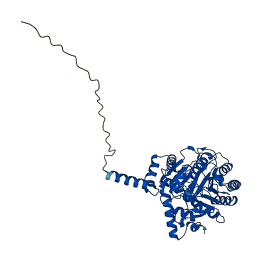
The autoinhibited protein was predicted that may have potential autoinhibitory elements via cis-regPred.
Autoinhibitory domains (AIDs)
Target domain |
|
Relief mechanism |
|
Assay |
cis-regPred |
Accessory elements
No accessory elements
Autoinhibited structure

Activated structure
1 structures for Q6SZS5
| Entry ID | Method | Resolution | Chain | Position | Source |
|---|---|---|---|---|---|
| AF-Q6SZS5-F1 | Predicted | AlphaFoldDB |
No variants for Q6SZS5
| Variant ID(s) | Position | Change | Description | Diseaes Association | Provenance |
|---|---|---|---|---|---|
| No variants for Q6SZS5 | |||||
No associated diseases with Q6SZS5
3 regional properties for Q6SZS5
| Type | Name | Position | InterPro Accession |
|---|---|---|---|
| conserved_site | Dihydroorotate dehydrogenase, conserved site | 137 - 156 | IPR001295-1 |
| conserved_site | Dihydroorotate dehydrogenase, conserved site | 375 - 395 | IPR001295-2 |
| domain | Dihydroorotate dehydrogenase domain | 102 - 423 | IPR005720 |
Functions
| Description | ||
|---|---|---|
| EC Number | 1.3.5.2 | With a quinone or related compound as acceptor |
| Subcellular Localization |
|
|
| PANTHER Family | ||
| PANTHER Subfamily | ||
| PANTHER Protein Class | ||
| PANTHER Pathway Category | No pathway information available | |
2 GO annotations of cellular component
| Name | Definition |
|---|---|
| integral component of membrane | The component of a membrane consisting of the gene products and protein complexes having at least some part of their peptide sequence embedded in the hydrophobic region of the membrane. |
| mitochondrial inner membrane | The inner, i.e. lumen-facing, lipid bilayer of the mitochondrial envelope. It is highly folded to form cristae. |
1 GO annotations of molecular function
| Name | Definition |
|---|---|
| dihydroorotate dehydrogenase activity | Catalysis of the reaction: (S)-dihydroorotate + A = AH(2) + orotate. |
2 GO annotations of biological process
| Name | Definition |
|---|---|
| 'de novo' pyrimidine nucleobase biosynthetic process | The chemical reactions and pathways resulting in the formation of pyrimidine nucleobases, 1,3-diazine, organic nitrogenous bases, beginning with the synthesis of a pyrimidine ring from simpler precursors. |
| 'de novo' UMP biosynthetic process | The chemical reactions and pathways resulting in the formation of UMP, uridine monophosphate, starting with the synthesis of (S)-dihydroorotate from bicarbonate; UMP biosynthesis may either occur via reduction by quinone, NAD(+) or oxygen. |
No homologous proteins in AiPD
| UniProt AC | Gene Name | Protein Name | Species | Evidence Code |
|---|---|---|---|---|
| No homologous proteins | ||||
| 10 | 20 | 30 | 40 | 50 | 60 |
| MMHRVGFNVI | GRRSFFTVNA | RRQVLKSSFM | GLKPLQLTAL | LLAGSAGYLY | FMNARSAIHE |
| 70 | 80 | 90 | 100 | 110 | 120 |
| YVVCPVVRLI | TPDPENGHKL | GIWCFKWGLS | PKLYFDKDPE | SLHVNVFGTT | MTNPIGCAAG |
| 130 | 140 | 150 | 160 | 170 | 180 |
| LDKDAEAIDG | IMPTGFGYME | VGSVTPVAQP | GNPRPRFFRL | PADDAVINRY | GFNSSGHDVV |
| 190 | 200 | 210 | 220 | 230 | 240 |
| YNNLMKRVNK | FLNSYFGDKS | IDKLSLYKDK | LLAVNLGKNK | NGDEVKDYLK | GVEKFQSLAD |
| 250 | 260 | 270 | 280 | 290 | 300 |
| VLVINVSSPN | TPGLRDLQNE | AKLTNLLSEI | ITKRDSQSNK | PNALGKQNHK | PPVLVKIAPD |
| 310 | 320 | 330 | 340 | 350 | 360 |
| LTEPELQSIV | EAAKKSKVDG | IIVSNTTIQR | PNTLKTQDET | LRNQVGGLSG | KPLKPFALKA |
| 370 | 380 | 390 | 400 | 410 | 420 |
| MKAVSKYAKD | SDLVLVGCGG | ISSGKDAIEF | AKAGATFVQL | YTSYAYVGPA | LIARIKDEVA |
| 430 | |||||
| EELKKEGKTW | MEIIGEDNK |