Q6PGR9
Gene name |
trim72 (mg53) |
Protein name |
Tripartite motif-containing protein 72 |
Names |
Mitsugumin-53, Mg53 |
Species |
Xenopus laevis (African clawed frog) |
KEGG Pathway |
xla:379612 |
EC number |
|
Protein Class |
|
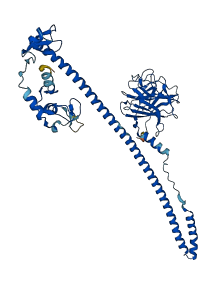
Descriptions
The autoinhibited protein was predicted that may have potential autoinhibitory elements via cis-regPred.
Autoinhibitory domains (AIDs)
Target domain |
|
Relief mechanism |
|
Assay |
cis-regPred |
Accessory elements
No accessory elements
Autoinhibited structure

Activated structure
1 structures for Q6PGR9
| Entry ID | Method | Resolution | Chain | Position | Source |
|---|---|---|---|---|---|
| AF-Q6PGR9-F1 | Predicted | AlphaFoldDB |
No variants for Q6PGR9
| Variant ID(s) | Position | Change | Description | Diseaes Association | Provenance |
|---|---|---|---|---|---|
| No variants for Q6PGR9 | |||||
No associated diseases with Q6PGR9
11 regional properties for Q6PGR9
| Type | Name | Position | InterPro Accession |
|---|---|---|---|
| domain | B-box-type zinc finger | 83 - 124 | IPR000315 |
| domain | Zinc finger, RING-type | 16 - 59 | IPR001841 |
| domain | B30.2/SPRY domain | 272 - 476 | IPR001870 |
| domain | SPRY domain | 343 - 473 | IPR003877 |
| domain | Butyrophylin-like, SPRY domain | 289 - 306 | IPR003879-1 |
| domain | Butyrophylin-like, SPRY domain | 306 - 323 | IPR003879-2 |
| domain | Butyrophylin-like, SPRY domain | 328 - 352 | IPR003879-3 |
| domain | Butyrophylin-like, SPRY domain | 358 - 371 | IPR003879-4 |
| domain | Butyrophylin-like, SPRY domain | 404 - 428 | IPR003879-5 |
| domain | SPRY-associated | 290 - 342 | IPR006574 |
| conserved_site | Zinc finger, RING-type, conserved site | 31 - 40 | IPR017907 |
Functions
2 GO annotations of cellular component
| Name | Definition |
|---|---|
| cytoplasmic vesicle membrane | The lipid bilayer surrounding a cytoplasmic vesicle. |
| sarcolemma | The outer membrane of a muscle cell, consisting of the plasma membrane, a covering basement membrane (about 100 nm thick and sometimes common to more than one fiber), and the associated loose network of collagen fibers. |
3 GO annotations of molecular function
| Name | Definition |
|---|---|
| phosphatidylserine binding | Binding to phosphatidylserine, a class of glycophospholipids in which a phosphatidyl group is esterified to the hydroxyl group of L-serine. |
| ubiquitin protein ligase activity | Catalysis of the transfer of ubiquitin to a substrate protein via the reaction X-ubiquitin + S -> X + S-ubiquitin, where X is either an E2 or E3 enzyme, the X-ubiquitin linkage is a thioester bond, and the S-ubiquitin linkage is an amide bond: an isopeptide bond between the C-terminal glycine of ubiquitin and the epsilon-amino group of lysine residues in the substrate or, in the linear extension of ubiquitin chains, a peptide bond the between the C-terminal glycine and N-terminal methionine of ubiquitin residues. |
| zinc ion binding | Binding to a zinc ion (Zn). |
6 GO annotations of biological process
| Name | Definition |
|---|---|
| exocytosis | A process of secretion by a cell that results in the release of intracellular molecules (e.g. hormones, matrix proteins) contained within a membrane-bounded vesicle. Exocytosis can occur either by full fusion, when the vesicle collapses into the plasma membrane, or by a kiss-and-run mechanism that involves the formation of a transient contact, a pore, between a granule (for exemple of chromaffin cells) and the plasma membrane. The latter process most of the time leads to only partial secretion of the granule content. Exocytosis begins with steps that prepare vesicles for fusion with the membrane (tethering and docking) and ends when molecules are secreted from the cell. |
| muscle organ development | The process whose specific outcome is the progression of the muscle over time, from its formation to the mature structure. The muscle is an organ consisting of a tissue made up of various elongated cells that are specialized to contract and thus to produce movement and mechanical work. |
| muscle system process | A organ system process carried out at the level of a muscle. Muscle tissue is composed of contractile cells or fibers. |
| negative regulation of insulin receptor signaling pathway | Any process that stops, prevents, or reduces the frequency, rate or extent of insulin receptor signaling. |
| plasma membrane repair | The resealing of a cell plasma membrane after cellular wounding due to, for instance, mechanical stress. |
| protein homooligomerization | The process of creating protein oligomers, compounds composed of a small number, usually between three and ten, of identical component monomers. Oligomers may be formed by the polymerization of a number of monomers or the depolymerization of a large protein polymer. |
No homologous proteins in AiPD
| UniProt AC | Gene Name | Protein Name | Species | Evidence Code |
|---|---|---|---|---|
| No homologous proteins | ||||
| 10 | 20 | 30 | 40 | 50 | 60 |
| MSTPQLMQGM | QKDLTCQLCL | ELFRAPVTPE | CGHTFCQGCL | TGVPKNQDQN | GSTPCPTCQS |
| 70 | 80 | 90 | 100 | 110 | 120 |
| PSRPETLQIN | RQLEHLVQSF | KQVPQGHCLE | HMDPLSVYCE | QDKELICGVC | ASLGKHKGHN |
| 130 | 140 | 150 | 160 | 170 | 180 |
| IITASEAFAK | LKRQLPQQQV | ILQEARLKKE | KTVAVLDRQV | AEVQDTVSRF | KGNVKHQLNA |
| 190 | 200 | 210 | 220 | 230 | 240 |
| MRSYLNIMEA | SLGKEADKAE | SAATEALLVE | RKTMGHYLDQ | LRQMEGVLKD | VEGQEQTEFL |
| 250 | 260 | 270 | 280 | 290 | 300 |
| RKYCVVAARL | NKILSESPPP | GRLDIQLPII | SDEFKFQVWR | KMFRALMPAL | ENMTFDPDTA |
| 310 | 320 | 330 | 340 | 350 | 360 |
| QQYLVVSSEG | KSVECADQKQ | SVSDEPNRFD | KSNCLVSKQS | FTEGEHYWEV | IVEDKPRWAL |
| 370 | 380 | 390 | 400 | 410 | 420 |
| GIISETANRK | GKLHATPSNG | FWIIGCKEGK | VYEAHTEQKE | PRVLRVEGRP | EKIGVYLSFS |
| 430 | 440 | 450 | 460 | 470 | |
| DGVVSFFDSS | DEDNLKLLYT | FNERFSGRLH | PFFDVCWHDK | GKNSQPLKIF | YPPAEQL |