Q6PDL0
Gene name |
Dync1li2 (Dncli2, Dnclic2) |
Protein name |
Cytoplasmic dynein 1 light intermediate chain 2 |
Names |
Dynein light intermediate chain 2, cytosolic |
Species |
Mus musculus (Mouse) |
KEGG Pathway |
mmu:234663 |
EC number |
|
Protein Class |
|
Descriptions
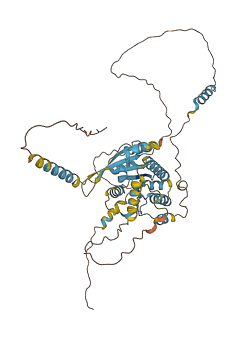
The autoinhibited protein was predicted that may have potential autoinhibitory elements via cis-regPred.
Autoinhibitory domains (AIDs)
Target domain |
|
Relief mechanism |
|
Assay |
cis-regPred |
Accessory elements
No accessory elements
Autoinhibited structure

Activated structure
1 structures for Q6PDL0
| Entry ID | Method | Resolution | Chain | Position | Source |
|---|---|---|---|---|---|
| AF-Q6PDL0-F1 | Predicted | AlphaFoldDB |
21 variants for Q6PDL0
| Variant ID(s) | Position | Change | Description | Diseaes Association | Provenance |
|---|---|---|---|---|---|
| rs3388973338 | 29 | E>D | No | EVA | |
| rs3388973327 | 85 | G>R | No | EVA | |
| rs3412866432 | 101 | H>R | No | EVA | |
| rs3399583268 | 117 | G>D | No | EVA | |
| rs3399076926 | 118 | L>Q | No | EVA | |
| rs3389010414 | 121 | F>S | No | EVA | |
| rs3399638927 | 123 | V>I | No | EVA | |
| rs240961730 | 144 | T>M | No | EVA | |
| rs3399616900 | 176 | K>N | No | EVA | |
| rs3389005740 | 196 | Q>* | No | EVA | |
| rs3388985124 | 201 | L>P | No | EVA | |
| rs3388973335 | 217 | N>Y | No | EVA | |
| rs217184718 | 295 | H>Q | No | EVA | |
| rs3399373149 | 316 | N>S | No | EVA | |
| rs3389001989 | 336 | Y>* | No | EVA | |
| rs3389005897 | 354 | L>W | No | EVA | |
| rs3389009540 | 361 | V>L | No | EVA | |
| rs3388985195 | 366 | Q>H | No | EVA | |
| rs3388997664 | 403 | V>L | No | EVA | |
| rs3389010365 | 430 | A>G | No | EVA | |
| rs213172844 | 476 | T>A | No | EVA |
No associated diseases with Q6PDL0
No regional properties for Q6PDL0
| Type | Name | Position | InterPro Accession |
|---|---|---|---|
| No domain, repeats, and functional sites for Q6PDL0 | |||
7 GO annotations of cellular component
| Name | Definition |
|---|---|
| centrosome | A structure comprised of a core structure (in most organisms, a pair of centrioles) and peripheral material from which a microtubule-based structure, such as a spindle apparatus, is organized. Centrosomes occur close to the nucleus during interphase in many eukaryotic cells, though in animal cells it changes continually during the cell-division cycle. |
| cytoplasmic dynein complex | Any dynein complex with a homodimeric dynein heavy chain core that catalyzes movement along a microtubule. Cytoplasmic dynein complexes participate in many cytoplasmic transport activities in eukaryotes, such as mRNA localization, intermediate filament transport, nuclear envelope breakdown, apoptosis, transport of centrosomal proteins, mitotic spindle assembly, virus transport, kinetochore functions, and movement of signaling and spindle checkpoint proteins. Some complexes participate in intraflagellar transport. Subunits associated with the dynein heavy chain mediate association between dynein heavy chain and cargoes, and may include light chains and light intermediate chains. |
| dynein complex | Any of several large complexes that contain two or three dynein heavy chains and several light chains, and have microtubule motor activity. |
| kinetochore | A multisubunit complex that is located at the centromeric region of DNA and provides an attachment point for the spindle microtubules. |
| late endosome | A prelysosomal endocytic organelle differentiated from early endosomes by lower lumenal pH and different protein composition. Late endosomes are more spherical than early endosomes and are mostly juxtanuclear, being concentrated near the microtubule organizing center. |
| lysosome | A small lytic vacuole that has cell cycle-independent morphology found in most animal cells and that contains a variety of hydrolases, most of which have their maximal activities in the pH range 5-6. The contained enzymes display latency if properly isolated. About 40 different lysosomal hydrolases are known and lysosomes have a great variety of morphologies and functions. |
| microtubule | Any of the long, generally straight, hollow tubes of internal diameter 12-15 nm and external diameter 24 nm found in a wide variety of eukaryotic cells; each consists (usually) of 13 protofilaments of polymeric tubulin, staggered in such a manner that the tubulin monomers are arranged in a helical pattern on the microtubular surface, and with the alpha/beta axes of the tubulin subunits parallel to the long axis of the tubule; exist in equilibrium with pool of tubulin monomers and can be rapidly assembled or disassembled in response to physiological stimuli; concerned with force generation, e.g. in the spindle. |
3 GO annotations of molecular function
| Name | Definition |
|---|---|
| ATP binding | Binding to ATP, adenosine 5'-triphosphate, a universally important coenzyme and enzyme regulator. |
| dynein heavy chain binding | Binding to a heavy chain of the dynein complex. |
| identical protein binding | Binding to an identical protein or proteins. |
4 GO annotations of biological process
| Name | Definition |
|---|---|
| cellular response to nerve growth factor stimulus | A process that results in a change in state or activity of a cell (in terms of movement, secretion, enzyme production, gene expression, etc.) as a result of a nerve growth factor stimulus. |
| centrosome localization | Any process in which a centrosome is transported to, and/or maintained in, a specific location within the cell. |
| microtubule cytoskeleton organization | A process that is carried out at the cellular level which results in the assembly, arrangement of constituent parts, or disassembly of cytoskeletal structures comprising microtubules and their associated proteins. |
| microtubule-based movement | A microtubule-based process that results in the movement of organelles, other microtubules, or other cellular components. Examples include motor-driven movement along microtubules and movement driven by polymerization or depolymerization of microtubules. |
1 homologous proteins in AiPD
| UniProt AC | Gene Name | Protein Name | Species | Evidence Code |
|---|---|---|---|---|
| O43237 | DYNC1LI2 | Cytoplasmic dynein 1 light intermediate chain 2 | Homo sapiens (Human) | PR |
| 10 | 20 | 30 | 40 | 50 | 60 |
| MAPVGVEKKL | LLGPNGPAVA | AAGDLTSEEE | EGQSLWSSIL | SEVSTRARSK | LPSGKNILVF |
| 70 | 80 | 90 | 100 | 110 | 120 |
| GEDGSGKTTL | MTKLQGAEHG | KKGRGLEYLY | LSVHDEDRDD | HTRCNVWILD | GDLYHKGLLK |
| 130 | 140 | 150 | 160 | 170 | 180 |
| FAVSAESLRE | TLVIFVADMS | RPWTIMESLQ | KWASVLREHI | DKMKIPPEEM | RDLERKFMKE |
| 190 | 200 | 210 | 220 | 230 | 240 |
| FQDYIEPEEG | CQGSPQRRGP | LTSGSDEDSV | ALPLGDNVLT | HNLGIPVLVV | CTKCDAMSVL |
| 250 | 260 | 270 | 280 | 290 | 300 |
| EKEHDYRDEH | LDFIQAHLRR | FCLQYGAALI | YTSVKEEKNL | DLLYKYIVHK | TYGFHFTIPA |
| 310 | 320 | 330 | 340 | 350 | 360 |
| LVVEKDAVFI | PAGWDNEKKI | AILHENFTTV | KPEDAYEDFI | VKPPVRKLVH | DKELAAEDEQ |
| 370 | 380 | 390 | 400 | 410 | 420 |
| VFLMKQQSLL | AKQPATPTRT | SESPARGPSG | SPRTQGRGGP | ASVPSASPGT | SVKKPDPNIK |
| 430 | 440 | 450 | 460 | 470 | 480 |
| NNAASEGVLA | SFFNSLLSKK | TGSPGSPSAG | GVQSTAKKSG | QKTVLSNVQE | ELDRMTRKPD |
| 490 | |||||
| SMVTNSSTEN | EA |