Q6PCP5
Gene name |
Mff |
Protein name |
Mitochondrial fission factor |
Names |
|
Species |
Mus musculus (Mouse) |
KEGG Pathway |
mmu:75734 |
EC number |
|
Protein Class |
|
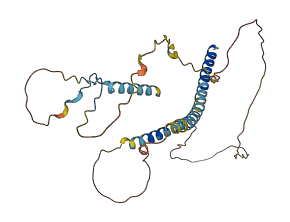
Descriptions
The autoinhibited protein was predicted that may have potential autoinhibitory elements via cis-regPred.
Autoinhibitory domains (AIDs)
Target domain |
|
Relief mechanism |
|
Assay |
cis-regPred |
Accessory elements
No accessory elements
Autoinhibited structure

Activated structure
1 structures for Q6PCP5
| Entry ID | Method | Resolution | Chain | Position | Source |
|---|---|---|---|---|---|
| AF-Q6PCP5-F1 | Predicted | AlphaFoldDB |
8 variants for Q6PCP5
| Variant ID(s) | Position | Change | Description | Diseaes Association | Provenance |
|---|---|---|---|---|---|
| rs3390249426 | 7 | I>T | No | EVA | |
| rs3388483471 | 29 | V>A | No | EVA | |
| rs3388482195 | 32 | P>S | No | EVA | |
| rs255435573 | 110 | L>P | No | EVA | |
| rs3388484607 | 169 | N>K | No | EVA | |
| rs3388482076 | 202 | V>M | No | EVA | |
| rs3388484544 | 239 | V>E | No | EVA | |
| rs580786331 | 276 | I>M | No | EVA |
No associated diseases with Q6PCP5
1 regional properties for Q6PCP5
| Type | Name | Position | InterPro Accession |
|---|---|---|---|
| domain | Methyltransferase domain 25 | 136 - 238 | IPR041698 |
Functions
10 GO annotations of cellular component
| Name | Definition |
|---|---|
| anchoring junction | A cell junction that mechanically attaches a cell (and its cytoskeleton) to neighboring cells or to the extracellular matrix. |
| integral component of mitochondrial membrane | The component of the mitochondrial membrane consisting of the gene products having at least some part of their peptide sequence embedded in the hydrophobic region of the membrane. |
| integral component of mitochondrial outer membrane | The component of the mitochondrial outer membrane consisting of the gene products having at least some part of their peptide sequence embedded in the hydrophobic region of the membrane. |
| mitochondrial membrane | Either of the lipid bilayers that surround the mitochondrion and form the mitochondrial envelope. |
| mitochondrial outer membrane | The outer, i.e. cytoplasm-facing, lipid bilayer of the mitochondrial envelope. |
| mitochondrion | A semiautonomous, self replicating organelle that occurs in varying numbers, shapes, and sizes in the cytoplasm of virtually all eukaryotic cells. It is notably the site of tissue respiration. |
| peroxisome | A small organelle enclosed by a single membrane, and found in most eukaryotic cells. Contains peroxidases and other enzymes involved in a variety of metabolic processes including free radical detoxification, lipid catabolism and biosynthesis, and hydrogen peroxide metabolism. |
| protein-containing complex | A stable assembly of two or more macromolecules, i.e. proteins, nucleic acids, carbohydrates or lipids, in which at least one component is a protein and the constituent parts function together. |
| synaptic vesicle | A secretory organelle, typically 50 nm in diameter, of presynaptic nerve terminals; accumulates in high concentrations of neurotransmitters and secretes these into the synaptic cleft by fusion with the 'active zone' of the presynaptic plasma membrane. |
| synaptic vesicle membrane | The lipid bilayer surrounding a synaptic vesicle. |
4 GO annotations of molecular function
| Name | Definition |
|---|---|
| GTPase binding | Binding to a GTPase, any enzyme that catalyzes the hydrolysis of GTP. |
| identical protein binding | Binding to an identical protein or proteins. |
| protein homodimerization activity | Binding to an identical protein to form a homodimer. |
| protein-containing complex binding | Binding to a macromolecular complex. |
14 GO annotations of biological process
| Name | Definition |
|---|---|
| mitochondrial fission | The division of a mitochondrion within a cell to form two or more separate mitochondrial compartments. |
| mitochondrial fragmentation involved in apoptotic process | The change in the morphology of the mitochondria in an apoptotic cell from a highly branched network to a fragmented vesicular form. |
| mitochondrial fusion | Merging of two or more mitochondria within a cell to form a single compartment. |
| mitochondrion morphogenesis | The process in which the anatomical structures of a mitochondrion are generated and organized. |
| peroxisome fission | The division of a mature peroxisome within a cell to form two or more separate peroxisome compartments. |
| positive regulation of cardiac muscle cell apoptotic process | Any process that increases the rate or extent of cardiac cell apoptotic process, a form of programmed cell death induced by external or internal signals that trigger the activity of proteolytic caspases whose actions dismantle a cardiac muscle cell and result in its death. |
| positive regulation of mitochondrial fission | Any process that increases the rate, frequency or extent of mitochondrial fission. Mitochondrial fission is the division of a mitochondrion within a cell to form two or more separate mitochondrial compartments. |
| positive regulation of protein targeting to membrane | Any process that increases the frequency, rate or extent of the process of directing proteins towards a membrane, usually using signals contained within the protein. |
| positive regulation of release of cytochrome c from mitochondria | Any process that increases the rate, frequency or extent of release of cytochrome c from mitochondria, the process in which cytochrome c is enabled to move from the mitochondrial intermembrane space into the cytosol, which is an early step in apoptosis and leads to caspase activation. |
| positive regulation of synaptic vesicle endocytosis | Any process that activates or increases the frequency, rate or extent of synaptic vesicle endocytosis. |
| protein targeting to mitochondrion | The process of directing proteins towards and into the mitochondrion, usually mediated by mitochondrial proteins that recognize signals contained within the imported protein. |
| regulation of mitochondrion organization | Any process that modulates the frequency, rate or extent of a process involved in the formation, arrangement of constituent parts, or disassembly of a mitochondrion. |
| regulation of peroxisome organization | Any process that modulates the frequency, rate or extent of peroxisome organization. |
| release of cytochrome c from mitochondria | The process that results in the movement of cytochrome c from the mitochondrial intermembrane space into the cytosol, which is part of the apoptotic signaling pathway and leads to caspase activation. |
1 homologous proteins in AiPD
| UniProt AC | Gene Name | Protein Name | Species | Evidence Code |
|---|---|---|---|---|
| Q9GZY8 | MFF | Mitochondrial fission factor | Homo sapiens (Human) | PR |
| 10 | 20 | 30 | 40 | 50 | 60 |
| MAEISRIQYE | MEYTEGISQR | MRVPEKLKVA | PPNADLEQEF | QDGVPNASVI | MQVPERIVVT |
| 70 | 80 | 90 | 100 | 110 | 120 |
| GNNEDISFSR | PADLDLIQST | PFKPLALKTP | PRVLTLSERP | LDFLDLERPL | PTPQSEESRA |
| 130 | 140 | 150 | 160 | 170 | 180 |
| VGRLKRERSM | SENAVRQNGQ | LVRNDSIVTP | SPPQARVCPP | HMLPEDGANL | SSARGILSLI |
| 190 | 200 | 210 | 220 | 230 | 240 |
| QSSTRRAYQQ | ILDVLDENRR | PVLRGGSAAA | TSNPHHDNVR | YGISNLDAAI | EGASDDMTVV |
| 250 | 260 | 270 | 280 | 290 | |
| DAASLRRQII | KLNRRLQLLE | EENKERAKRE | MVMYSITVAF | WLLNSWLWFR | R |