Q6NU09
Gene name |
lrrc8e |
Protein name |
Volume-regulated anion channel subunit LRRC8E |
Names |
Leucine-rich repeat-containing protein 8E |
Species |
Xenopus laevis (African clawed frog) |
KEGG Pathway |
xla:414524 |
EC number |
|
Protein Class |
|
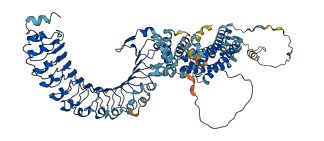
Descriptions
The autoinhibited protein was predicted that may have potential autoinhibitory elements via cis-regPred.
Autoinhibitory domains (AIDs)
Target domain |
|
Relief mechanism |
|
Assay |
cis-regPred |
Accessory elements
No accessory elements
Autoinhibited structure

Activated structure
1 structures for Q6NU09
| Entry ID | Method | Resolution | Chain | Position | Source |
|---|---|---|---|---|---|
| AF-Q6NU09-F1 | Predicted | AlphaFoldDB |
No variants for Q6NU09
| Variant ID(s) | Position | Change | Description | Diseaes Association | Provenance |
|---|---|---|---|---|---|
| No variants for Q6NU09 | |||||
No associated diseases with Q6NU09
10 regional properties for Q6NU09
| Type | Name | Position | InterPro Accession |
|---|---|---|---|
| repeat | Leucine-rich repeat | 616 - 637 | IPR001611-1 |
| repeat | Leucine-rich repeat | 640 - 708 | IPR001611-2 |
| repeat | Leucine-rich repeat | 711 - 766 | IPR001611-3 |
| repeat | Leucine-rich repeat, typical subtype | 614 - 637 | IPR003591-1 |
| repeat | Leucine-rich repeat, typical subtype | 639 - 661 | IPR003591-2 |
| repeat | Leucine-rich repeat, typical subtype | 662 - 685 | IPR003591-3 |
| repeat | Leucine-rich repeat, typical subtype | 687 - 706 | IPR003591-4 |
| repeat | Leucine-rich repeat, typical subtype | 708 - 731 | IPR003591-5 |
| repeat | Leucine-rich repeat, typical subtype | 754 - 777 | IPR003591-6 |
| domain | LRRC8, pannexin-like TM region | 1 - 341 | IPR021040 |
Functions
6 GO annotations of cellular component
| Name | Definition |
|---|---|
| cytoplasm | The contents of a cell excluding the plasma membrane and nucleus, but including other subcellular structures. |
| endoplasmic reticulum membrane | The lipid bilayer surrounding the endoplasmic reticulum. |
| integral component of lysosomal membrane | The component of the lysosome membrane consisting of the gene products and protein complexes having at least some part of their peptide sequence embedded in the hydrophobic region of the membrane. |
| integral component of plasma membrane | The component of the plasma membrane consisting of the gene products and protein complexes having at least some part of their peptide sequence embedded in the hydrophobic region of the membrane. |
| ion channel complex | A protein complex that spans a membrane and forms a water-filled channel across the phospholipid bilayer allowing selective ion transport down its electrochemical gradient. |
| plasma membrane | The membrane surrounding a cell that separates the cell from its external environment. It consists of a phospholipid bilayer and associated proteins. |
1 GO annotations of molecular function
| Name | Definition |
|---|---|
| volume-sensitive anion channel activity | Enables the transmembrane transfer of an anion by a volume-sensitive channel. An anion is a negatively charged ion. A volume-sensitive channel is a channel that responds to changes in the volume of a cell. |
5 GO annotations of biological process
| Name | Definition |
|---|---|
| anion transmembrane transport | The process in which an anion is transported across a membrane. |
| aspartate transmembrane transport | The process in which aspartate is transported across a lipid bilayer, from one side of a membrane to the other. |
| cell volume homeostasis | Any process involved in maintaining the steady state of a cell's volume. The cell's volume refers to the three-dimensional space occupied by a cell. |
| cellular response to osmotic stress | Any process that results in a change in state or activity of a cell (in terms of movement, secretion, enzyme production, gene expression, etc.) as a result of a stimulus indicating an increase or decrease in the concentration of solutes outside the organism or cell. |
| cyclic-GMP-AMP transmembrane import across plasma membrane | The directed movement of cyclic-GMP-AMP from outside of a cell, across the plasma membrane and into the cytosol. |
No homologous proteins in AiPD
| UniProt AC | Gene Name | Protein Name | Species | Evidence Code |
|---|---|---|---|---|
| No homologous proteins | ||||
| 10 | 20 | 30 | 40 | 50 | 60 |
| MIPVAEFKQF | TEQQPAFKVL | KPWWDVLAEY | ITYAMLMIGV | FGCTLQVTQD | KIICLPNHTS |
| 70 | 80 | 90 | 100 | 110 | 120 |
| ADVVSQITCQ | EFTQQSSASN | DSDLETTVPP | PTATSSPPRE | MSGLRNNLDL | QQYSFINQMC |
| 130 | 140 | 150 | 160 | 170 | 180 |
| YETALHWYAK | YFPYLVVIHT | LIFIICGNFW | FKFPGTSSKI | EHFISILGKC | FDSPWTTRAL |
| 190 | 200 | 210 | 220 | 230 | 240 |
| SEVSGESSQE | KPNQERSIDR | ELSKPNFEEG | SPATADLPIP | DKLVAETSSA | SALDKKEGEQ |
| 250 | 260 | 270 | 280 | 290 | 300 |
| AKALFEKVKK | FRHHVEEGDL | LYSMYMRQTV | LKVCKFVLIT | IYNAVLVGKI | HFIVPCSVHT |
| 310 | 320 | 330 | 340 | 350 | 360 |
| EDMTGYNSFC | CNHTKAHLFS | KLAISYLCFL | GVYGLTCFYT | LYWLFRRPLK | EYSFRSVREE |
| 370 | 380 | 390 | 400 | 410 | 420 |
| TGIGDIPDVK | NDFAFVLHLV | DQYDSLYSKR | FAVFLSEVSE | SRLRQLNLNH | EWPADKLRQK |
| 430 | 440 | 450 | 460 | 470 | 480 |
| LQHTPEGRLE | LHLFKLPGLP | DTVFEVAEME | SLKLEMVNEA | LIPPLVSKLV | RLEELSLLNC |
| 490 | 500 | 510 | 520 | 530 | 540 |
| TAKVQHASMA | YLRDHLRILQ | VKFDDIKEIP | LWIFGLRALE | ELHLFGWLSQ | DLSKNPALES |
| 550 | 560 | 570 | 580 | 590 | 600 |
| LRELKSLKVL | TIKSNLSKIP | ATVADVAGHL | QKFSIHNDGT | KLLTLNALKR | LVLVKELELV |
| 610 | 620 | 630 | 640 | 650 | 660 |
| RCELERIPHA | VFSLTNLQVL | DLKENTLHTI | EEIISLQHCR | KLSVLRLWHN | QIAYIPDHIR |
| 670 | 680 | 690 | 700 | 710 | 720 |
| KLKGLEELSL | NRNKILVIPS | QLFLCNKLRH | LDLSFNEIRE | LPPEIGVLQL | LQYLGLSGNF |
| 730 | 740 | 750 | 760 | 770 | 780 |
| LEDLPTELFF | CQKLKTLKLG | QNRLASLSPK | VGSLVCLVKL | ELKGNRMDML | PPEIGNCLSL |
| 790 | 800 | ||||
| KRSGLNVESL | LFDTLPVDVR | DKFKED |