Q6NLW5
Gene name |
XRI1 (At5g48720, K24G6.5) |
Protein name |
Protein XRI1 |
Names |
Protein X-RAY INDUCED 1 |
Species |
Arabidopsis thaliana (Mouse-ear cress) |
KEGG Pathway |
ath:AT5G48720 |
EC number |
|
Protein Class |
|
Descriptions
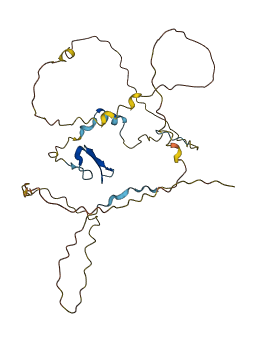
The autoinhibited protein was predicted that may have potential autoinhibitory elements via cis-regPred.
Autoinhibitory domains (AIDs)
Target domain |
|
Relief mechanism |
|
Assay |
cis-regPred |
Accessory elements
No accessory elements
Autoinhibited structure

Activated structure
1 structures for Q6NLW5
| Entry ID | Method | Resolution | Chain | Position | Source |
|---|---|---|---|---|---|
| AF-Q6NLW5-F1 | Predicted | AlphaFoldDB |
21 variants for Q6NLW5
| Variant ID(s) | Position | Change | Description | Diseaes Association | Provenance |
|---|---|---|---|---|---|
| ENSVATH07374469 | 9 | S>I | No | 1000Genomes | |
| ENSVATH07374470 | 21 | H>Q | No | 1000Genomes | |
| ENSVATH12642341 | 48 | M>L | No | 1000Genomes | |
| ENSVATH12642342 | 58 | A>T | No | 1000Genomes | |
| tmp_5_19760115_C_G | 60 | S>R | No | 1000Genomes | |
| ENSVATH07374475 | 67 | T>I | No | 1000Genomes | |
| tmp_5_19760241_G_T | 73 | R>M | No | 1000Genomes | |
| tmp_5_19760252_G_A | 77 | V>M | No | 1000Genomes | |
| ENSVATH12642369 | 88 | R>C | No | 1000Genomes | |
| tmp_5_19760759_A_T | 131 | I>L | No | 1000Genomes | |
| tmp_5_19760908_G_A | 155 | A>T | No | 1000Genomes | |
| tmp_5_19760927_C_T | 161 | A>V | No | 1000Genomes | |
| tmp_5_19760929_G_A | 162 | E>K | No | 1000Genomes | |
| ENSVATH12642393 | 173 | G>S | No | 1000Genomes | |
| ENSVATH14613549 | 188 | P>S | No | 1000Genomes | |
| tmp_5_19761194_G_A | 194 | R>K | No | 1000Genomes | |
| ENSVATH07374504 | 196 | V>I | No | 1000Genomes | |
| ENSVATH07374504 | 196 | V>L | No | 1000Genomes | |
| tmp_5_19761220_T_C | 203 | S>P | No | 1000Genomes | |
| ENSVATH12642427 | 222 | L>V | No | 1000Genomes | |
| ENSVATH14613550 | 296 | M>L | No | 1000Genomes |
No associated diseases with Q6NLW5
No regional properties for Q6NLW5
| Type | Name | Position | InterPro Accession |
|---|---|---|---|
| No domain, repeats, and functional sites for Q6NLW5 | |||
1 GO annotations of cellular component
| Name | Definition |
|---|---|
| nucleus | A membrane-bounded organelle of eukaryotic cells in which chromosomes are housed and replicated. In most cells, the nucleus contains all of the cell's chromosomes except the organellar chromosomes, and is the site of RNA synthesis and processing. In some species, or in specialized cell types, RNA metabolism or DNA replication may be absent. |
No GO annotations of molecular function
| Name | Definition |
|---|---|
| No GO annotations for molecular function |
5 GO annotations of biological process
| Name | Definition |
|---|---|
| DNA repair | The process of restoring DNA after damage. Genomes are subject to damage by chemical and physical agents in the environment (e.g. UV and ionizing radiations, chemical mutagens, fungal and bacterial toxins, etc.) and by free radicals or alkylating agents endogenously generated in metabolism. DNA is also damaged because of errors during its replication. A variety of different DNA repair pathways have been reported that include direct reversal, base excision repair, nucleotide excision repair, photoreactivation, bypass, double-strand break repair pathway, and mismatch repair pathway. |
| female meiotic nuclear division | A cell cycle process by which the cell nucleus divides as part of a meiotic cell cycle in the female germline. |
| male meiotic nuclear division | A cell cycle process by which the cell nucleus divides as part of a meiotic cell cycle in the male germline. |
| pollen development | The process whose specific outcome is the progression of the pollen grain over time, from its formation to the mature structure. The process begins with the meiosis of the microsporocyte to form four haploid microspores. The nucleus of each microspore then divides by mitosis to form a two-celled organism, the pollen grain, that contains a tube cell as well as a smaller generative cell. The pollen grain is surrounded by an elaborate cell wall. In some species, the generative cell immediately divides again to give a pair of sperm cells. In most flowering plants, however this division takes place later, in the tube that develops when a pollen grain germinates. |
| response to X-ray | Any process that results in a change in state or activity of a cell or an organism (in terms of movement, secretion, enzyme production, gene expression, etc.) as a result of X-ray radiation. An X-ray is a form of electromagnetic radiation with a wavelength in the range of 10 nanometers to 100 picometers (corresponding to frequencies in the range 30 PHz to 3 EHz). |
No homologous proteins in AiPD
| UniProt AC | Gene Name | Protein Name | Species | Evidence Code |
|---|---|---|---|---|
| No homologous proteins | ||||
| 10 | 20 | 30 | 40 | 50 | 60 |
| MDYGDDDRSS | SWNWQVDNYN | HQPQSHFSDV | PDCTMTEVTL | NQEDHSYMFD | DENTPVKACS |
| 70 | 80 | 90 | 100 | 110 | 120 |
| ELGYHVTTED | TNRKMEVHSE | TRSALKRRRM | LQFEDQPETS | LFSSESFSAI | LKSSARDDTF |
| 130 | 140 | 150 | 160 | 170 | 180 |
| DELLPEGSQL | IEGFSEDASA | SSFEGLDLYA | EEWYADCLND | AETPMLPDDL | NFGSPDVQVD |
| 190 | 200 | 210 | 220 | 230 | 240 |
| ISEYLNVPPE | TETREVQRPV | TRSSPNVIFK | GRKSFSRPVS | KLPSSIIYPF | AFIKPCGVHG |
| 250 | 260 | 270 | 280 | 290 | |
| GMTLKDINQK | IRNPPAKPKA | HIEEPAVIQT | SAFSGKPVVG | KTKIRTEGGK | GSITIMRTRG |