Q6INE2
Gene name |
unc119b-b |
Protein name |
Protein unc-119 homolog B-B |
Names |
|
Species |
Xenopus laevis (African clawed frog) |
KEGG Pathway |
xla:443847 |
EC number |
|
Protein Class |
|
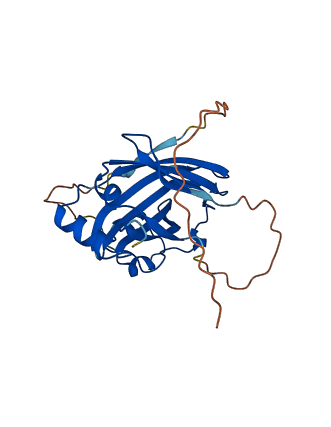
Descriptions
The autoinhibited protein was predicted that may have potential autoinhibitory elements via cis-regPred.
Autoinhibitory domains (AIDs)
Target domain |
|
Relief mechanism |
|
Assay |
cis-regPred |
Accessory elements
No accessory elements
Autoinhibited structure

Activated structure
1 structures for Q6INE2
| Entry ID | Method | Resolution | Chain | Position | Source |
|---|---|---|---|---|---|
| AF-Q6INE2-F1 | Predicted | AlphaFoldDB |
No variants for Q6INE2
| Variant ID(s) | Position | Change | Description | Diseaes Association | Provenance |
|---|---|---|---|---|---|
| No variants for Q6INE2 | |||||
No associated diseases with Q6INE2
No regional properties for Q6INE2
| Type | Name | Position | InterPro Accession |
|---|---|---|---|
| No domain, repeats, and functional sites for Q6INE2 | |||
1 GO annotations of cellular component
| Name | Definition |
|---|---|
| ciliary transition zone | A region of the cilium between the basal body and proximal segment that is characterized by Y-shaped assemblages that connect axonemal microtubules to the ciliary membrane. The ciliary transition zone appears to function as a gate that controls ciliary membrane composition and separates the cytosol from the ciliary plasm. |
1 GO annotations of molecular function
| Name | Definition |
|---|---|
| lipid binding | Binding to a lipid. |
2 GO annotations of biological process
| Name | Definition |
|---|---|
| cell projection organization | A process that is carried out at the cellular level which results in the assembly, arrangement of constituent parts, or disassembly of a prolongation or process extending from a cell, e.g. a flagellum or axon. |
| lipoprotein transport | The directed movement of any conjugated, water-soluble protein in which the nonprotein group consists of a lipid or lipids, into, out of or within a cell, or between cells, by means of some agent such as a transporter or pore. |
No homologous proteins in AiPD
| UniProt AC | Gene Name | Protein Name | Species | Evidence Code |
|---|---|---|---|---|
| No homologous proteins | ||||
| 10 | 20 | 30 | 40 | 50 | 60 |
| MSGSNREAAL | AGQPKDERKK | SGGGVINRLK | ARRVQGKESG | TSDQSSITRF | REEELLGLNE |
| 70 | 80 | 90 | 100 | 110 | 120 |
| LRPEHVLGLS | RVTDNYLCKP | EDNIFGIDFT | RFKIRDLETG | TVLFEISKPC | SEQEEEEEST |
| 130 | 140 | 150 | 160 | 170 | 180 |
| HLDASAGRFV | RYQFTPAFLR | LRKVGATVEF | TVGDKPVKSF | RMIERHYFRD | RILKSFDFDF |
| 190 | 200 | 210 | 220 | 230 | 240 |
| GFCIPNSRNT | CEHMYEFPQL | SEELIRLMTE | NPYETRSDSF | YFVDNKLIMH | NKADYAYNGG |
| Q |