Q6GPU3
Gene name |
dtl-b (cdt2-b) |
Protein name |
Denticleless protein homolog B |
Names |
|
Species |
Xenopus laevis (African clawed frog) |
KEGG Pathway |
xla:444035 |
EC number |
|
Protein Class |
|
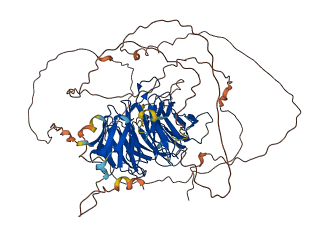
Descriptions
The autoinhibited protein was predicted that may have potential autoinhibitory elements via cis-regPred.
Autoinhibitory domains (AIDs)
Target domain |
|
Relief mechanism |
|
Assay |
cis-regPred |
Accessory elements
No accessory elements
Autoinhibited structure

Activated structure
1 structures for Q6GPU3
| Entry ID | Method | Resolution | Chain | Position | Source |
|---|---|---|---|---|---|
| AF-Q6GPU3-F1 | Predicted | AlphaFoldDB |
No variants for Q6GPU3
| Variant ID(s) | Position | Change | Description | Diseaes Association | Provenance |
|---|---|---|---|---|---|
| No variants for Q6GPU3 | |||||
No associated diseases with Q6GPU3
10 regional properties for Q6GPU3
| Type | Name | Position | InterPro Accession |
|---|---|---|---|
| repeat | WD40 repeat | 87 - 171 | IPR001680-1 |
| repeat | WD40 repeat | 206 - 254 | IPR001680-2 |
| repeat | WD40 repeat | 266 - 300 | IPR001680-3 |
| repeat | WD40 repeat | 305 - 348 | IPR001680-4 |
| repeat | WD40 repeat | 350 - 399 | IPR001680-5 |
| conserved_site | WD40 repeat, conserved site | 113 - 127 | IPR019775-1 |
| conserved_site | WD40 repeat, conserved site | 232 - 246 | IPR019775-2 |
| repeat | G-protein beta WD-40 repeat | 113 - 127 | IPR020472-1 |
| repeat | G-protein beta WD-40 repeat | 232 - 246 | IPR020472-2 |
| repeat | G-protein beta WD-40 repeat | 377 - 391 | IPR020472-3 |
6 GO annotations of cellular component
| Name | Definition |
|---|---|
| centrosome | A structure comprised of a core structure (in most organisms, a pair of centrioles) and peripheral material from which a microtubule-based structure, such as a spindle apparatus, is organized. Centrosomes occur close to the nucleus during interphase in many eukaryotic cells, though in animal cells it changes continually during the cell-division cycle. |
| chromosome | A structure composed of a very long molecule of DNA and associated proteins (e.g. histones) that carries hereditary information. |
| Cul4A-RING E3 ubiquitin ligase complex | A ubiquitin ligase complex in which a cullin from the Cul4A subfamily and a RING domain protein form the catalytic core; substrate specificity is conferred by an adaptor protein. |
| Cul4B-RING E3 ubiquitin ligase complex | A ubiquitin ligase complex in which a cullin from the Cul4B subfamily and a RING domain protein form the catalytic core; substrate specificity is conferred by unknown subunits. |
| cytoplasm | The contents of a cell excluding the plasma membrane and nucleus, but including other subcellular structures. |
| nucleus | A membrane-bounded organelle of eukaryotic cells in which chromosomes are housed and replicated. In most cells, the nucleus contains all of the cell's chromosomes except the organellar chromosomes, and is the site of RNA synthesis and processing. In some species, or in specialized cell types, RNA metabolism or DNA replication may be absent. |
No GO annotations of molecular function
| Name | Definition |
|---|---|
| No GO annotations for molecular function |
10 GO annotations of biological process
| Name | Definition |
|---|---|
| cellular response to DNA damage stimulus | Any process that results in a change in state or activity of a cell (in terms of movement, secretion, enzyme production, gene expression, etc.) as a result of a stimulus indicating damage to its DNA from environmental insults or errors during metabolism. |
| DNA replication | The cellular metabolic process in which a cell duplicates one or more molecules of DNA. DNA replication begins when specific sequences, known as origins of replication, are recognized and bound by initiation proteins, and ends when the original DNA molecule has been completely duplicated and the copies topologically separated. The unit of replication usually corresponds to the genome of the cell, an organelle, or a virus. The template for replication can either be an existing DNA molecule or RNA. |
| mitotic G2 DNA damage checkpoint signaling | A mitotic cell cycle checkpoint that detects and negatively regulates progression through the G2/M transition of the cell cycle in response to DNA damage. |
| protein monoubiquitination | Addition of a single ubiquitin group to a protein. |
| protein polyubiquitination | Addition of multiple ubiquitin groups to a protein, forming a ubiquitin chain. |
| regulation of cell cycle | Any process that modulates the rate or extent of progression through the cell cycle. |
| response to UV | Any process that results in a change in state or activity of a cell or an organism (in terms of movement, secretion, enzyme production, gene expression, etc.) as a result of an ultraviolet radiation (UV light) stimulus. Ultraviolet radiation is electromagnetic radiation with a wavelength in the range of 10 to 380 nanometers. |
| rhythmic process | Any process pertinent to the generation and maintenance of rhythms in the physiology of an organism. |
| translesion synthesis | The replication of damaged DNA by synthesis across a lesion in the template strand; a specialized DNA polymerase or replication complex inserts a defined nucleotide across from the lesion which allows DNA synthesis to continue beyond the lesion. This process can be mutagenic depending on the damaged nucleotide and the inserted nucleotide. |
| ubiquitin-dependent protein catabolic process | The chemical reactions and pathways resulting in the breakdown of a protein or peptide by hydrolysis of its peptide bonds, initiated by the covalent attachment of a ubiquitin group, or multiple ubiquitin groups, to the protein. |
No homologous proteins in AiPD
| UniProt AC | Gene Name | Protein Name | Species | Evidence Code |
|---|---|---|---|---|
| No homologous proteins | ||||
| 10 | 20 | 30 | 40 | 50 | 60 |
| MLFRSVVNKP | RFGCGHNGAP | FTSPLQSLLQ | CYQCVKQDEH | ISYGDLGRAV | PPFGCAFSTV |
| 70 | 80 | 90 | 100 | 110 | 120 |
| PGMSHVLAVA | NEEGIVRLYD | TECGDMQRLV | VKEFMAHTNA | VFDIAWVPGE | HKLVTASGDQ |
| 130 | 140 | 150 | 160 | 170 | 180 |
| TAKLWDVKAG | ELIGECKGHQ | CSLKSVAFSK | FERAVFSTGG | RDGNIMVWDT | RCNKKDGFYR |
| 190 | 200 | 210 | 220 | 230 | 240 |
| QVNQITGAHN | AIDKQTPSKV | KKRKPSIRGL | APSVDSQQSV | TVVIFQDEYT | VISAGAVDGV |
| 250 | 260 | 270 | 280 | 290 | 300 |
| VKIWDLRKNY | STYRQDPVPV | KLFPYPGNST | RKLGYSSLVL | DPTGTNLFAS | CTDDNVYMFN |
| 310 | 320 | 330 | 340 | 350 | 360 |
| ATGLKTDPVS | VFRGHQNSTF | YIKASVSPDG | QFLLSGSSDH | SAYIWQVSDP | LAAPINLIGH |
| 370 | 380 | 390 | 400 | 410 | 420 |
| CQEVTSVAWC | QSDFTKIATC | SDDNTVRIWR | LNRSSEDSSE | SNKTDYVGWA | CKKKFEPSSM |
| 430 | 440 | 450 | 460 | 470 | 480 |
| AAILCTPGKP | SMIPSSSLMS | SPTPATCAPS | NTGDLPLPSS | TPLSALLPTS | KLQTPKRINN |
| 490 | 500 | 510 | 520 | 530 | 540 |
| GGLGASPKQM | SSSKISIKDW | VTRTPKSSKG | TDSKTPSPRK | AFTPVEQYPI | VSNARVQLPY |
| 550 | 560 | 570 | 580 | 590 | 600 |
| EKRAKRRLET | SSEDVEHVCL | DNCCVMELEP | RLKKSKLDLC | SLNERDCRDD | KCLRLSDLSK |
| 610 | 620 | 630 | 640 | 650 | 660 |
| EFDQELSPSP | STSLHMNATD | NPPTLSPLSE | MKSDFVDKEN | SSPEKNWLSA | LGHKFKSDNS |
| 670 | 680 | 690 | 700 | 710 | |
| SPQFKSSSSP | SSRNSTSKKH | QPRNAPNSPV | SVPTTPGSMR | KICTYFFKKS | E |