Q6GPQ4
Gene name |
smyd5 |
Protein name |
Histone-lysine N-trimethyltransferase SMYD5 |
Names |
SET and MYND domain-containing protein 5, [histone H4]-lysine20 N-trimethyltransferase SMYD5 |
Species |
Xenopus laevis (African clawed frog) |
KEGG Pathway |
xla:444061 |
EC number |
2.1.1.372: Methyltransferases |
Protein Class |
|
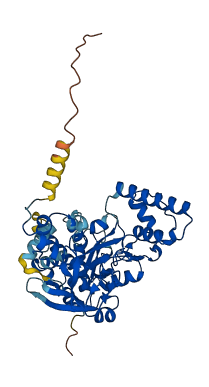
Descriptions
The autoinhibited protein was predicted that may have potential autoinhibitory elements via cis-regPred.
Autoinhibitory domains (AIDs)
Target domain |
|
Relief mechanism |
|
Assay |
cis-regPred |
Accessory elements
No accessory elements
Autoinhibited structure

Activated structure
1 structures for Q6GPQ4
| Entry ID | Method | Resolution | Chain | Position | Source |
|---|---|---|---|---|---|
| AF-Q6GPQ4-F1 | Predicted | AlphaFoldDB |
No variants for Q6GPQ4
| Variant ID(s) | Position | Change | Description | Diseaes Association | Provenance |
|---|---|---|---|---|---|
| No variants for Q6GPQ4 | |||||
No associated diseases with Q6GPQ4
No regional properties for Q6GPQ4
| Type | Name | Position | InterPro Accession |
|---|---|---|---|
| No domain, repeats, and functional sites for Q6GPQ4 | |||
Functions
| Description | ||
|---|---|---|
| EC Number | 2.1.1.372 | Methyltransferases |
| Subcellular Localization |
|
|
| PANTHER Family | ||
| PANTHER Subfamily | ||
| PANTHER Protein Class | ||
| PANTHER Pathway Category | No pathway information available | |
No GO annotations of cellular component
| Name | Definition |
|---|---|
| No GO annotations for cellular component |
2 GO annotations of molecular function
| Name | Definition |
|---|---|
| histone methyltransferase activity (H4-K20 specific) | Catalysis of the reaction: S-adenosyl-L-methionine + histone H4 L-lysine (position 20) = S-adenosyl-L-homocysteine + histone H4 N6-methyl-L-lysine (position 20). This reaction is the addition of a methyl group onto lysine at position 20 of the histone H4 protein. |
| metal ion binding | Binding to a metal ion. |
4 GO annotations of biological process
| Name | Definition |
|---|---|
| histone H4-K20 trimethylation | The modification of histone H4 by addition of three methyl groups to lysine at position 20 of the histone. |
| negative regulation of gene expression, epigenetic | An epigenetic process that silences gene expression at specific genomic regions through chromatin remodelling either by modifying higher order chromatin fiber structure, nucleosomal histones, or the DNA. |
| regulation of stem cell differentiation | Any process that modulates the frequency, rate or extent of stem cell differentiation. |
| regulation of stem cell division | Any process that modulates the frequency, rate or extent of stem cell division. |
No homologous proteins in AiPD
| UniProt AC | Gene Name | Protein Name | Species | Evidence Code |
|---|---|---|---|---|
| No homologous proteins | ||||
| 10 | 20 | 30 | 40 | 50 | 60 |
| MAASMCDVFA | FCAEQEPARR | TVEIRFVSSG | KGKGLFAIRT | IRKGETIFQE | KPLVSSQFQW |
| 70 | 80 | 90 | 100 | 110 | 120 |
| NALYRYRACD | HCLRSLETAE | ENAQRLSGNA | HVLLPYPELC | TVRNGLHQQC | PRCQVTYCSA |
| 130 | 140 | 150 | 160 | 170 | 180 |
| ECLKAAAEQY | HQILCLETSR | DNPAHPLNKL | EEAWRNMHYP | PETASIMLMA | RMVGTIKQAQ |
| 190 | 200 | 210 | 220 | 230 | 240 |
| DKDWWLHLFS | QFCNKTANEE | EEIVHKLLGE | KFKGQLDQLR | RLFVDALYEE | RMSRWFTPEG |
| 250 | 260 | 270 | 280 | 290 | 300 |
| FRSLFALVGT | NGQGIGTSSL | SQWVHACDAL | ELPPRDREKL | DALIDQLYKD | IEKVTGEFLN |
| 310 | 320 | 330 | 340 | 350 | 360 |
| CEGSGLYLLQ | SCCNHSCVPN | AEASFPDNNF | ILHLTALEDI | QPGEEICISY | LDCCQRDRSR |
| 370 | 380 | 390 | 400 | 410 | 420 |
| HSRQKILREN | YLFMCSCPKC | LAQADEPDIT | SEEEEEEEEE | DDAELEGEPE | DAELEDEMTD |
| V |