Q6GPN6
Gene name |
sgk1-a (sgk-a) |
Protein name |
Serine/threonine-protein kinase Sgk1-A |
Names |
Serum/glucocorticoid-regulated kinase 1-A |
Species |
Xenopus laevis (African clawed frog) |
KEGG Pathway |
xla:399130 |
EC number |
2.7.11.1: Protein-serine/threonine kinases |
Protein Class |
|
Descriptions
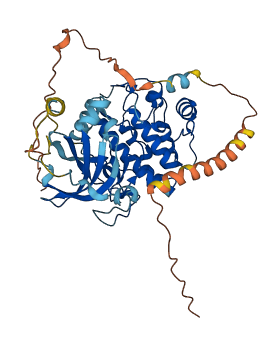
The autoinhibited protein was predicted that may have potential autoinhibitory elements via cis-regPred.
Autoinhibitory domains (AIDs)
Target domain |
|
Relief mechanism |
|
Assay |
cis-regPred |
Accessory elements
242-265 (Activation loop from InterPro)
Target domain |
101-358 (Protein kinase domain) |
Relief mechanism |
|
Assay |
|
Autoinhibited structure

Activated structure
1 structures for Q6GPN6
| Entry ID | Method | Resolution | Chain | Position | Source |
|---|---|---|---|---|---|
| AF-Q6GPN6-F1 | Predicted | AlphaFoldDB |
No variants for Q6GPN6
| Variant ID(s) | Position | Change | Description | Diseaes Association | Provenance |
|---|---|---|---|---|---|
| No variants for Q6GPN6 | |||||
No associated diseases with Q6GPN6
5 regional properties for Q6GPN6
| Type | Name | Position | InterPro Accession |
|---|---|---|---|
| domain | Protein kinase domain | 101 - 358 | IPR000719 |
| domain | AGC-kinase, C-terminal | 359 - 434 | IPR000961 |
| active_site | Serine/threonine-protein kinase, active site | 221 - 233 | IPR008271 |
| binding_site | Protein kinase, ATP binding site | 107 - 139 | IPR017441 |
| domain | Protein kinase, C-terminal | 379 - 426 | IPR017892 |
Functions
| Description | ||
|---|---|---|
| EC Number | 2.7.11.1 | Protein-serine/threonine kinases |
| Subcellular Localization |
|
|
| PANTHER Family | ||
| PANTHER Subfamily | ||
| PANTHER Protein Class | ||
| PANTHER Pathway Category | No pathway information available | |
2 GO annotations of cellular component
| Name | Definition |
|---|---|
| endoplasmic reticulum | The irregular network of unit membranes, visible only by electron microscopy, that occurs in the cytoplasm of many eukaryotic cells. The membranes form a complex meshwork of tubular channels, which are often expanded into slitlike cavities called cisternae. The ER takes two forms, rough (or granular), with ribosomes adhering to the outer surface, and smooth (with no ribosomes attached). |
| nucleus | A membrane-bounded organelle of eukaryotic cells in which chromosomes are housed and replicated. In most cells, the nucleus contains all of the cell's chromosomes except the organellar chromosomes, and is the site of RNA synthesis and processing. In some species, or in specialized cell types, RNA metabolism or DNA replication may be absent. |
3 GO annotations of molecular function
| Name | Definition |
|---|---|
| ATP binding | Binding to ATP, adenosine 5'-triphosphate, a universally important coenzyme and enzyme regulator. |
| protein serine kinase activity | Catalysis of the reactions: ATP + protein serine = ADP + protein serine phosphate. |
| protein serine/threonine kinase activity | Catalysis of the reactions: ATP + protein serine = ADP + protein serine phosphate, and ATP + protein threonine = ADP + protein threonine phosphate. |
2 GO annotations of biological process
| Name | Definition |
|---|---|
| apoptotic process | A programmed cell death process which begins when a cell receives an internal (e.g. DNA damage) or external signal (e.g. an extracellular death ligand), and proceeds through a series of biochemical events (signaling pathway phase) which trigger an execution phase. The execution phase is the last step of an apoptotic process, and is typically characterized by rounding-up of the cell, retraction of pseudopodes, reduction of cellular volume (pyknosis), chromatin condensation, nuclear fragmentation (karyorrhexis), plasma membrane blebbing and fragmentation of the cell into apoptotic bodies. When the execution phase is completed, the cell has died. |
| protein phosphorylation | The process of introducing a phosphate group on to a protein. |
No homologous proteins in AiPD
| UniProt AC | Gene Name | Protein Name | Species | Evidence Code |
|---|---|---|---|---|
| No homologous proteins | ||||
| 10 | 20 | 30 | 40 | 50 | 60 |
| MTVKTETAAG | ASTLTYSKMR | GMVALLIAFM | KQRRMGLNDF | IQKIATNSSY | ACKPSEVQSI |
| 70 | 80 | 90 | 100 | 110 | 120 |
| LNISPPQEPE | LLNENSSPPP | SPSQQINLGP | SSNPHAKPSD | FQFLKIIGKG | SFGKVLLARH |
| 130 | 140 | 150 | 160 | 170 | 180 |
| QADEKFYAVK | VLQKKAILKK | KEEKHIMSER | NVLLKNVKHP | FLVGLHFSFQ | TTSRLYFILD |
| 190 | 200 | 210 | 220 | 230 | 240 |
| YINGGELFYH | LQRERCFLEP | RARFYAAEIA | SALGYLHSLN | IVYRDLKPEN | ILLDSQGHIV |
| 250 | 260 | 270 | 280 | 290 | 300 |
| LTDFGLCKEN | IEPNGTTSTF | CGTPEYLAPE | VLHKQPYDRT | VDWWCLGAVL | YEMLYGLPPF |
| 310 | 320 | 330 | 340 | 350 | 360 |
| YSRNTAEMYD | NILNKPLQLK | PNITNSARNL | LEGLLQKDRT | KRIGAKNDFM | EIKNHIFFSP |
| 370 | 380 | 390 | 400 | 410 | 420 |
| INWDDLINKK | ITPPFNPNVS | GPSDLQHFDP | EFTEEPVPNS | IGQSPDSILI | TASIKEAAEA |
| 430 | |||||
| FMGFSYAPPM | ESYL |