Q6GND3
Gene name |
jmjd6-a (ptdsr-a) |
Protein name |
Bifunctional arginine demethylase and lysyl-hydroxylase JMJD6-A |
Names |
Histone arginine demethylase JMJD6-A, JmjC domain-containing protein 6-A, Jumonji domain-containing protein 6-A, Lysyl-hydroxylase JMJD6-A, Peptide-lysine 5-dioxygenase JMJD6-A, Phosphatidylserine receptor-A, Protein PTDSR-A |
Species |
Xenopus laevis (African clawed frog) |
KEGG Pathway |
xla:444377 |
EC number |
|
Protein Class |
|
Descriptions
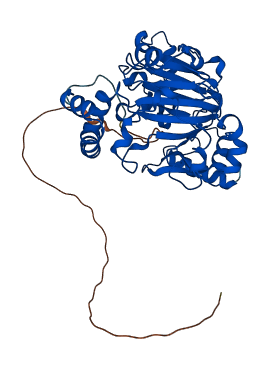
The autoinhibited protein was predicted that may have potential autoinhibitory elements via cis-regPred.
Autoinhibitory domains (AIDs)
Target domain |
|
Relief mechanism |
|
Assay |
cis-regPred |
Accessory elements
No accessory elements
Autoinhibited structure

Activated structure
1 structures for Q6GND3
| Entry ID | Method | Resolution | Chain | Position | Source |
|---|---|---|---|---|---|
| AF-Q6GND3-F1 | Predicted | AlphaFoldDB |
No variants for Q6GND3
| Variant ID(s) | Position | Change | Description | Diseaes Association | Provenance |
|---|---|---|---|---|---|
| No variants for Q6GND3 | |||||
No associated diseases with Q6GND3
1 regional properties for Q6GND3
| Type | Name | Position | InterPro Accession |
|---|---|---|---|
| domain | JmjC domain | 141 - 305 | IPR003347 |
4 GO annotations of cellular component
| Name | Definition |
|---|---|
| cytoplasm | The contents of a cell excluding the plasma membrane and nucleus, but including other subcellular structures. |
| nucleolus | A small, dense body one or more of which are present in the nucleus of eukaryotic cells. It is rich in RNA and protein, is not bounded by a limiting membrane, and is not seen during mitosis. Its prime function is the transcription of the nucleolar DNA into 45S ribosomal-precursor RNA, the processing of this RNA into 5.8S, 18S, and 28S components of ribosomal RNA, and the association of these components with 5S RNA and proteins synthesized outside the nucleolus. This association results in the formation of ribonucleoprotein precursors; these pass into the cytoplasm and mature into the 40S and 60S subunits of the ribosome. |
| nucleoplasm | That part of the nuclear content other than the chromosomes or the nucleolus. |
| nucleus | A membrane-bounded organelle of eukaryotic cells in which chromosomes are housed and replicated. In most cells, the nucleus contains all of the cell's chromosomes except the organellar chromosomes, and is the site of RNA synthesis and processing. In some species, or in specialized cell types, RNA metabolism or DNA replication may be absent. |
7 GO annotations of molecular function
| Name | Definition |
|---|---|
| demethylase activity | Catalysis of the removal of a methyl group from a substrate. |
| histone demethylase activity | Catalysis of the removal of a methyl group from a histone. |
| histone H3-methyl-arginine-2 demethylase activity | Catalysis of the removal of the methyl group from a modified arginine residue at position 2 of the histone H3 protein. This is a dioxygenase reaction that is dependent on Fe(II) and 2-oxoglutarate. |
| histone H3-methyl-arginine-3 demethylase activity | Catalysis of the removal of the methyl group from a modified arginine residue at position 3 of the histone H3 protein. This is a dioxygenase reaction that is dependent on Fe(II) and 2-oxoglutarate. |
| metal ion binding | Binding to a metal ion. |
| peptidyl-lysine 5-dioxygenase activity | Catalysis of the reaction: protein L-lysine + 2-oxoglutarate + O2 = protein 5-hydroxy-L-lysine + succinate + CO2. |
| single-stranded RNA binding | Binding to single-stranded RNA. |
10 GO annotations of biological process
| Name | Definition |
|---|---|
| cell differentiation | The process in which relatively unspecialized cells, e.g. embryonic or regenerative cells, acquire specialized structural and/or functional features that characterize the cells, tissues, or organs of the mature organism or some other relatively stable phase of the organism's life history. Differentiation includes the processes involved in commitment of a cell to a specific fate and its subsequent development to the mature state. |
| chromatin organization | The assembly or remodeling of chromatin composed of DNA complexed with histones, other associated proteins, and sometimes RNA. |
| histone H4-R3 demethylation | The modification of histone H4 by the removal of a methyl group from arginine at position 3 of the histone. |
| mRNA processing | Any process involved in the conversion of a primary mRNA transcript into one or more mature mRNA(s) prior to translation into polypeptide. |
| peptidyl-lysine hydroxylation to 5-hydroxy-L-lysine | The hydroxylation of peptidyl-lysine to peptidyl-5-hydroxy-L-lysine. |
| protein demethylation | The removal of a methyl group, from a protein amino acid. A methyl group is derived from methane by the removal of a hydrogen atom. |
| protein homooligomerization | The process of creating protein oligomers, compounds composed of a small number, usually between three and ten, of identical component monomers. Oligomers may be formed by the polymerization of a number of monomers or the depolymerization of a large protein polymer. |
| regulation of mRNA splicing, via spliceosome | Any process that modulates the frequency, rate or extent of mRNA splicing via a spliceosomal mechanism. |
| RNA splicing | The process of removing sections of the primary RNA transcript to remove sequences not present in the mature form of the RNA and joining the remaining sections to form the mature form of the RNA. |
| sprouting angiogenesis | The extension of new blood vessels from existing vessels into avascular tissues, this process includes the specialization of endothelial cells into leading tip and stalk cells, proliferation and migration of the endothelial cells and cell adhesion resulting in angiogenic sprout fusion or lumen formation. |
No homologous proteins in AiPD
| UniProt AC | Gene Name | Protein Name | Species | Evidence Code |
|---|---|---|---|---|
| No homologous proteins | ||||
| 10 | 20 | 30 | 40 | 50 | 60 |
| MNHKSKKRIK | EAKRSARPEL | KDSQDWCRHN | YCEVFSLNPS | TVRDNVERAD | DAHLSIEEFI |
| 70 | 80 | 90 | 100 | 110 | 120 |
| DRYEKPYKPV | VIVNATADWP | AQEKWTLERL | KRKYRNQKFK | CGEDNDGYSV | KMKMKYYIDY |
| 130 | 140 | 150 | 160 | 170 | 180 |
| MEGTRDDSPL | YIFDSSYGEH | PKRKKLLEDY | EVPKYFRDDL | FQFAGEKRRP | PYRWFVMGPA |
| 190 | 200 | 210 | 220 | 230 | 240 |
| RSGTGIHIDP | LGTSAWNSLV | HGHKRWCLFP | TNTPRELIKV | TRDEGGNQQD | EAITWFNVIY |
| 250 | 260 | 270 | 280 | 290 | 300 |
| PRTQLPSWPP | EFKPLEILQK | PGETVFVPGG | WWHVVLNLDT | AIAVTQNFAS | CSNFPVVWHK |
| 310 | 320 | 330 | 340 | 350 | 360 |
| TVRGRPKLSR | KWYRILKQER | PELAALADTV | DLQEATGIAS | DSSSDSSSSS | SSSSSESCSE |
| 370 | 380 | 390 | 400 | ||
| DDLSSGAEMM | SHRKKKRKIC | SVMENGDSTT | QDDCVSKERS | SSR |