Q6GM71
Gene name |
lrwd1 (orca) |
Protein name |
Leucine-rich repeat and WD repeat-containing protein 1 |
Names |
ORC-associated protein, ORCA, Origin recognition complex-associated protein |
Species |
Xenopus laevis (African clawed frog) |
KEGG Pathway |
xla:444544 |
EC number |
|
Protein Class |
|
Descriptions
The autoinhibited protein was predicted that may have potential autoinhibitory elements via cis-regPred.
Autoinhibitory domains (AIDs)
Target domain |
|
Relief mechanism |
|
Assay |
cis-regPred |
Accessory elements
No accessory elements
Autoinhibited structure

Activated structure
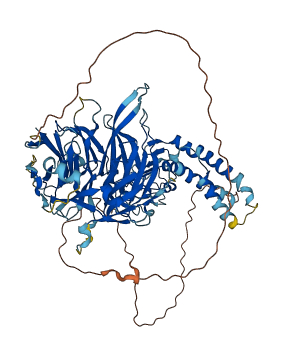
1 structures for Q6GM71
| Entry ID | Method | Resolution | Chain | Position | Source |
|---|---|---|---|---|---|
| AF-Q6GM71-F1 | Predicted | AlphaFoldDB |
No variants for Q6GM71
| Variant ID(s) | Position | Change | Description | Diseaes Association | Provenance |
|---|---|---|---|---|---|
| No variants for Q6GM71 | |||||
No associated diseases with Q6GM71
6 regional properties for Q6GM71
| Type | Name | Position | InterPro Accession |
|---|---|---|---|
| repeat | Leucine-rich repeat | 48 - 69 | IPR001611 |
| repeat | WD40 repeat | 339 - 391 | IPR001680-1 |
| repeat | WD40 repeat | 447 - 488 | IPR001680-2 |
| repeat | WD40 repeat | 498 - 537 | IPR001680-3 |
| repeat | WD40 repeat | 612 - 653 | IPR001680-4 |
| conserved_site | WD40 repeat, conserved site | 474 - 488 | IPR019775 |
Functions
7 GO annotations of cellular component
| Name | Definition |
|---|---|
| chromosome, telomeric region | The end of a linear chromosome, required for the integrity and maintenance of the end. A chromosome telomere usually includes a region of telomerase-encoded repeats the length of which rarely exceeds 20 bp each and that permits the formation of a telomeric loop (T-loop). The telomeric repeat region is usually preceded by a sub-telomeric region that is gene-poor but rich in repetitive elements. Some telomeres only consist of the latter part (for eg. D. melanogaster telomeres). |
| cytoplasm | The contents of a cell excluding the plasma membrane and nucleus, but including other subcellular structures. |
| kinetochore | A multisubunit complex that is located at the centromeric region of DNA and provides an attachment point for the spindle microtubules. |
| microtubule organizing center | An intracellular structure that can catalyze gamma-tubulin-dependent microtubule nucleation and that can anchor microtubules by interacting with their minus ends, plus ends or sides. |
| nuclear origin of replication recognition complex | A multisubunit complex that is located at the replication origins of a chromosome in the nucleus. |
| nucleus | A membrane-bounded organelle of eukaryotic cells in which chromosomes are housed and replicated. In most cells, the nucleus contains all of the cell's chromosomes except the organellar chromosomes, and is the site of RNA synthesis and processing. In some species, or in specialized cell types, RNA metabolism or DNA replication may be absent. |
| pericentric heterochromatin | Heterochromatin that is located adjacent to the CENP-A rich centromere 'central core' and characterized by methylated H3 histone at lysine 9 (H3K9me2/H3K9me3). |
3 GO annotations of molecular function
| Name | Definition |
|---|---|
| chromatin binding | Binding to chromatin, the network of fibers of DNA, protein, and sometimes RNA, that make up the chromosomes of the eukaryotic nucleus during interphase. |
| methyl-CpG binding | Binding to a methylated cytosine/guanine dinucleotide. |
| methylated histone binding | Binding to a histone in which a residue has been modified by methylation. |
3 GO annotations of biological process
| Name | Definition |
|---|---|
| chromatin organization | The assembly or remodeling of chromatin composed of DNA complexed with histones, other associated proteins, and sometimes RNA. |
| DNA replication | The cellular metabolic process in which a cell duplicates one or more molecules of DNA. DNA replication begins when specific sequences, known as origins of replication, are recognized and bound by initiation proteins, and ends when the original DNA molecule has been completely duplicated and the copies topologically separated. The unit of replication usually corresponds to the genome of the cell, an organelle, or a virus. The template for replication can either be an existing DNA molecule or RNA. |
| establishment of protein localization to chromatin | The directed movement of a protein to a part of a chromosome that is organized into chromatin. |
No homologous proteins in AiPD
| UniProt AC | Gene Name | Protein Name | Species | Evidence Code |
|---|---|---|---|---|
| No homologous proteins | ||||
| 10 | 20 | 30 | 40 | 50 | 60 |
| MTKLTTELLL | KKGLPKCSHL | KDLKKLNLSK | MQLDLKDLDQ | KLFSQMVNLD | ELDISHNTLS |
| 70 | 80 | 90 | 100 | 110 | 120 |
| DLPGNLRLHN | LRILNFADNH | VEDVTVLKQF | PNLEEVIYED | NIYLTVSDNY | KVFCLLPKLR |
| 130 | 140 | 150 | 160 | 170 | 180 |
| RLNNKDITSL | ANHVRFVNHR | ELSNRVEAYW | ESKYKDKLPD | KPPSQKINAV | AKDFIKAVVD |
| 190 | 200 | 210 | 220 | 230 | 240 |
| NVRYGPSSLK | DFVRWKVEMI | ARNLIFSLSN | DPKKDTDPVL | QTSEDTAVEN | SSKKRESADE |
| 250 | 260 | 270 | 280 | 290 | 300 |
| CTEGSPTKRP | RIQIDLQSMP | LSPRKSSRLQ | NSPLCLTPTK | RKQETSAQGT | PSKFIETKSP |
| 310 | 320 | 330 | 340 | 350 | 360 |
| KIALKTTPSK | KHTNELSAKI | TGKPKLPLTP | KKIHKALDNI | EPLHFLQCHS | KNNSCEDFKT |
| 370 | 380 | 390 | 400 | 410 | 420 |
| QLWACAFEPN | LDSSCPKAVA | TCGGDSICII | DCETGKVMKK | YKVTGEEFFT | LVWTTLTMIG |
| 430 | 440 | 450 | 460 | 470 | 480 |
| KDGQKRKINV | LAAGGKYGVV | RMIHAKGSLC | YGEIKAHKKA | ISIMCFSPKQ | ETFLFTGSYD |
| 490 | 500 | 510 | 520 | 530 | 540 |
| KRIILWDIGV | PDCDYNFRPS | QLLTLDTTSV | PLRMCVVPSC | PDEFLVAACE | DGCFAWDIGL |
| 550 | 560 | 570 | 580 | 590 | 600 |
| DKKQGRRSHE | VEFNFPLYKE | ERKDKCFHII | DSLAFLNEDI | IASKSVMQGS | IYLWSWEKTL |
| 610 | 620 | 630 | 640 | 650 | 660 |
| KSRKNKNVKK | LDAVILSQMK | WSSSETPYLV | LSTSPERDCV | FCGDEDGKIW | IYDLDSCKAD |
| 670 | 680 | 690 | 700 | 710 | 720 |
| LQRGKLCSTV | KEPTKILSWP | LLCSQKEKTV | DKTLINVVTV | DPTMEYLVAL | TDINIVSIWK |
| IQ |