Q6GLP0
Gene name |
ctnna2 |
Protein name |
Catenin alpha-2 |
Names |
Alpha N-catenin |
Species |
Xenopus laevis (African clawed frog) |
KEGG Pathway |
xla:444710 |
EC number |
|
Protein Class |
|
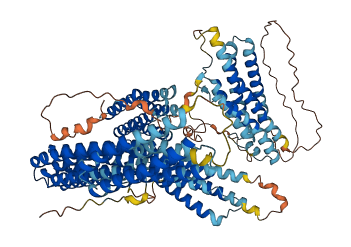
Descriptions
The autoinhibited protein was predicted that may have potential autoinhibitory elements via cis-regPred.
Autoinhibitory domains (AIDs)
Target domain |
|
Relief mechanism |
|
Assay |
cis-regPred |
Accessory elements
No accessory elements
Autoinhibited structure

Activated structure
1 structures for Q6GLP0
| Entry ID | Method | Resolution | Chain | Position | Source |
|---|---|---|---|---|---|
| AF-Q6GLP0-F1 | Predicted | AlphaFoldDB |
No variants for Q6GLP0
| Variant ID(s) | Position | Change | Description | Diseaes Association | Provenance |
|---|---|---|---|---|---|
| No variants for Q6GLP0 | |||||
No associated diseases with Q6GLP0
1 regional properties for Q6GLP0
| Type | Name | Position | InterPro Accession |
|---|---|---|---|
| conserved_site | Vinculin, conserved site | 177 - 197 | IPR000633 |
Functions
6 GO annotations of cellular component
| Name | Definition |
|---|---|
| actin cytoskeleton | The part of the cytoskeleton (the internal framework of a cell) composed of actin and associated proteins. Includes actin cytoskeleton-associated complexes. |
| adherens junction | A cell-cell junction composed of the epithelial cadherin-catenin complex. The epithelial cadherins, or E-cadherins, of each interacting cell extend through the plasma membrane into the extracellular space and bind to each other. The E-cadherins bind to catenins on the cytoplasmic side of the membrane, where the E-cadherin-catenin complex binds to cytoskeletal components and regulatory and signaling molecules. |
| axon | The long process of a neuron that conducts nerve impulses, usually away from the cell body to the terminals and varicosities, which are sites of storage and release of neurotransmitter. |
| cytoplasm | The contents of a cell excluding the plasma membrane and nucleus, but including other subcellular structures. |
| nucleus | A membrane-bounded organelle of eukaryotic cells in which chromosomes are housed and replicated. In most cells, the nucleus contains all of the cell's chromosomes except the organellar chromosomes, and is the site of RNA synthesis and processing. In some species, or in specialized cell types, RNA metabolism or DNA replication may be absent. |
| plasma membrane | The membrane surrounding a cell that separates the cell from its external environment. It consists of a phospholipid bilayer and associated proteins. |
3 GO annotations of molecular function
| Name | Definition |
|---|---|
| actin filament binding | Binding to an actin filament, also known as F-actin, a helical filamentous polymer of globular G-actin subunits. |
| cadherin binding | Binding to cadherin, a type I membrane protein involved in cell adhesion. |
| structural molecule activity | The action of a molecule that contributes to the structural integrity of a complex or its assembly within or outside a cell. |
5 GO annotations of biological process
| Name | Definition |
|---|---|
| axonogenesis | De novo generation of a long process of a neuron, including the terminal branched region. Refers to the morphogenesis or creation of shape or form of the developing axon, which carries efferent (outgoing) action potentials from the cell body towards target cells. |
| brain morphogenesis | The process in which the anatomical structures of the brain are generated and organized. The brain is one of the two components of the central nervous system and is the center of thought and emotion. It is responsible for the coordination and control of bodily activities and the interpretation of information from the senses (sight, hearing, smell, etc.). |
| cell-cell adhesion | The attachment of one cell to another cell via adhesion molecules. |
| dendrite morphogenesis | The process in which the anatomical structures of a dendrite are generated and organized. |
| regulation of synapse structural plasticity | Any process that modulates the frequency, rate or extent of synapse structural plasticity. Synapse structural plasticity is a type of cytoskeletal remodeling; this remodeling is induced by stimuli that can lead to long term potentiation and it can be activity-dependent or -independent. Examples of cytoskeletal changes include the formation of new spines and increase in spine size; this can be accompanied by the insertion of greater numbers of glutamate (or other neurotransmitter) receptors into the post-synaptic membrane. |
No homologous proteins in AiPD
| UniProt AC | Gene Name | Protein Name | Species | Evidence Code |
|---|---|---|---|---|
| No homologous proteins | ||||
| 10 | 20 | 30 | 40 | 50 | 60 |
| MSSATSPIIL | KWDPKSLEIR | TLTVESLLEP | LVTQVTTLVN | TSNKGPSGKK | KGRSKKAHVL |
| 70 | 80 | 90 | 100 | 110 | 120 |
| AASVEQATQN | FLEKGEQIAK | ESQDLKDELI | SAVEDVRKQG | ETMRIASSEF | ADDPCSSVKR |
| 130 | 140 | 150 | 160 | 170 | 180 |
| GTMVRAARAL | LSAVTRLLIL | ADMADVMRLL | THLKIVEEAL | EMVKNATNEQ | DLAHRFKEFG |
| 190 | 200 | 210 | 220 | 230 | 240 |
| KEMVKLNYVA | ARRQQELKDP | HCRDEMAAAR | GALKKNATML | YTASQAFLRH | SDVAATRANR |
| 250 | 260 | 270 | 280 | 290 | 300 |
| DYVFKQVQEA | IAGISNAAQA | TSPTDEKQAH | TGIGELAAAL | NEFDNKIILD | PLTFSEARFR |
| 310 | 320 | 330 | 340 | 350 | 360 |
| PSLEERLESI | ISGAALMADS | SCTRDDRRER | IVAECNSVRQ | ALQDLLSEYM | NNCRYGTWMD |
| 370 | 380 | 390 | 400 | 410 | 420 |
| ESSKSGRKEK | GDPLNIAIDK | MTKKTRDLRR | QLRKAVMDHI | SDSFLETNVP | LLVLIEAAKS |
| 430 | 440 | 450 | 460 | 470 | 480 |
| GNEKEVKEYA | QVFREHANKL | VEVANLACSI | SNNEEGVKLV | RMAATQIDSL | CPQVINAALT |
| 490 | 500 | 510 | 520 | 530 | 540 |
| LAARPQSKVA | QDNMDVFKDQ | WEKQVRVLTE | AVDDITSVDD | FLSVSENHIL | EDVNKCVIAL |
| 550 | 560 | 570 | 580 | 590 | 600 |
| QEGDVDTLDR | TAGAIRGRAA | RVIHIINAEM | ENYEAGVYTE | KVLETTKLLS | ETVMPRFAEQ |
| 610 | 620 | 630 | 640 | 650 | 660 |
| VEVAIEALST | NIPQPFEENE | FIDASRLVYD | GVRDIRKAVL | MIRTPEELED | DSDFEQEDYD |
| 670 | 680 | 690 | 700 | 710 | 720 |
| VRSRTSVQTE | DDQLIAGQSA | RAIMAQLPQE | EKAKIAEQVE | IFHQEKSKLD | AEVAKWDDSG |
| 730 | 740 | 750 | 760 | 770 | 780 |
| NDIIVLAKQM | CMIMMEMTDF | TRGKGPLKNT | SDVINAAKKI | AEAGSRMDKL | ARAVADQCPD |
| 790 | 800 | 810 | 820 | 830 | 840 |
| SACKQDLLAY | LQRIALYCHQ | LNICSKVKAE | VQNLGGELIV | SGTGVQSTFT | TFYEVAGDVI |
| 850 | 860 | 870 | 880 | 890 | 900 |
| AGGRDSQLSL | DLLPSCTEGS | LFGSGSRDST | MLDSATSLIQ | AAKNLMNAVV | LTVKASYVAS |
| 910 | 920 | 930 | 940 | 950 | 960 |
| TKYQKVYGTA | AVNSPVVSWK | MKAPEKKPLV | KREKPEEYQT | RVRRGSQKKH | ISPVQALSEF |
| KAMDSF |