Q6GLD9
Gene name |
mkrn2 |
Protein name |
E3 ubiquitin-protein ligase makorin-2 |
Names |
RING-type E3 ubiquitin transferase makorin-2 |
Species |
Xenopus tropicalis (Western clawed frog) (Silurana tropicalis) |
KEGG Pathway |
xtr:448038 |
EC number |
2.3.2.27: Aminoacyltransferases |
Protein Class |
|
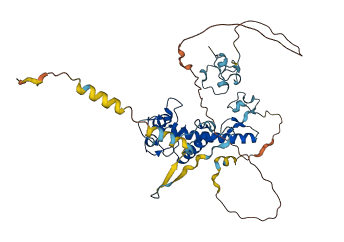
Descriptions
The autoinhibited protein was predicted that may have potential autoinhibitory elements via cis-regPred.
Autoinhibitory domains (AIDs)
Target domain |
|
Relief mechanism |
|
Assay |
cis-regPred |
Accessory elements
No accessory elements
Autoinhibited structure

Activated structure
1 structures for Q6GLD9
| Entry ID | Method | Resolution | Chain | Position | Source |
|---|---|---|---|---|---|
| AF-Q6GLD9-F1 | Predicted | AlphaFoldDB |
No variants for Q6GLD9
| Variant ID(s) | Position | Change | Description | Diseaes Association | Provenance |
|---|---|---|---|---|---|
| No variants for Q6GLD9 | |||||
No associated diseases with Q6GLD9
9 regional properties for Q6GLD9
| Type | Name | Position | InterPro Accession |
|---|---|---|---|
| domain | Zinc finger, CCCH-type | 2 - 29 | IPR000571-1 |
| domain | Zinc finger, CCCH-type | 31 - 58 | IPR000571-2 |
| domain | Zinc finger, CCCH-type | 164 - 191 | IPR000571-3 |
| domain | Zinc finger, CCCH-type | 320 - 349 | IPR000571-4 |
| domain | Zinc finger, RING-type | 237 - 291 | IPR001841 |
| conserved_site | Zinc finger, RING-type, conserved site | 261 - 270 | IPR017907 |
| domain | Zinc finger, RING-type, eukaryotic | 237 - 280 | IPR027370 |
| domain | E3 ligase, CCCH-type zinc finger | 7 - 27 | IPR041367-1 |
| domain | E3 ligase, CCCH-type zinc finger | 36 - 55 | IPR041367-2 |
Functions
| Description | ||
|---|---|---|
| EC Number | 2.3.2.27 | Aminoacyltransferases |
| Subcellular Localization |
|
|
| PANTHER Family | ||
| PANTHER Subfamily | ||
| PANTHER Protein Class | ||
| PANTHER Pathway Category | No pathway information available | |
2 GO annotations of cellular component
| Name | Definition |
|---|---|
| cytoplasm | The contents of a cell excluding the plasma membrane and nucleus, but including other subcellular structures. |
| nucleus | A membrane-bounded organelle of eukaryotic cells in which chromosomes are housed and replicated. In most cells, the nucleus contains all of the cell's chromosomes except the organellar chromosomes, and is the site of RNA synthesis and processing. In some species, or in specialized cell types, RNA metabolism or DNA replication may be absent. |
3 GO annotations of molecular function
| Name | Definition |
|---|---|
| LIM domain binding | Binding to a LIM domain (for Lin-11 Isl-1 Mec-3) of a protein, a domain with seven conserved cysteine residues and a histidine, that binds two zinc ions and acts as an interface for protein-protein interactions. |
| metal ion binding | Binding to a metal ion. |
| ubiquitin protein ligase activity | Catalysis of the transfer of ubiquitin to a substrate protein via the reaction X-ubiquitin + S -> X + S-ubiquitin, where X is either an E2 or E3 enzyme, the X-ubiquitin linkage is a thioester bond, and the S-ubiquitin linkage is an amide bond: an isopeptide bond between the C-terminal glycine of ubiquitin and the epsilon-amino group of lysine residues in the substrate or, in the linear extension of ubiquitin chains, a peptide bond the between the C-terminal glycine and N-terminal methionine of ubiquitin residues. |
14 GO annotations of biological process
| Name | Definition |
|---|---|
| axis specification | The establishment, maintenance and elaboration of a pattern along a line or around a point. |
| cell differentiation | The process in which relatively unspecialized cells, e.g. embryonic or regenerative cells, acquire specialized structural and/or functional features that characterize the cells, tissues, or organs of the mature organism or some other relatively stable phase of the organism's life history. Differentiation includes the processes involved in commitment of a cell to a specific fate and its subsequent development to the mature state. |
| DNA-templated transcription | The synthesis of an RNA transcript from a DNA template. |
| embryo development ending in birth or egg hatching | The process whose specific outcome is the progression of an embryo over time, from zygote formation until the end of the embryonic life stage. The end of the embryonic life stage is organism-specific and may be somewhat arbitrary; for mammals it is usually considered to be birth, for insects the hatching of the first instar larva from the eggshell. |
| negative regulation of inflammatory response to antigenic stimulus | Any process that stops, prevents, or reduces the frequency, rate, or extent of an inflammatory response to an antigenic stimulus. |
| negative regulation of neurogenesis | Any process that stops, prevents, or reduces the frequency, rate or extent of neurogenesis, the generation of cells within the nervous system. |
| negative regulation of NIK/NF-kappaB signaling | Any process that stops, prevents or reduces the frequency, rate or extent of NIK/NF-kappaB signaling. |
| nervous system development | The process whose specific outcome is the progression of nervous tissue over time, from its formation to its mature state. |
| phosphatidylinositol 3-kinase signaling | A series of reactions within the signal-receiving cell, mediated by the intracellular phosphatidylinositol 3-kinase (PI3K). Many cell surface receptor linked signaling pathways signal through PI3K to regulate numerous cellular functions. |
| positive regulation of transcription by RNA polymerase II | Any process that activates or increases the frequency, rate or extent of transcription from an RNA polymerase II promoter. |
| positive regulation of transcription factor catabolic process | Any process that activates or increases the frequency, rate or extent of transcription factor catabolic process. |
| protein kinase B signaling | A series of reactions, mediated by the intracellular serine/threonine kinase protein kinase B (also called AKT), which occurs as a result of a single trigger reaction or compound. |
| protein polyubiquitination | Addition of multiple ubiquitin groups to a protein, forming a ubiquitin chain. |
| protein ubiquitination | The process in which one or more ubiquitin groups are added to a protein. |
| 10 | 20 | 30 | 40 | 50 | 60 |
| MNTKHVTCRY | FLHGVCREGG | RCLFSHDLAT | SKPSTVCRFY | QRGQCAYGAR | CRYDHVKPCN |
| 70 | 80 | 90 | 100 | 110 | 120 |
| GSVFYPPQEM | APAPLESTPP | LLPTQEAAAP | VTKSAPQRRE | KKSVVLRDRD | LCGASVEKAH |
| 130 | 140 | 150 | 160 | 170 | 180 |
| PDPALRPGCA | ADPPVSELEA | KPHSYLEAIC | TGLDETPIPS | AYPDAPQQLC | PFAQAGGCHY |
| 190 | 200 | 210 | 220 | 230 | 240 |
| GESCPYIHGN | VCEICGLQVL | HPYDQEQRGH | HEKLCMANFE | RDMERAFAFQ | ASEGKVCSIC |
| 250 | 260 | 270 | 280 | 290 | 300 |
| MERVYDKQSP | SERRFGILSN | CHHTYCLACI | RQWRCARQFE | NPVIKSCPEC | RVISEFVIPS |
| 310 | 320 | 330 | 340 | 350 | 360 |
| AYWVEDQSKK | FELIEAFKQG | MGKKACKYFD | QGRGTCPFGG | KCLYLHAYPD | GTRAEPEKPR |
| 370 | 380 | 390 | 400 | 410 | |
| KQLGSEGTVR | FLNSVRLWDF | IEEREQRNLP | DAEDEVAELG | ELFMHLSGVG | EEPPAASN |