Q6FZK6
Gene name |
tig |
Protein name |
Trigger factor |
Names |
TF, PPIase |
Species |
Bartonella quintana (strain Toulouse) (Rochalimaea quintana) |
KEGG Pathway |
bqu:BQ07290 |
EC number |
5.2.1.8: Cis-trans isomerases |
Protein Class |
|
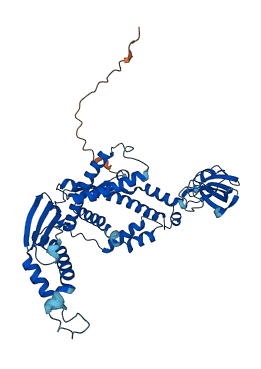
Descriptions
The autoinhibited protein was predicted that may have potential autoinhibitory elements via cis-regPred.
Autoinhibitory domains (AIDs)
Target domain |
|
Relief mechanism |
|
Assay |
cis-regPred |
Accessory elements
No accessory elements
Autoinhibited structure

Activated structure
1 structures for Q6FZK6
| Entry ID | Method | Resolution | Chain | Position | Source |
|---|---|---|---|---|---|
| AF-Q6FZK6-F1 | Predicted | AlphaFoldDB |
No variants for Q6FZK6
| Variant ID(s) | Position | Change | Description | Diseaes Association | Provenance |
|---|---|---|---|---|---|
| No variants for Q6FZK6 | |||||
No associated diseases with Q6FZK6
Functions
| Description | ||
|---|---|---|
| EC Number | 5.2.1.8 | Cis-trans isomerases |
| Subcellular Localization |
|
|
| PANTHER Family | ||
| PANTHER Subfamily | ||
| PANTHER Protein Class | ||
| PANTHER Pathway Category | No pathway information available | |
1 GO annotations of cellular component
| Name | Definition |
|---|---|
| cytoplasm | The contents of a cell excluding the plasma membrane and nucleus, but including other subcellular structures. |
1 GO annotations of molecular function
| Name | Definition |
|---|---|
| peptidyl-prolyl cis-trans isomerase activity | Catalysis of the reaction: peptidyl-proline (omega=180) = peptidyl-proline (omega=0). |
4 GO annotations of biological process
| Name | Definition |
|---|---|
| cell cycle | The progression of biochemical and morphological phases and events that occur in a cell during successive cell replication or nuclear replication events. Canonically, the cell cycle comprises the replication and segregation of genetic material followed by the division of the cell, but in endocycles or syncytial cells nuclear replication or nuclear division may not be followed by cell division. |
| cell division | The process resulting in division and partitioning of components of a cell to form more cells; may or may not be accompanied by the physical separation of a cell into distinct, individually membrane-bounded daughter cells. |
| protein folding | The process of assisting in the covalent and noncovalent assembly of single chain polypeptides or multisubunit complexes into the correct tertiary structure. |
| protein transport | The directed movement of proteins into, out of or within a cell, or between cells, by means of some agent such as a transporter or pore. |
No homologous proteins in AiPD
| UniProt AC | Gene Name | Protein Name | Species | Evidence Code |
|---|---|---|---|---|
| No homologous proteins | ||||
| 10 | 20 | 30 | 40 | 50 | 60 |
| MQVTETLNEG | LKREIKIVVP | AKALEEKLNE | WLDDTKDKIK | LNGFRPGKVP | AEYLRKMYGK |
| 70 | 80 | 90 | 100 | 110 | 120 |
| SFMAEILNEI | ISDAPRSILA | DRNERPAMQP | QIDIDEDEKI | LDGRADFVFS | LKYEVLPKFE |
| 130 | 140 | 150 | 160 | 170 | 180 |
| IKDFDHIEII | REIAAVPEKE | IDEQVERVLS | STRSYSLKEG | LSEEGDCVTI | DYLGKLEGVP |
| 190 | 200 | 210 | 220 | 230 | 240 |
| FEGGADSDAQ | LILGSKQFIP | GFEEQLVDVK | AGDTKTISVK | FPDNYSAVHL | AGRDAEFDIT |
| 250 | 260 | 270 | 280 | 290 | 300 |
| VKAISKPDEL | KIDDEAAKKV | GLESLERLRE | VVRGQIESQY | GSIIRQKIKR | QILDALDADY |
| 310 | 320 | 330 | 340 | 350 | 360 |
| NFEIPEGLLE | IEFNNIWAQV | NDDLKKAGRS | FEDEGVTEKH | AREEYRVLAQ | RRVRLGLVLS |
| 370 | 380 | 390 | 400 | 410 | 420 |
| EIGMKADVKI | SEDELKAAVF | DQVRQYPGQE | KEIMNFFRNT | PEAVANLRAP | IFEEKVIDHL |
| 430 | 440 | 450 | 460 | ||
| LSRIKITDKE | VTVEELMKEY | DESDLTEKKP | EKKKGVEKTP | IRKKAPKKG |