Q6FY76
Gene name |
RAD5 (CAGL0A03432g) |
Protein name |
DNA repair protein RAD5 |
Names |
|
Species |
Candida glabrata (strain ATCC 2001 / CBS 138 / JCM 3761 / NBRC 0622 / NRRL Y-65) (Yeast) (Torulopsis glabrata) |
KEGG Pathway |
cgr:CAGL0A03432g |
EC number |
|
Protein Class |
|
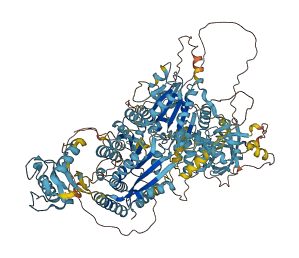
Descriptions
The autoinhibited protein was predicted that may have potential autoinhibitory elements via cis-regPred.
Autoinhibitory domains (AIDs)
Target domain |
|
Relief mechanism |
|
Assay |
cis-regPred |
Accessory elements
No accessory elements
Autoinhibited structure

Activated structure
1 structures for Q6FY76
| Entry ID | Method | Resolution | Chain | Position | Source |
|---|---|---|---|---|---|
| AF-Q6FY76-F1 | Predicted | AlphaFoldDB |
No variants for Q6FY76
| Variant ID(s) | Position | Change | Description | Diseaes Association | Provenance |
|---|---|---|---|---|---|
| No variants for Q6FY76 | |||||
No associated diseases with Q6FY76
6 regional properties for Q6FY76
| Type | Name | Position | InterPro Accession |
|---|---|---|---|
| domain | SNF2, N-terminal | 421 - 828 | IPR000330 |
| domain | Helicase, C-terminal | 978 - 1146 | IPR001650 |
| domain | Zinc finger, RING-type | 896 - 944 | IPR001841 |
| domain | Helicase superfamily 1/2, ATP-binding domain | 414 - 723 | IPR014001 |
| domain | HIRAN domain | 167 - 278 | IPR014905 |
| conserved_site | Zinc finger, RING-type, conserved site | 915 - 924 | IPR017907 |
4 GO annotations of cellular component
| Name | Definition |
|---|---|
| chromatin | The ordered and organized complex of DNA, protein, and sometimes RNA, that forms the chromosome. |
| chromosome, telomeric region | The end of a linear chromosome, required for the integrity and maintenance of the end. A chromosome telomere usually includes a region of telomerase-encoded repeats the length of which rarely exceeds 20 bp each and that permits the formation of a telomeric loop (T-loop). The telomeric repeat region is usually preceded by a sub-telomeric region that is gene-poor but rich in repetitive elements. Some telomeres only consist of the latter part (for eg. D. melanogaster telomeres). |
| cytoplasm | The contents of a cell excluding the plasma membrane and nucleus, but including other subcellular structures. |
| nucleus | A membrane-bounded organelle of eukaryotic cells in which chromosomes are housed and replicated. In most cells, the nucleus contains all of the cell's chromosomes except the organellar chromosomes, and is the site of RNA synthesis and processing. In some species, or in specialized cell types, RNA metabolism or DNA replication may be absent. |
7 GO annotations of molecular function
| Name | Definition |
|---|---|
| ATP binding | Binding to ATP, adenosine 5'-triphosphate, a universally important coenzyme and enzyme regulator. |
| ATP-dependent chromatin remodeler activity | An activity, driven by ATP hydrolysis, that modulates the contacts between histones and DNA, resulting in a change in chromosome architecture within the nucleosomal array, leading to chromatin remodeling. |
| four-way junction DNA binding | Binding to a DNA segment containing four-way junctions, also known as Holliday junctions, a structure where two DNA double strands are held together by reciprocal exchange of two of the four strands, one strand each from the two original helices. |
| four-way junction helicase activity | Unwinding a DNA helix of DNA containing four-way junctions, including Holliday junctions, driven by ATP hydrolysis. |
| hydrolase activity, acting on acid anhydrides, in phosphorus-containing anhydrides | Catalysis of the hydrolysis of any acid anhydride which contains phosphorus. |
| Y-form DNA binding | Binding to a DNA segment shaped like a Y. This shape occurs when DNA contains a region of paired double-stranded DNA on one end and a region of unpaired DNA strands on the opposite end. |
| zinc ion binding | Binding to a zinc ion (Zn). |
6 GO annotations of biological process
| Name | Definition |
|---|---|
| double-strand break repair | The repair of double-strand breaks in DNA via homologous and nonhomologous mechanisms to reform a continuous DNA helix. |
| error-free postreplication DNA repair | The conversion of DNA-damage induced single-stranded gaps into large molecular weight DNA via processes such as template switching, which does not remove the replication-blocking lesions but does not increase the endogenous mutation rate. |
| error-free translesion synthesis | The conversion of DNA-damage induced single-stranded gaps into large molecular weight DNA after replication by using a specialized DNA polymerase or replication complex to insert a defined nucleotide across the lesion. This process does not remove the replication-blocking lesions but does not causes an increase in the endogenous mutation level. For S. cerevisiae, RAD30 encodes DNA polymerase eta, which incorporates two adenines. When incorporated across a thymine-thymine dimer, it does not increase the endogenous mutation level. |
| error-prone translesion synthesis | The conversion of DNA-damage induced single-stranded gaps into large molecular weight DNA after replication by using a specialized DNA polymerase or replication complex to insert a defined nucleotide across the lesion. This process does not remove the replication-blocking lesions and causes an increase in the endogenous mutation level. For example, in E. coli, a low fidelity DNA polymerase, pol V, copies lesions that block replication fork progress. This produces mutations specifically targeted to DNA template damage sites, but it can also produce mutations at undamaged sites. |
| free ubiquitin chain polymerization | The process of creating free ubiquitin chains, compounds composed of a large number of ubiquitin monomers. These chains are not conjugated to a protein. |
| protein polyubiquitination | Addition of multiple ubiquitin groups to a protein, forming a ubiquitin chain. |
No homologous proteins in AiPD
| UniProt AC | Gene Name | Protein Name | Species | Evidence Code |
|---|---|---|---|---|
| No homologous proteins | ||||
| 10 | 20 | 30 | 40 | 50 | 60 |
| MDQNANQKKR | FFKDELESSI | ETTLTDKSSF | LFEPQVDAIQ | EENANDPEEQ | IAQGTQESPF |
| 70 | 80 | 90 | 100 | 110 | 120 |
| IEQLRAVLPT | IRLEVALALE | EKYRDIDDGL | DLAISEYFDQ | YQTGNDDAPP | SSLELQHSQE |
| 130 | 140 | 150 | 160 | 170 | 180 |
| VLTVPDNEEK | DTDLQLVSVK | RKREDDFMQS | SQSKKPQRAN | SSWKKFVGSL | QVTVMVTRPT |
| 190 | 200 | 210 | 220 | 230 | 240 |
| MRPVPYGTPL | IFKRSNNNVP | LKKIYEQLNK | KKTGLAAFVK | IYSANDEREI | GRVPEDIARI |
| 250 | 260 | 270 | 280 | 290 | 300 |
| VFPLLHRNEV | HFKLTMIYPG | DKRLSIGDNI | IIQMDSFLTS | TLFNRKENPT | FSTQNGNGRE |
| 310 | 320 | 330 | 340 | 350 | 360 |
| RFGAIVETEQ | ELEERNIRMG | LIMLFDKIKL | RPVKDEAKFL | EKLKQDGDDN | EIVDLEDDES |
| 370 | 380 | 390 | 400 | 410 | 420 |
| FGNFLSQEPL | NDELPTQHQE | DTMNINQLTS | FYKATQSSKQ | LNSLIPTTPP | PELVKVELRK |
| 430 | 440 | 450 | 460 | 470 | 480 |
| YQKQGLTWML | RREGISIGHD | NEDKSEDDTT | LLNPLWRQFQ | WPRNMSWHNQ | STGSENDNSN |
| 490 | 500 | 510 | 520 | 530 | 540 |
| PKLIFFYGNL | HTGEFSLERP | TMNSFKNGGI | LSDEMGLGKT | ISALSLVLMR | PKDEHTTSQS |
| 550 | 560 | 570 | 580 | 590 | 600 |
| LFHQESSNLS | SDDVIEIKEP | ERSYAYKTTL | IIVPMSLLTQ | WRDEFDKVNN | NAGLTCELYY |
| 610 | 620 | 630 | 640 | 650 | 660 |
| GGNVSSLKSL | LIKRKNPPTV | VLTTYGIVQN | EWTKLSKDGT | NIRSLGRTSG | IFSIEFFRII |
| 670 | 680 | 690 | 700 | 710 | 720 |
| LDEGHTIRNK | STITSKAVLE | LSSKYRWILT | GTPIINRLDD | LYSLVKFLKL | EPWSQIGYWK |
| 730 | 740 | 750 | 760 | 770 | 780 |
| QFITNPFEER | NFKQAFDVVN | AIMEPVLLRR | TKQMKDTDGN | PLVQLPPKEI | VIEKLQLSKK |
| 790 | 800 | 810 | 820 | 830 | 840 |
| QKLIYEEFLQ | RAEKTFRSGL | QSGDLLKKYS | TILVHILRLR | QVCCDSNLIG | TLDENDEDLS |
| 850 | 860 | 870 | 880 | 890 | 900 |
| SGNNKLITES | VDVKTLIPDT | EEEEDEVPPF | ENDELDKLIE | SVEAKFIDSN | QLIPVECSIC |
| 910 | 920 | 930 | 940 | 950 | 960 |
| TAEPIESSSA | VVTECEHVFC | KECLEEYGNF | QKEKSLQQKC | PNCRRDINLN | RCLAFEKGSD |
| 970 | 980 | 990 | 1000 | 1010 | 1020 |
| GILKLIHFDR | KERPAKLNAL | IRHLQQLQDS | SAGEQVVVFS | QFSSYLDILE | SQLNEVYSSN |
| 1030 | 1040 | 1050 | 1060 | 1070 | 1080 |
| KLKVYKFDGR | LSLKERTAVL | EDFKVKDYAV | QKVLLLSLKA | GGVGLNLTCA | SYAFMMDPWW |
| 1090 | 1100 | 1110 | 1120 | 1130 | 1140 |
| SPSMEDQAID | RIHRIGQTNS | VKVIRFVIDG | SIEEKMLRIQ | DRKRTLGEAM | DTDEDERRKR |
| 1150 | |||||
| RIEEIQMLFE | S |