Q6FVD8
Gene name |
LIG4 (CAGL0E02695g) |
Protein name |
DNA ligase 4 |
Names |
DNA ligase IV, Polydeoxyribonucleotide synthase [ATP] 4 |
Species |
Candida glabrata (strain ATCC 2001 / CBS 138 / JCM 3761 / NBRC 0622 / NRRL Y-65) (Yeast) (Torulopsis glabrata) |
KEGG Pathway |
cgr:CAGL0E02695g |
EC number |
6.5.1.1: Forming phosphoric ester bonds |
Protein Class |
|
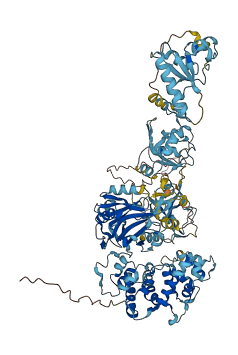
Descriptions
The autoinhibited protein was predicted that may have potential autoinhibitory elements via cis-regPred.
Autoinhibitory domains (AIDs)
Target domain |
|
Relief mechanism |
|
Assay |
cis-regPred |
Accessory elements
No accessory elements
Autoinhibited structure

Activated structure
1 structures for Q6FVD8
| Entry ID | Method | Resolution | Chain | Position | Source |
|---|---|---|---|---|---|
| AF-Q6FVD8-F1 | Predicted | AlphaFoldDB |
No variants for Q6FVD8
| Variant ID(s) | Position | Change | Description | Diseaes Association | Provenance |
|---|---|---|---|---|---|
| No variants for Q6FVD8 | |||||
No associated diseases with Q6FVD8
6 regional properties for Q6FVD8
| Type | Name | Position | InterPro Accession |
|---|---|---|---|
| domain | BRCT domain | 688 - 787 | IPR001357-1 |
| domain | BRCT domain | 847 - 945 | IPR001357-2 |
| domain | DNA ligase, ATP-dependent, N-terminal | 34 - 229 | IPR012308 |
| domain | DNA ligase, ATP-dependent, central | 271 - 513 | IPR012310 |
| conserved_site | DNA ligase, ATP-dependent, conserved site | 295 - 303 | IPR016059 |
| domain | DNA Ligase 4, adenylation domain | 258 - 486 | IPR044125 |
Functions
| Description | ||
|---|---|---|
| EC Number | 6.5.1.1 | Forming phosphoric ester bonds |
| Subcellular Localization |
|
|
| PANTHER Family | ||
| PANTHER Subfamily | ||
| PANTHER Protein Class | ||
| PANTHER Pathway Category | No pathway information available | |
1 GO annotations of cellular component
| Name | Definition |
|---|---|
| DNA ligase IV complex | A eukaryotically conserved protein complex that contains DNA ligase IV and is involved in DNA repair by non-homologous end joining; in addition to the ligase, the complex also contains XRCC4 or a homolog, e.g. Saccharomyces Lif1p. |
4 GO annotations of molecular function
| Name | Definition |
|---|---|
| ATP binding | Binding to ATP, adenosine 5'-triphosphate, a universally important coenzyme and enzyme regulator. |
| DNA binding | Any molecular function by which a gene product interacts selectively and non-covalently with DNA (deoxyribonucleic acid). |
| DNA ligase (ATP) activity | Catalysis of the reaction: ATP + deoxyribonucleotide(n) + deoxyribonucleotide(m) = AMP + diphosphate + deoxyribonucleotide(n+m). |
| metal ion binding | Binding to a metal ion. |
5 GO annotations of biological process
| Name | Definition |
|---|---|
| DNA biosynthetic process | The biosynthetic process resulting in the formation of DNA. |
| DNA ligation involved in DNA repair | The re-formation of a broken phosphodiester bond in the DNA backbone, carried out by DNA ligase, that contributes to DNA repair. |
| DNA recombination | Any process in which a new genotype is formed by reassortment of genes resulting in gene combinations different from those that were present in the parents. In eukaryotes genetic recombination can occur by chromosome assortment, intrachromosomal recombination, or nonreciprocal interchromosomal recombination. Interchromosomal recombination occurs by crossing over. In bacteria it may occur by genetic transformation, conjugation, transduction, or F-duction. |
| DNA replication | The cellular metabolic process in which a cell duplicates one or more molecules of DNA. DNA replication begins when specific sequences, known as origins of replication, are recognized and bound by initiation proteins, and ends when the original DNA molecule has been completely duplicated and the copies topologically separated. The unit of replication usually corresponds to the genome of the cell, an organelle, or a virus. The template for replication can either be an existing DNA molecule or RNA. |
| double-strand break repair via nonhomologous end joining | The repair of a double-strand break in DNA in which the two broken ends are rejoined with little or no sequence complementarity. Information at the DNA ends may be lost due to the modification of broken DNA ends. This term covers instances of separate pathways, called classical (or canonical) and alternative nonhomologous end joining (C-NHEJ and A-NHEJ). These in turn may further branch into sub-pathways, but evidence is still unclear. |
No homologous proteins in AiPD
| UniProt AC | Gene Name | Protein Name | Species | Evidence Code |
|---|---|---|---|---|
| No homologous proteins | ||||
| 10 | 20 | 30 | 40 | 50 | 60 |
| MADEGGLETG | AHDELKGTEE | QAVNFAPSPD | FLWLCEQLFA | KIDHVQFERA | NNLLTKPVTA |
| 70 | 80 | 90 | 100 | 110 | 120 |
| RYYEVISNFT | TLWRTTVGNN | IYPALRLILP | YRDRRVFNIK | DYTLIKAICA | FLKLPKDSST |
| 130 | 140 | 150 | 160 | 170 | 180 |
| EKKLINWKQD | AGRSVRLSKF | CVEEIKKRRS | EPQIDRNERI | TIDDLNGYLD | QLAIERTEQG |
| 190 | 200 | 210 | 220 | 230 | 240 |
| RSFKNLANSD | IMNKCLTSMT | FLEMQYFFDI | LLKNRPLGGH | EHKLLNCWHP | DAQDYLSVVS |
| 250 | 260 | 270 | 280 | 290 | 300 |
| DLETVAKRLW | DPSQRLGNQD | LKINIGLAFA | PQLATKLHVS | YQKIGEKLGW | DFFIEEKMDG |
| 310 | 320 | 330 | 340 | 350 | 360 |
| ERIQMHYTNF | GSDIKFYSRR | ATDYTYLYGN | NLKTGTLANF | INLNKNVKDC | VLDCEVVTFD |
| 370 | 380 | 390 | 400 | 410 | 420 |
| SNNKIVLPFG | MVKSSAKNML | SQDGIDTQGF | HPLLMVFDVL | YLNGATLVDL | PYYKRREYLK |
| 430 | 440 | 450 | 460 | 470 | 480 |
| QILTPTAHRI | EIIKSIRAND | EQMIKKSLEK | ALSVGSEGII | LKRYDSRYVI | ASRSDDWIKI |
| 490 | 500 | 510 | 520 | 530 | 540 |
| KPEYLEQFGE | NMDLVLMGRD | PSKKDSLMLG | LLDYEEVIQD | SPIMVNSQSS | EENSQRFRGF |
| 550 | 560 | 570 | 580 | 590 | 600 |
| VSLCIIANGI | SNEEYKEIDR | KTKGLWNDSE | KIPPLEYMKF | GSKVPRQWID | PKKSLILEIK |
| 610 | 620 | 630 | 640 | 650 | 660 |
| ARSLDNTRSS | ERKFAAGCTL | FGGYCRQIRE | DKNWKTCYTL | QEFERAKSGN | NWRKRGSSKP |
| 670 | 680 | 690 | 700 | 710 | 720 |
| QKVISKKRRY | NIISSVNKAL | EDFAELEHRS | DIFDGMYFYV | LSDYFDGVKR | KRIKKSEIQK |
| 730 | 740 | 750 | 760 | 770 | 780 |
| VIVANGGQLV | QNVITRNYNL | NDLRIISSRN | TVECNSLIVR | GYDIISPKWV | FDCLLSGKIM |
| 790 | 800 | 810 | 820 | 830 | 840 |
| KLEPSHCFNF | SKQLMDYAYK | RIDQYGDPYE | RDINKYEWSS | LTSEKICTTA | KQQPDVQFDN |
| 850 | 860 | 870 | 880 | 890 | 900 |
| SLMDVPHFLF | HGRIVFLLSD | NNNIQKESFM | VDAYGGKVTN | ELSSANLVIV | VGAVTQRRIN |
| 910 | 920 | 930 | 940 | ||
| DIRKQISSEV | IKQDHPPRIP | DMVSEGWLYD | CIKQNTQVAE | DNYRLP |