Q6FU81
Gene name |
MSS116 (CAGL0F05577g) |
Protein name |
ATP-dependent RNA helicase MSS116, mitochondrial |
Names |
|
Species |
Candida glabrata (strain ATCC 2001 / CBS 138 / JCM 3761 / NBRC 0622 / NRRL Y-65) (Yeast) (Torulopsis glabrata) |
KEGG Pathway |
cgr:CAGL0F05577g |
EC number |
3.6.4.13: Acting on ATP; involved in cellular and subcellular movement |
Protein Class |
|
Descriptions
The autoinhibited protein was predicted that may have potential autoinhibitory elements via cis-regPred.
Autoinhibitory domains (AIDs)
Target domain |
|
Relief mechanism |
|
Assay |
cis-regPred |
Accessory elements
No accessory elements
Autoinhibited structure

Activated structure
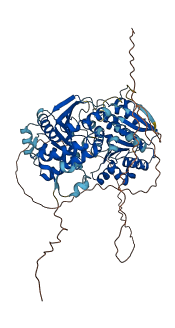
1 structures for Q6FU81
| Entry ID | Method | Resolution | Chain | Position | Source |
|---|---|---|---|---|---|
| AF-Q6FU81-F1 | Predicted | AlphaFoldDB |
No variants for Q6FU81
| Variant ID(s) | Position | Change | Description | Diseaes Association | Provenance |
|---|---|---|---|---|---|
| No variants for Q6FU81 | |||||
No associated diseases with Q6FU81
9 regional properties for Q6FU81
| Type | Name | Position | InterPro Accession |
|---|---|---|---|
| domain | Zinc finger, PHD-type | 104 - 155 | IPR001965-1 |
| domain | Zinc finger, PHD-type | 203 - 253 | IPR001965-2 |
| domain | Tudor domain | 44 - 101 | IPR002999 |
| conserved_site | Zinc finger, PHD-type, conserved site | 105 - 154 | IPR019786 |
| domain | Zinc finger, PHD-finger | 102 - 157 | IPR019787 |
| domain | Polycomb-like MTF2 factor 2, C-terminal domain | 545 - 591 | IPR025894 |
| domain | Lysine-specific demethylase 4-like, Tudor domain | 49 - 84 | IPR040477 |
| domain | MTF2, PHD domain 1 | 104 - 156 | IPR042014 |
| domain | MTF2, PHD domain 2 | 203 - 254 | IPR042015 |
Functions
| Description | ||
|---|---|---|
| EC Number | 3.6.4.13 | Acting on ATP; involved in cellular and subcellular movement |
| Subcellular Localization |
|
|
| PANTHER Family | ||
| PANTHER Subfamily | ||
| PANTHER Protein Class | ||
| PANTHER Pathway Category | No pathway information available | |
1 GO annotations of cellular component
| Name | Definition |
|---|---|
| mitochondrial matrix | The gel-like material, with considerable fine structure, that lies in the matrix space, or lumen, of a mitochondrion. It contains the enzymes of the tricarboxylic acid cycle and, in some organisms, the enzymes concerned with fatty acid oxidation. |
4 GO annotations of molecular function
| Name | Definition |
|---|---|
| ATP binding | Binding to ATP, adenosine 5'-triphosphate, a universally important coenzyme and enzyme regulator. |
| ATP hydrolysis activity | Catalysis of the reaction: ATP + H2O = ADP + H+ phosphate. ATP hydrolysis is used in some reactions as an energy source, for example to catalyze a reaction or drive transport against a concentration gradient. |
| RNA helicase activity | Unwinding of an RNA helix, driven by ATP hydrolysis. |
| RNA strand annealing activity | An activity that facilitates the formation of a complementary double-stranded RNA molecule. |
7 GO annotations of biological process
| Name | Definition |
|---|---|
| Group I intron splicing | The splicing of Group I introns. This occurs by a ribozymic mechanism where the intron sequence forms a distinct 3D structure, characteristic of Group I introns and involved in determining the locations of the splice sites (there do not appear to be consensus splice site sequences) as well as having a role in catalyzing the splicing reactions, though protein factors are also required in vivo. Splicing occurs by a series of two transesterification reactions, generally with exogenous guanosine as the initiating nucleophile. The intron is excised as a linear piece (though it may subsequently circularize). |
| Group II intron splicing | The splicing of Group II introns. This occurs by a ribozymic mechanism where the intron sequence forms a distinct 3D structure, characteristic of Group II introns and containing splice site consensus sequences, that is involved in catalyzing the splicing reactions, though protein factors are also required in vivo. Splicing occurs by a series of two transesterification reactions (mechanistically similar to those for splicing of nuclear mRNAs) initiated by a bulged adenosine residue within the intron sequence as the initiating nucleophile. The intron is excised as a lariat. |
| mitochondrial RNA processing | The conversion of a primary RNA molecule transcribed from a mitochondrial genome into one or more mature RNA molecules; occurs in the mitochondrion. |
| mRNA processing | Any process involved in the conversion of a primary mRNA transcript into one or more mature mRNA(s) prior to translation into polypeptide. |
| regulation of translation | Any process that modulates the frequency, rate or extent of the chemical reactions and pathways resulting in the formation of proteins by the translation of mRNA or circRNA. |
| RNA folding | The process of assisting in the covalent and noncovalent assembly of single or multimeric RNAs into the correct tertiary structure. |
| transcription elongation by mitochondrial RNA polymerase | The extension of an RNA molecule after transcription initiation and promoter clearance at mitochondrial promoter by the addition of ribonucleotides catalyzed by a mitchondrial RNA polymerase. |
No homologous proteins in AiPD
| UniProt AC | Gene Name | Protein Name | Species | Evidence Code |
|---|---|---|---|---|
| No homologous proteins | ||||
| 10 | 20 | 30 | 40 | 50 | 60 |
| MLRHCSLGLV | TTQISAIAPL | RLVGSPLFCR | SYQDFAGRDR | RSSRSREDKP | YNSRTRRFDD |
| 70 | 80 | 90 | 100 | 110 | 120 |
| EGSSNYSSSR | DDYRGQNTYG | FRGKAPRKNF | SSRDNYSSRD | NFRSSNGFQE | RGYKNKFSKN |
| 130 | 140 | 150 | 160 | 170 | 180 |
| TKSYSKGGNT | SGSFIPEGKM | AKMTHIGKSD | SDIVVTLESL | LEKNVISRDL | YDSISRMGFE |
| 190 | 200 | 210 | 220 | 230 | 240 |
| QLTPVQQKTI | EPIITNSDSD | IIARAKTGTG | KTFAFLLPIF | QHLLNTKIDS | QNKVKSVIVA |
| 250 | 260 | 270 | 280 | 290 | 300 |
| PTRDLALQIE | DEVRKIHSKN | RKLKAFECVS | LVGGTNFDRS | IRYIEKVSPS | IVIGTPGRLI |
| 310 | 320 | 330 | 340 | 350 | 360 |
| DVMEKFGNKF | FKDVDFKVLD | EADRLLEIGF | KEDLSYINKM | LNTLNTNSTE | HIRTLLFSAT |
| 370 | 380 | 390 | 400 | 410 | 420 |
| LDHKVQSLSN | DIMNKEECLY | IDTIDENEPQ | AHEKIDQTLV | VGETFADNLY | AAIEHIREFG |
| 430 | 440 | 450 | 460 | 470 | 480 |
| TKTPNYKSIL | FLPTVKFTKF | MATILKRQVK | LPIYEFHGQI | DQKKRTRIVN | EFKTMKKGLL |
| 490 | 500 | 510 | 520 | 530 | 540 |
| VCTDVGARGM | DFPNITEVLQ | IGLPSEIPNY | IHRIGRTARS | GKEGSSVTFI | SKEELPFFEI |
| 550 | 560 | 570 | 580 | 590 | 600 |
| LEDKHNVTIK | NIRKFEAQPH | VMADLSLRLH | VSEDELQEII | LSVISFYRAC | LKDYGINYKN |
| 610 | 620 | 630 | 640 | 650 | 660 |
| MLPQIAHTYG | TLLQNEDKRI | PLAGNHILNR | LGMDRDPIAT | KMFQIDEMPN | QYNRRGPRSN |
| YNRRRF |