Q6FU45
Gene name |
RNA14 (CAGL0F06479g) |
Protein name |
mRNA 3'-end-processing protein RNA14 |
Names |
|
Species |
Candida glabrata (strain ATCC 2001 / CBS 138 / JCM 3761 / NBRC 0622 / NRRL Y-65) (Yeast) (Torulopsis glabrata) |
KEGG Pathway |
cgr:CAGL0F06479g |
EC number |
|
Protein Class |
|
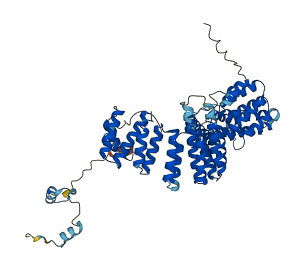
Descriptions
The autoinhibited protein was predicted that may have potential autoinhibitory elements via cis-regPred.
Autoinhibitory domains (AIDs)
Target domain |
|
Relief mechanism |
|
Assay |
cis-regPred |
Accessory elements
No accessory elements
Autoinhibited structure

Activated structure
1 structures for Q6FU45
| Entry ID | Method | Resolution | Chain | Position | Source |
|---|---|---|---|---|---|
| AF-Q6FU45-F1 | Predicted | AlphaFoldDB |
No variants for Q6FU45
| Variant ID(s) | Position | Change | Description | Diseaes Association | Provenance |
|---|---|---|---|---|---|
| No variants for Q6FU45 | |||||
No associated diseases with Q6FU45
1 regional properties for Q6FU45
| Type | Name | Position | InterPro Accession |
|---|---|---|---|
| domain | Small GTP-binding protein domain | 24 - 167 | IPR005225 |
3 GO annotations of cellular component
| Name | Definition |
|---|---|
| cytosol | The part of the cytoplasm that does not contain organelles but which does contain other particulate matter, such as protein complexes. |
| mitochondrion | A semiautonomous, self replicating organelle that occurs in varying numbers, shapes, and sizes in the cytoplasm of virtually all eukaryotic cells. It is notably the site of tissue respiration. |
| mRNA cleavage factor complex | Any macromolecular complex involved in cleavage or polyadenylation of mRNA molecules. |
1 GO annotations of molecular function
| Name | Definition |
|---|---|
| RNA binding | Binding to an RNA molecule or a portion thereof. |
3 GO annotations of biological process
| Name | Definition |
|---|---|
| mRNA polyadenylation | The enzymatic addition of a sequence of 40-200 adenylyl residues at the 3' end of a eukaryotic mRNA primary transcript. |
| pre-mRNA cleavage required for polyadenylation | The targeted, endonucleolytic cleavage of a pre-mRNA, required for polyadenylation of the 3' end. This cleavage is directed by binding sites near the 3' end of the mRNA and leaves a 3' hydoxyl end which then becomes a target for adenylation. |
| response to DNA damage checkpoint signaling | A process that occurs in response to signals generated as a result of DNA damage checkpoint signaling. |
No homologous proteins in AiPD
| UniProt AC | Gene Name | Protein Name | Species | Evidence Code |
|---|---|---|---|---|
| No homologous proteins | ||||
| 10 | 20 | 30 | 40 | 50 | 60 |
| MSTTNEETQA | NASKDYSEDA | LKMSYAAQPL | DIMRALKLIE | YYESKDDYDN | SRKLYAELHE |
| 70 | 80 | 90 | 100 | 110 | 120 |
| RFPLYSPLWT | MHLQSELQRN | EFDTVEKLLA | QCLAGDLENN | DLSLWSTYLD | YVRRKNNLIT |
| 130 | 140 | 150 | 160 | 170 | 180 |
| GGQEARAVVI | KAFKLVMDKC | ATFEPKASSF | WNDYLGFLHQ | WKPMNKWEEQ | QRLDMIREVY |
| 190 | 200 | 210 | 220 | 230 | 240 |
| KKMLCVPFDK | LEKMWNQYTL | WEQETNTLTA | RKFIGELSAD | YMKARSIYQE | LLNVTANIRR |
| 250 | 260 | 270 | 280 | 290 | 300 |
| TSPLNLRTAN | KNNIPQYVLP | CKKNDHTQLE | AWLKWIAWEK | ENKLELTEDA | LKDRVTYVYK |
| 310 | 320 | 330 | 340 | 350 | 360 |
| QAIQQLLFEP | EIWYDYVMYE | FDNDAARKNI | LKVALQANPT | SPTLTFKLAE | CYEVENKSEE |
| 370 | 380 | 390 | 400 | 410 | 420 |
| VQNCFEKTID | ELLRQYKNDN | GNDELSSDII | WERKTLTYIY | CIYMNTMKRL | SGLSAARAVF |
| 430 | 440 | 450 | 460 | 470 | 480 |
| GKCRKLKKAM | THDIYVENAY | LEFQNQNDHK | TASKVLELGL | KYFGDDGEYI | NKYMDFLSLL |
| 490 | 500 | 510 | 520 | 530 | 540 |
| NRGSQMKTLF | ETSIEKVEDL | RQLKKIYVKM | IGYESKYGNL | NNVYQLEKRF | FEKFPDTDLI |
| 550 | 560 | 570 | 580 | 590 | 600 |
| QLFSTRYKIQ | DDNKIKNLEL | TYKLPDIISS | DGDPSGVDKS | FKKRQIENDE | NLPDSKRQKS |
| 610 | 620 | 630 | 640 | ||
| QPLLPKEILD | ILAVLPKKQY | FKNAFLDPSN | LVNYLNEQVK | LADEEN |